

Work reveals new ways to understand and manipulate electrons in materials.
MIT physicists, in collaboration with colleagues, have measured the geometry—or shape—of electrons in solids at the quantum level for the first time. While scientists have long been able to measure the energies and velocities of electrons in crystalline materials, the quantum geometry of these systems has, until now, remained theoretical or, in some cases, completely elusive.
The work, recently published in Nature Physics, “opens new avenues for understanding and manipulating the quantum properties of materials,” says Riccardo Comin, MIT’s Class of 1947 Career Development Associate Professor of Physics and leader of the work.
“We’ve essentially developed a blueprint for obtaining some completely new information that couldn’t be obtained before,” says Comin, who is also affiliated with MIT’s Materials Research Laboratory and the Research Laboratory of Electronics. The work could be applied to “any kind of quantum material, not just the one we worked with,” says Mingu Kang, first author of the Nature Physics paper and a Kavli Postdoctoral Fellow at Cornell’s Laboratory of Atomic and Solid State Physics. Kang, MIT PhD 2023, conducted the work as a graduate student at MIT.
Kang was also invited to write an accompanying Research Briefing on the work, including its implications, for the November 25 issue of Nature Physics.
A Weird World
In the weird world of quantum physics, an electron can be described as both a point in space and a wave-like shape. At the heart of the current work is a fundamental object known as a wave function that describes the latter. “You can think of it like a surface in a three-dimensional space,” says Comin.
There are different types of wave functions, ranging from the simple to the complex. Think of a ball. That is analogous to a simple, or trivial wave function. Now picture a Mobius strip, the kind of structure explored by M.C. Escher in his art. That’s analogous to a complex, or non-trivial wave function. And the quantum world is filled with materials composed of the latter.
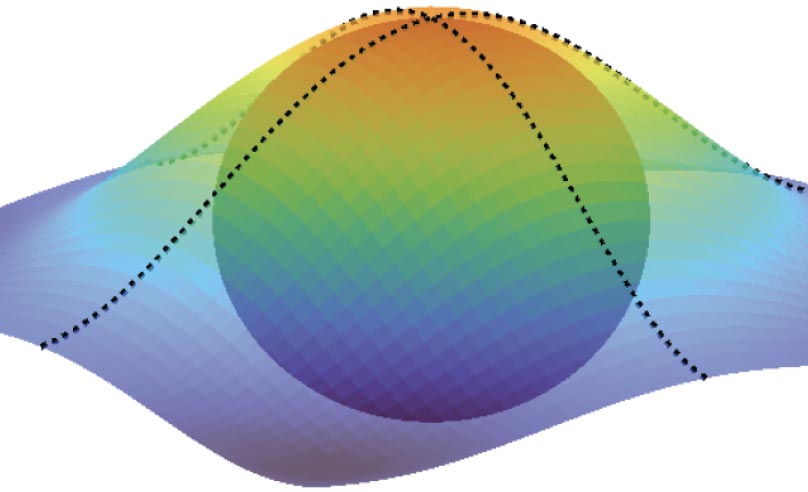
But until now, the quantum geometry of wave functions could only be inferred theoretically, or sometimes not at all. And the property is becoming more and more important as physicists find more and more quantum materials with potential applications in everything from quantum computers to advanced electronic and magnetic devices.
The MIT team solved the problem using a technique called angle-resolved photoemission spectroscopy, or ARPES. Comin, Kang, and some of the same colleagues had used the technique in other research. For example, in 2022 they reported discovering the ‘secret sauce’ behind exotic properties of a new quantum material known as a kagome metal. That work, too, appeared in Nature Physics. In the current work, the team adapted ARPES to measure the quantum geometry of a kagome metal.
Close Collaborations
Kang stresses that the new ability to measure the quantum geometry of materials “comes from the close cooperation between theorists and experimentalists.”
The COVID pandemic, too, had an impact. Kang, who is from South Korea, was based in that country during the pandemic. “That facilitated a collaboration with theorists in South Korea,” says Kang, an experimentalist.
The pandemic also led to an unusual opportunity for Comin. He traveled to Italy to help run the ARPES experiments at the Italian Light Source Elettra, a national laboratory. The lab was closed during the pandemic, but was starting to reopen when Comin arrived. He found himself alone, however, when Kang tested positive for COVID and couldn’t join him. So he inadvertently ran the experiments himself with the support of local scientists. “As a professor, I lead projects but students and postdocs actually carry out the work. So this is basically the last study where I actually contributed to the experiments themselves,” he says with a smile.
References:
“Measurements of the quantum geometric tensor in solids” by Mingu Kang, Sunje Kim, Yuting Qian, Paul M. Neves, Linda Ye, Junseo Jung, Denny Puntel, Federico Mazzola, Shiang Fang, Chris Jozwiak, Aaron Bostwick, Eli Rotenberg, Jun Fuji, Ivana Vobornik, Jae-Hoon Park, Joseph G. Checkelsky, Bohm-Jung Yang and Riccardo Comin, 25 November 2024, Nature Physics.
DOI: 10.1038/s41567-024-02678-8
“Quantum geometry in solids measured using photo-emitted electrons,” 25 November 2024, Nature Physics.
DOI: 10.1038/s41567-024-02681-z
In addition to Kang and Comin, additional authors of the Nature Physics paper are Sunje Kim of Seoul National University (Kim is a co-first author with Kang); Paul M. Neves, a graduate student in the MIT Department of Physics; Linda Ye of Stanford University; Junseo Jung of Seoul National University; Denny Puntel of the University of Trieste; Federico Mazzola of Consiglio Nazionale delle Ricerche and Ca’ Foscari University of Venice; Shiang Fang of Google DeepMind; Chris Jozwiak, Aaron Bostwick, and Eli Rotenberg of Lawrence Berkeley National Laboratory; Jun Fuji and Ivana Vobornik of Consiglio Nazionale delle Ricerche; Jae-Hoon Park of Max Planck POSTECH/Korea Research Initiative and Pohang University of Science and Technology; Joseph G. Checkelsky, Associate Professor of Physics at MIT; and Bohm-Jung Yang of Seoul National University, who co-led the research project with Comin.
This work was funded by the Air Force Office of Scientific Research, the National Science Foundation, the Gordon and Betty Moore Foundation, the National Research Foundation of Korea, the Samsung Science and Technology Foundation, the Army Research Office, the Department of Energy Office of Science, the Heising-Simons Physics Research Fellow Program, the Tsinghua Education Foundation, the NFFA-MUR Italy Progetti Internazionali facility, the Samsung Foundation of Culture, and the Kavli Institute at Cornell.
Never miss a breakthrough: Join the SciTechDaily newsletter.
Follow us on Google and Google News.
25 Comments
MIT physicists, in collaboration with colleagues, have measured the geometry—or shape—of electrons in solids at the quantum level for the first time.
GOOD.
Ask the MIT physicists:
1. What is the physical reality of quantum physics?
2. How is your quantum level defined?
3. What is the spacetime background of your quantum level?
What one researcher see or touch about an elephant will be different, and what different researchers see or touch will be even more different. It is a scientific phenomenon, not the essence of nature. Scientific research guided by correct theories can enable researchers to think more.
According to the Topological Vortex Theory (TVT), spins create everything, spins shape the world. There are substantial distinctions between Topological Vortex Theory (TVT) and traditional physical theories. Grounded in the inviscid and absolutely incompressible spaces, TVT introduces the concept of topological phase transitions and employs topological principles to elucidate the formation and evolution of matter in the universe, as well as the impact of interactions between topological vortices and anti-vortices on spacetime dynamics and thermodynamics.
Within TVT, low-dimensional spacetime matter serves as the foundation for high-dimensional spacetime matter, and the hierarchical structure of matter and its interaction mechanisms challenge conventional macroscopic and microscopic interpretations. The conflict between Quantum Physics and Classical Physics can be attributed to their differing focuses: Quantum Physics emphasizes low-dimensional spacetime matter, whereas Classical Physics centers on high-dimensional spacetime matter.
Subatomic particles in the quantum world often defy the familiar rules of the physical world. The fact repeatedly suggests that the familiar rules of the physical world are pseudoscience. In the familiar rules of the physical world, two sets of cobalt-60 can form the mirror image of each other by rotating in opposite directions, and can receive heavy rewards.
Please witness the grand performance of some so-called academic publications (including PRL, Nature, Science, etc.). https://scitechdaily.com/microscope-spacecrafts-most-precise-test-of-key-component-of-the-theory-of-general-relativity/#comment-854286. Some so-called academic publications (including PRL, Nature, Science, etc.) are addicted to their own small circles and have long deviated from science. They hardly know what ashamed is.
If the researchers are truly interested in science, please read: The Application of Inviscid and Absolutely Incompressible Spaces in Engineering Simulation (https://scitechdaily.com/microscope-spacecrafts-most-precise-test-of-key-component-of-the-theory-of-general-relativity/#comment-870077).
Researchers are interested in science, you are not as you fantasize about things we don’t observe.
NO!
Researchers have already observed it. Just as some so-called peer review publications (including PRL, PNAS, Nature, Science, etc.) adamantly defend two sets of cobalt-60 can form the mirror image of each other by rotating in opposite directions, which deserves the Nobel Prize for Physics. This is an open and blatant humiliation to science, and is a typical manifestation of rampant pseudoscience. These so-called peer review publications (including PRL, PNAS, Nature, Science, etc.) mislead the direction of science and are known for their various absurdities and wonders.
Surely physics is about building models that are founded in objective phenomena. It is not about understanding truth, whatever that might be.
The models help us to make useful things, including more models. Truth and reality belong to God. In this world the models are enough.
What you are expressing is the attitude towards science in some so-called academic publications, including Physical Review Letters (PRL), Proceedings of the National Academy of Sciences (PNAS), Nature, Science, and others.
Some so-called academic publications, including Physical Review Letters (PRL), Proceedings of the National Academy of Sciences (PNAS), Nature, Science, and others stubbornly defend that two sets of Cobalt-60 rotating in reverse can become two objects that mirror each other, which deserves the Nobel Prize in Physics. This is an open and blatant humiliation of science.
Some so-called peer review publications (including PRL, PNAS, Nature, Science, etc.) adamantly defend two sets of cobalt-60 can form the mirror image of each other by rotating in opposite directions, which deserves the Nobel Prize in Physics. This is an open and blatant humiliation to science, and is a typical manifestation of rampant pseudoscience. A true physicist shouldn’t be fooled by pseudoscience like so-called peer review publications (including PRL, PNAS, Nature, Science, etc.) are. The so-called search for neutrinos, god particles, devil particles, antimatter, anti electrons, etc. are all farces misled by pseudoscientific theories. They mislead the direction of science and are known for their various absurdities and wonders, and had been no different from theology.
God’s creation is unfolded day by day(half heartedly?)
Can the present trend of research unveil the mystery of God’s creation fully?
God has ,perhaps,His own MATHEMATICS behind His creation.
No one knows how and when the TRUTH will come to light.
I think that will not require any heavy budget research work.
The type of organized superstition you propose is not about reality. The observed entirely natural process of space expansion that produces our universe – see “Scale factor (cosmology”, Wikipedia – has robustly and beyond reasonable doubt demonstrated that there is no magic agency in the universe.
What you observed, looked or saw may not necessarily be the truth or everything.
Integrating Kant’s concept of the “thing-in-itself,” Topological Vortex Theory (TVT) separates phenomenal entities from noumenal entities, thereby dissolving the subjective dependence of quantum phenomena on the observer. The introduction of this philosophical perspective fundamentally opposes the positivist tradition of “observation creates reality” prevalent in quantum interpretations, paving a revolutionary new direction for quantum theory.
——Excerpted from https://t.pineal.cn/blogs/4546/Topological-Vortex-Theory-TVT-Challenges-the-Quantum-Mechanics-Paradigm.
OK, so when do we get something useful out of all this quantum research? Maybe a Warp drive so we can travel between stars and galaxies?
Point is, we read of endless “discoveries” but se few ported into real products or applications.
This is the greatest contribution of some so-called academic publications (including PRL, PNAS, Nature, Science, etc.) to science. They firmly believe that two sets of cobalt-60 can form the mirror image of each other by rotating in opposite directions, and should receive the Nobel Prize for physics. This is an open and blatant insult to science.
Fake academic publications that deceive people in the name of academia are more hated than general public publications. They deceive the government, prey on the people, hinder scientific progress and development, and only serve to enrich themselves. The so-called academic publications (including PRL, PNAS, Nature, Science, etc.) collude together, reference each other, and use so-called Impact Factor (IF) to deceive people around without ashamed and shamed. They mislead the direction of science and are known for their various wonders. They had been no different from theology.
Science has the same success rate as e.g. industry. States invest in both.
Shaped so, would be charge perturbations – there are no electrons – no maybe’s about this. You know: ding dong.
The so-called academic publications (including PRL, PNAS, Nature, Science, etc.) stubbornly adhere two sets of cobalt-60 can form the mirror image of each other by rotating in opposite directions. It is a typical manifestation of rampant pseudoscience. You shouldn’t be fooled by pseudoscience like so-called academic publications (including PRL, PNAS, Nature, Science, etc.) are. The so-called search for neutrinos, god particles, devil particles, antimatter, anti electrons, etc. is a farce misled by pseudoscientific theories. Please remember that there are no eternal particles, only eternal fluid mechanics.
Et you are gods tool for door.. you are wanting on Billy to door queen so are you X come see ?
The so-called academic publications (including PRL, PNAS, Nature, Science, etc.) adamantly defend two sets of cobalt-60 can form the mirror image of each other by rotating in opposite directions. That is a typical manifestation of rampant pseudoscience. The public shouldn’t be fooled by pseudoscience like so-called academic publications (including PRL, PNAS, Nature, Science, etc.) are. The so-called search for neutrinos, god particles, devil particles, antimatter, anti electrons, etc. is a farce misled by pseudoscientific theories.
I hope everyone understands the truth that there are no eternal particles, only eternal fluid mechanics. Don’t waste research funds. There are more and better ways to make human society develop better, rather than letting these vested interest groups squander their resources recklessly.
I hope everyone understands the truth that there are no eternal particles, only eternal fluid mechanics. Don’t waste research funds. There are more and better ways to make human society develop better, rather than letting the vested interest groups squander public resources recklessly.
Since we have science but your alternative is nonsense, perhaps you shouldn’t be so quick to suggest what funding agencies invest in and what is squandering public resources. Funding agencies didn’t invest in you, it seems from your attempts to circumvent peer review publication, and you recklessly squander science interested reader’s times.
Some so-called peer review publications (including PRL, PNAS, Nature, Science, etc.) adamantly defend two sets of cobalt-60 can form the mirror image of each other by rotating in opposite directions, which deserves the Nobel Prize in Physics. This is an open and blatant humiliation of science, and is a typical manifestation of rampant pseudoscience. You shouldn’t be fooled by pseudoscience like so-called academic publications (including PRL, PNAS, Nature, Science, etc.) are.
Fake academic publications that deceive people in the name of academia are more hated than general public publications. They deceive the government, waste research funds, hinder scientific progress and development, and only serve to enrich themselves. Some so-called peer review publications (including PRL, PNAS, Nature, Science, etc.) collude together, reference each other, and use so-called Impact Factor (IF) to deceive people around without ashamed and shamed. They mislead the direction of science and are known for their various absurdities and wonders.
Somewhere here is were the article goes off track:
“In the weird world of quantum physics, an electron can be described as both a point in space and a wave-like shape. At the heart of the current work is a fundamental object known as a wave function that describes the latter. “You can think of it like a surface in a three-dimensional space,” says Comin.”
An electron can be described as point-like or extended in space depending on if you consider collisions or if you consider, say, a stationary electron. But the wave function is neither since it is a description of a system of objects that exists in a space of possibilities (of observation outcomes), not in “three-dimensional space”.
What “Geometric Quantum Mechanics” is about is proposing a probability metric structure to these possibility spaces. “Geometric Quantum Mechanics is a novel and prospecting approach motivated by the
belief that our world is ultimately geometrical.” [“Quantum Geometric Tensor (Fubini-Study Metric) in Simple Quantum System: A pedagogical Introduction”, arXiv:1012.1337; see also “Bloch sphere”, Wikipedia]
From the abstract: “Establishing this momentum- and energy-resolved spectroscopic probe of the QGT is poised to significantly advance our understanding of quantum geometric responses in a wide range of crystalline systems.”
Thus far it is math, not new physics.
“Somewhere here is were ” – Somewhere here is where …
VERY VERY GOOD!!!
1. Is geometric shape a physical reality or an imagination?
2. Is mathematics the language of science?
3. Does physics require mathematics?
4. What is the foundation of the relationship between physics and mathematics?
5. Can physics, which does not require mathematics, still be called science?
6. Does new physics not require math?
All physics is math, even if all math is not physics. For example, special relativity, from the existence of a maximum relative velocity to relativistic momentum, is nothing more than hyperbolic trigonometry.
VERY VERY GOOD!!!
Absolutely outstanding!
I must give you a resounding thumbs up.