
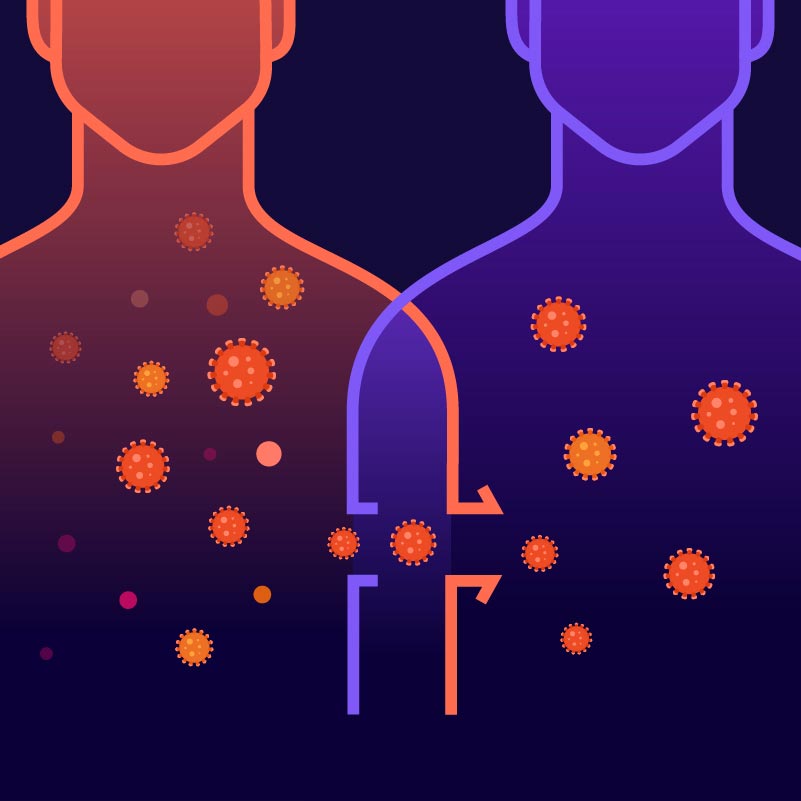
Study suggests that different modes of transmission are associated with virus evolution.
Variations in virus strains in different populations are associated with varying disease severity and treatment outcomes. A study published on March 10, 2022, in PLOS Pathogens by Ananthu James and Narendra Dixit at Indian Institute of Science, India suggests that HIV-1 is more virulent when transmitted through penile-vaginal intercourse than anal intercourse due to transmission bottlenecks.
Transmission bottlenecks introduce selection pressures, or evolution opportunities that result in a fitter virus. A pathogen that causes more severe disease is said to be more virulent, and fitter strains tend to be more virulent. Reduction in helper T cells early in infection is associated with more virulent strains. However, how these changes manifest in different risk groups has not been previously described. To better understand differences in transmission-related virus fitness in men-who-have-sex-with-men (MSM) and individuals who engaged in penile-vaginal intercourse, researchers analyzed T cell counts by collating data previously collected in large studies of MSM and non-MSM individuals infected with HIV. The researchers were able to compile data from 340,000 infected individuals of a range of ethnicities from over 25 countries.
Greater Virulence in Heterosexual Transmission
The authors found that infections transmitted via penile-vaginal intercourse correlated with lower T cell counts than in the MSM risk group, suggesting greater selective pressure at transmission, and, in turn, resulting in more virulent strains than in transmission by MSM. However, the study was limited by its reliance on population level datasets that could not account for specific behaviors that increased or decreased risk of infection or stratify non-sexually transmitted infections in either risk group. Further studies are needed to analyze individual level transmission and infection data.
According to the authors, “Transmission bottlenecks are expected to drive HIV-1 evolution and influence the design of prevention strategies. The bottlenecks are affected by the mode of transmission. Because different risk groups tend to use different predominant modes of transmission, it is possible that the strains of HIV-1, directly affected by the bottlenecks, may have evolved differently in the different groups. These findings have implications for our understanding of HIV-1 pathogenesis, evolution, and epidemiology.”
“Different modes of transmission of HIV from one individual to another can exert different bottlenecks on the virus,” Dixit adds. “Analysis of early CD4 count measurements from over 340,000 patients reveals more virulent transmitted HIV strains in heterosexual individuals than men-who-have-sex-with-men, potentially affecting the HIV epidemic differently in these groups.”
Reference: “Transmitted HIV-1 is more virulent in heterosexual individuals than men-who-have-sex-with-men” by Ananthu James and Narendra M. Dixit, 10 March 2022, PLOS Pathogens.
DOI: 10.1371/journal.ppat.1010319
Never miss a breakthrough: Join the SciTechDaily newsletter.
Follow us on Google and Google News.
1 Comment
Missing from this study are two other essential elements: 1 A comparison with virulence related to heterosexual anal sex and 2 a comparison with vaginal sex between heterosexual women and either bi or gay infected men.
Irrespective of the virulence of the virus depending on how it is passed on and by whom, the fact remains that the vast majority of new cases of HIV are the result of MSM, a fact which no amount of political correctness or pseudo science can obfuscate.