
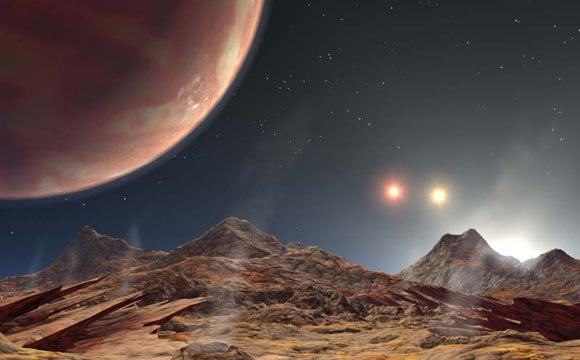
Using the Kilodegree Extremely Little Telescope, a team of astronomers has discovered an alien planet that has three suns in its sky.
Eat your heart out, Tatooine: A newly discovered alien planet has not one, not two, but three suns in its sky.
While scientists know of many planets with two suns, a planet with three bright stars in its sky is much rarer. The newly found distant world, known as KELT-4Ab, orbits one star. That star in turn is orbited by a nearby pair of stars. The twin stars are close enough to the planet to appear about as bright as the full moon in the sky, new research has revealed.
In addition to providing an example of a solar system very different from Earth’s, the strange arrangement may help provide insight into how gas giants that lie close to their parent star — known as “hot Jupiters” — evolve.
A Triple Sunset
KELT-4Ab, which is about as massive as Jupiter, orbits the single star KELT-A once every three days. Nearby, the stars KELT-B and KELT-C orbit one another once every 30 years, and together they travel around KELT-A and its planet every 4,000 years or so.
“Hot Jupiters aren’t supposed to exist. None of them.” Jason Eastman
Jason Eastman, a research associate at the Harvard-Smithsonian Center for Astrophysics, is the lead author of a study that used the two robotic telescopes that make up the Kilodegree Extremely Little Telescope (KELT), located in Arizona and South Africa respectively, to identify the system that includes the single star KELT-A, the more distant pairing KELT-BC and the overheated planet.
While the composition of the planet’s atmosphere isn’t yet known, standing in the atmosphere above the planet the single star would appear to be about 40 times as large as the sun appears in the sky on Earth. Each member of the binary star pair would be almost as bright as the full moon, though without a good telescope they would look like dots of light about a pinky-finger-width apart in the sky.
“Those two stars would orbit each other every about 30 years, and every 4,000 years they’d make one orbit around KELT-4A,” Eastman said.
Planets around triple stars are rare; KELT-4Ab is only the fourth known system to contain three stars. Of these, KELT-A is the brightest host star, not only because it is a hotter star than the ones in the other three systems, but also because it lies so close to Earth — only 680 light-years away.
The research was published in the Astronomical Journal.
Hot Jupiters
“Hot Jupiters aren’t supposed to exist. None of them,” Eastman said.
“Gaseous planets the size of Jupiter are supposed to form much farther out [from their parent star] and stay there, like our own Jupiter did,” he said. “Exactly how they got so close is an outstanding question, but one theory is that it migrates due to hot interactions with a third body — in this case, the third and fourth bodies KELT-BC.”
When astronomers developed the first theories of planet formation, all they had to work with was the solar system. When the first exoplanet discoveries were gas giants that orbited their stars in a handful of days, it turned the existing theory on its head and sent scientists scrambling to understand how the newly observed systems could exist. Most scientists seem to agree that the massive worlds traveled to their current position after they finished forming, driven by companion planets, stars or other processes, Eastman said.
“The binary system KELT-4BC may be what ultimately drove the planet KELT-4Ab so close to its star,” Eastman said.
Using a survey produced by KELT, the scientists identified the potential planet KELT-4Ab, then confirmed its existence with several other instruments. Like the more well-known NASA Kepler spacecraft, KELT relies on the transit method to detect exoplanets, observing how the amount of light from a star drops as the planet passes between it and Earth.
“KELT is different in several ways [from other transit surveys],” Eastman said. “It has a smaller telescope, a larger field of view and a larger pixel scale than other mature transit surveys.”
These features deliberately bias the instrument toward brighter stars, which Eastman said allows a broader range of observations and characterizations. Among those is the ability to determine if the planet’s orbital plane appears edge-on as seen from Earth, or whether the plane is tipped, and this process allows scientists to more precisely calculate the star’s mass.
Looking to the future
When the KELT-4 system was originally observed in 1973, it was thought to host only two stars. Not until Eastman observed the system almost 40 years later was one of the single stars resolved into two individuals.
“In all previous observations, KELT-4B and KELT-4C were blended together and looked just like one star,” Eastman said.
This is a recurring challenge for scientists observing binary systems — resolving close-orbiting stars into binary pairs. Eastman said that many known planets may live in unknown triple systems. One reason the twin stars in the KELT-4 system were so easily identified as two individual stars instead of one was because of the system’s close proximity to Earth.
The European Space Agency’s Gaia satellite, currently engaged in a five-year mission, will observe the triple system in the coming years. These observations will enable a more precise measurement of the distance to KELT-4A, providing more detailed measurements of its mass and radius, which will result in more precise measurements of the mass and radius of the planet.
“But more exciting, Gaia will be able to measure the motion of the KELT-4BC binary pair around KELT-4A,” Eastman said.
Measuring the path of the pair of stars will help improve models of how they could have affected the migration of the planet, shoving it closer to its parent star. In doing so, it will help scientists understand how hot Jupiters manage to form so close to their parent stars.
Reference: “KELT-4Ab: An inflated Hot Jupiter transiting the bright (V~10) component of a hierarchical triple” by Jason D. Eastman, Thomas G. Beatty, Robert J. Siverd, Joseph M. O. Antognini, Matthew T. Penny, Erica J. Gonzales, Justin R. Crepp, Andrew W. Howard, Ryan L. Avril, Allyson Bieryla, Karen Collins, Benjamin J. Fulton, Jian Ge, Joao Gregorio, Bo Ma, Samuel N. Mellon, Thomas E. Oberst, Ji Wang, B. Scott Gaudi, Joshua Pepper, Keivan G. Stassun, Lars A. Buchhave, Eric L. N. Jensen, David W. Latham, Perry Berlind, Michael L. Calkins, Phillip A. Cargile, Knicole D. Colon, Saurav Dhital, Gilbert A. Esquerdo, John Asher Johnson, John F. Kielkopf, Mark Manner, Qingqing Mao, Kim K. McLeod, Kaloyan Penev, Robert P. Stefanik, Rachel Street, Roberto Zambelli, D. L. DePoy, Andrew Gould, Jennifer L. Marshall, Richard W. Pogge, Mark Trueblood and Patricia Trueblood, 4 February 2016, The Astrophysical Journal.
DOI: 10.3847/0004-6256/151/2/45
arXiv:1510.00015
Never miss a breakthrough: Join the SciTechDaily newsletter.
Follow us on Google and Google News.