
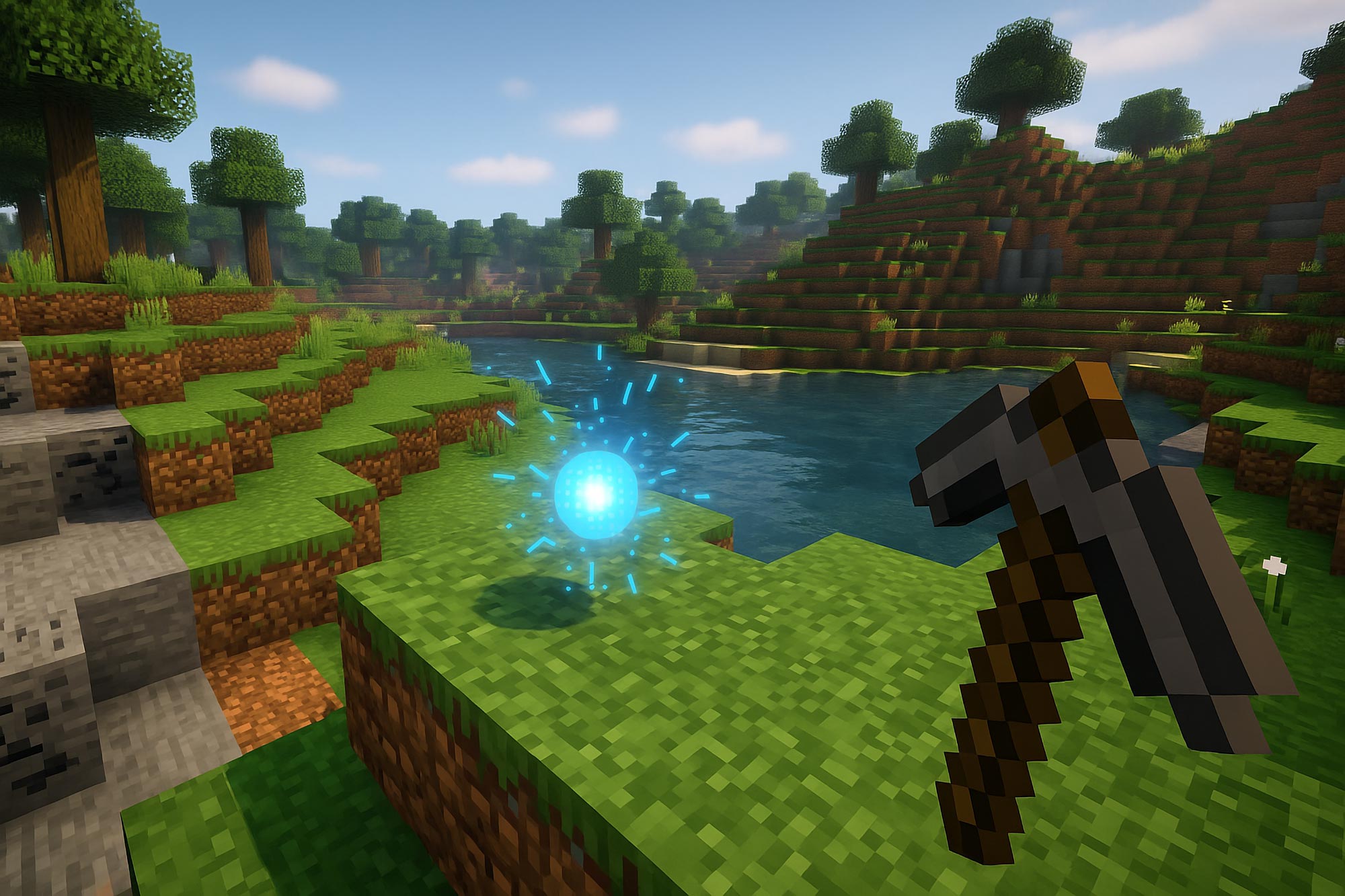
A team of scientists used the popular video game Minecraft to explore how humans combine individual instincts with social cues when learning in complex environments.
By tracking players’ actions and visual focus in a simulated foraging task, they discovered that success depends not on using just one strategy, but on being flexible, adapting between solo exploration and social observation. This novel experiment bridges a long-standing gap between traditional studies and real-world learning, revealing that human intelligence thrives on adaptability, especially in uncertain environments.
The Uniquely Human Edge: Social Learning Across Generations
The ability to learn from others is a core trait of human beings. This kind of social learning allows us to pass knowledge across generations, helping us build on the discoveries of those who came before. It’s what makes achievements like skyscrapers, space travel, and life-saving medical advances possible.
However, most scientific studies on social learning have focused on simple, abstract tasks that don’t reflect how we actually learn in complex, real-world situations. As a result, we still know relatively little about how people combine personal experience (asocial learning) with information from others (social learning) in realistic settings.
To explore this, an international team of researchers, from the Cluster of Excellence Science of Intelligence (SCIoI), the Max Planck Institute for Human Development, the University of Tübingen, and NYU, designed a virtual foraging experiment using the video game Minecraft. Their study, published today (April 25) in Nature Communications, revealed that adaptability, the ability to flexibly switch between social and individual learning strategies, was the strongest predictor of success.
Minecraft as a Research Lab: A Realistic Social Learning Environment
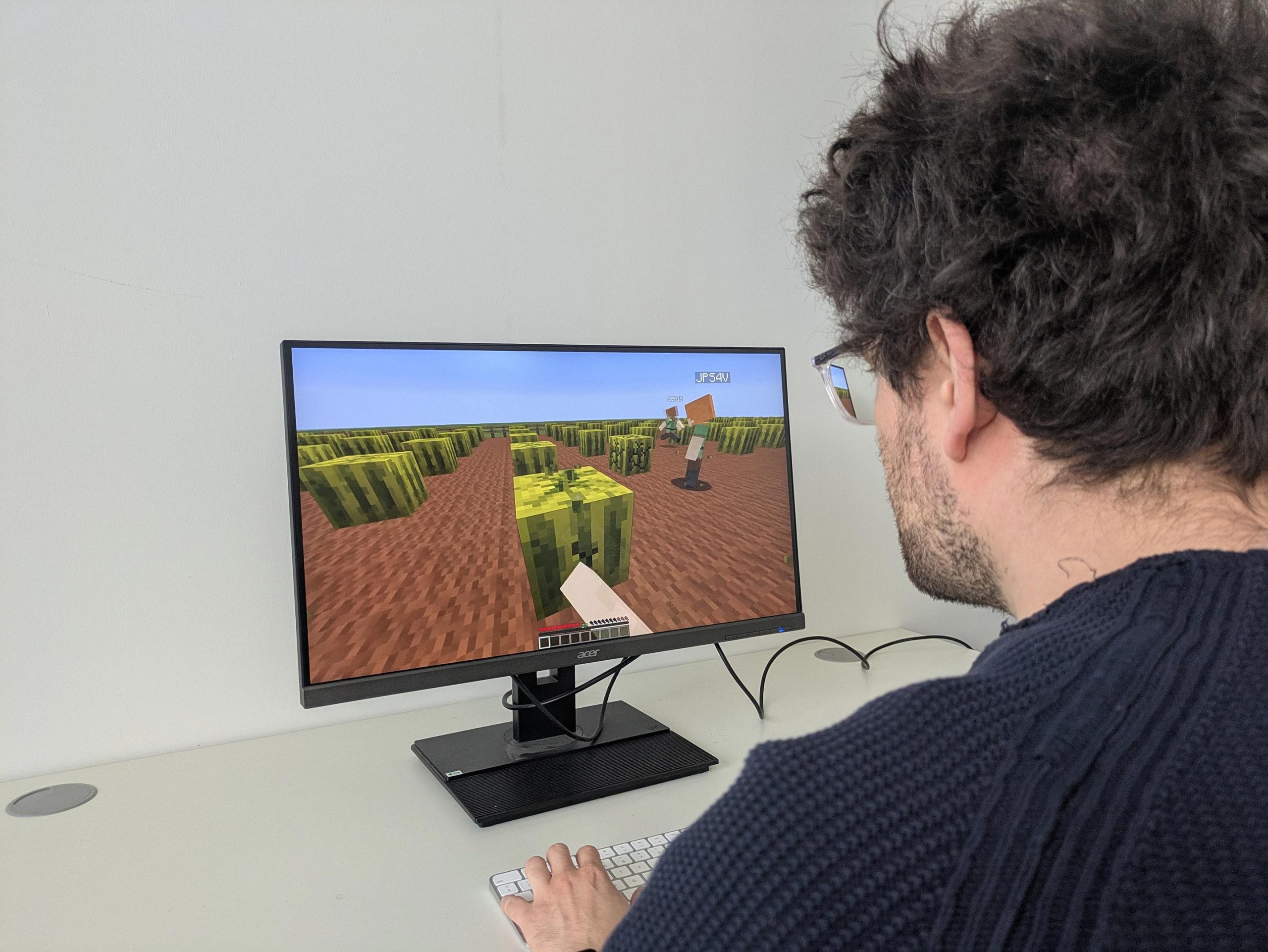
In the experiment, each participant controls an avatar that destroys Minecraft blocks in order to find resources. Whenever a resource is discovered, a blue splash appears, which is visible to other players, and could potentially provide useful social information about the location of further resources.
At the beginning of each round, the players are informed of whether they will be working alone or in a group of four people who can interact with each other in real-time. Additionally, they are tested across two types of environments. In “patchy” environments, resources are clustered together, which means that participants can find numerous blocks containing resources close to each other, while in “random” environments resources are spread out.
Thus, social information is particularly valuable in “patchy” environments, since it may reveal other rewards nearby. However, social information has no value in “random” environments, since there is no learnable pattern of resource locations. Each player tries to maximize their own rewards, rather than working towards a collective goal, and thus needs to effectively find rewards using the right balance of individual and social learning strategies.
Strategy in Action: Deciding Between Individual Instinct and Group Clues
“Using a game like Minecraft is useful because it simulates real-life challenges. For instance, since you can only see a small part of the game world at a time, you must choose whether to focus on searching on your own or pay attention to what the other players are doing to learn from them,” said Ralf Kurvers, the senior author of the study.
“This means that I am constantly faced with a choice: do I follow my own instinct and go search alone, or do I utilize social information (in this case, the blue “splashes”) by following the players who’ve already found something, as they are likely to have found a resource patch?”
Tracking Attention and Decision-Making in Real Time
Through a newly developed computational method for automating the transcription of visual field data, the scientists measured which objects, events, and other players were observed by each participant, recorded at a rate of 20 times per second. They created a model that brings together where people look, how they move, and the choices they make when foraging.
“In simpler terms, we can now predict which block a participant will choose next by combining individual and social learning strategies, all in one computational framework,” explained Charley Wu from the University of Tübingen. “This new approach allows us to connect the learning algorithms that power modern AI with flexible social learning mechanisms that adaptively learn from the successful behaviors of others.”
The Power of Adaptability in Human Intelligence
Altogether, the study bridges a decades-long gap between research on individual and social learning. The results show that humans are not just passive imitators or stubborn individual learners. Rather, they dynamically balance these strategies; adaptive mechanisms of individual and social learning amplify one another, and are driven by a common currency of individual performance.
Furthermore, the extent to which each individual was able to adapt their individual and social learning strategies was the best predictor of their performance. This emphasizes that adaptability, rather than fixed strategies, is what drives human intelligence.
From Digital Worlds to Real-World Innovation
This work advances our understanding of the cognitive mechanisms underlying adaptive learning and decision-making in social contexts, opening new pathways for understanding how information spreads in groups, how new innovations emerge, and gives clues on how to design systems that better foster adaptive learning in social settings.
In Brief:
- The study found that adaptability, the ability to flexibly switch between individual and social learning strategies, is a key factor for success.
- Researchers used the popular video game Minecraft to simulate a complex, interactive environment for studying how people learn from others.
- A newly developed computer-based method captured visual field data in real time, allowing precise modeling and prediction of how participants used social and individual learning.
- The findings help bridge a long-standing research gap, showing that people dynamically adjust their learning strategies, which has important implications for designing more effective learning environments and understanding how information spreads within groups.
Reference: “Adaptive mechanisms of social and asocial learning in immersive collective foraging” by Charley M. Wu, Dominik Deffner, Benjamin Kahl, Björn Meder, Mark H. Ho and Ralf H.J.M. Kurvers, 25 April 2025, Nature Communications.
DOI: 10.1038/s41467-025-58365-6
Never miss a breakthrough: Join the SciTechDaily newsletter.
Follow us on Google and Google News.