
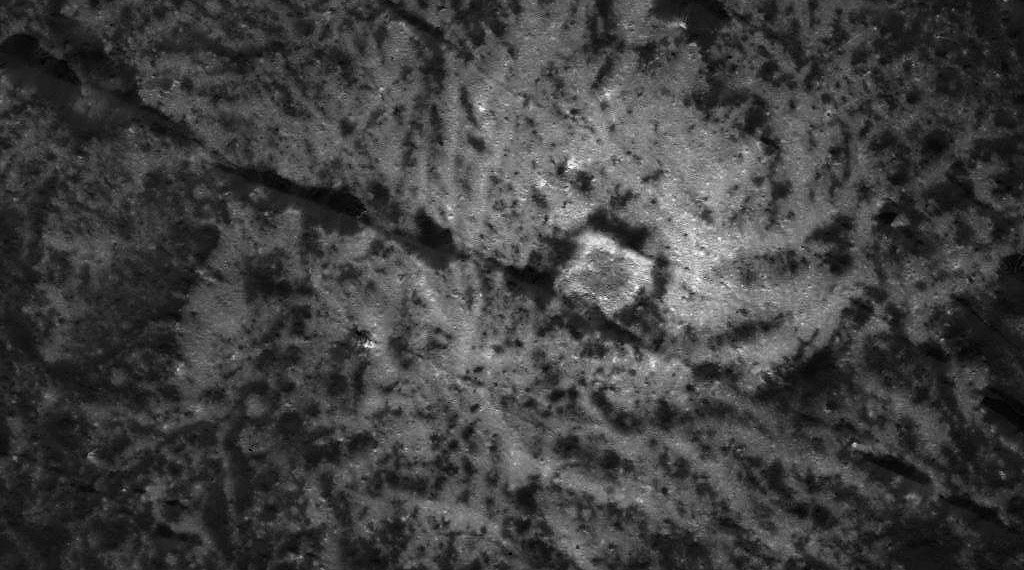
An artificial neural network has identified a square structure within a triangular one in a crater on the dwarf planet Ceres, with several people agreeing on this perception. The result of this intriguing visual experiment, carried out by a Spanish neuropsychologist, calls into question the application of artificial intelligence to the search for extra-terrestrial intelligence (SETI).
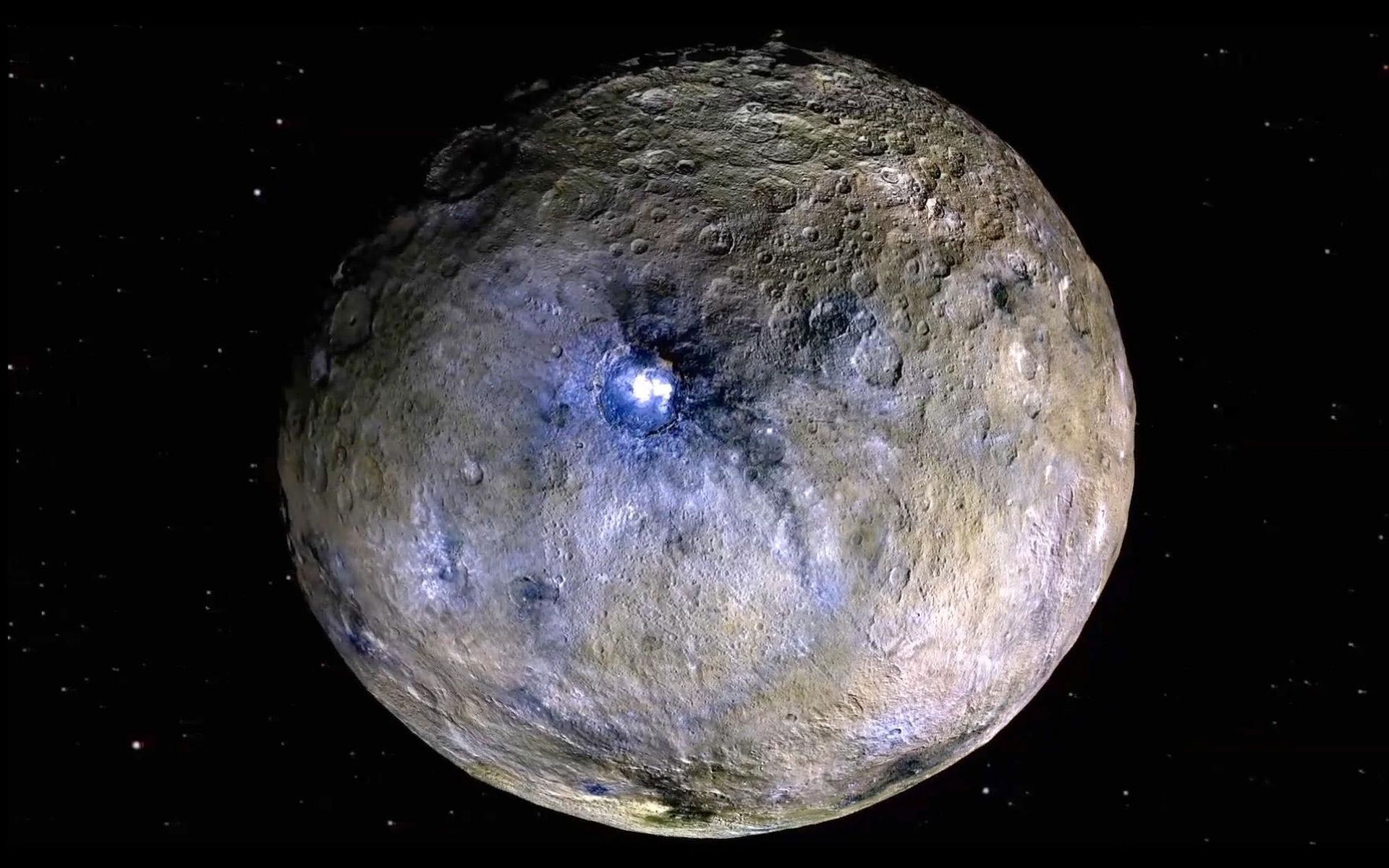
Ceres, although the largest object in the main asteroid belt, is a dwarf planet. It became famous a few years ago for one of its craters: Occator, where some bright spots were observed, leading to all manner of speculations. The mystery was solved when NASA’s Dawn probe came close enough to discover that these bright spots originated from volcanic ice and salt emissions.
Now researchers from the University of Cadiz (Spain) have looked at one of these spots, called Vinalia Faculae, and have been struck by an area where geometric shapes are ostensibly observable. This peculiarity has served them to propose a curious experiment: to compare how human beings and machines recognize planetary images. The ultimate goal was to analyze whether artificial intelligence (AI) can help discover ‘technosignatures’ of possible extra-terrestrial civilizations.
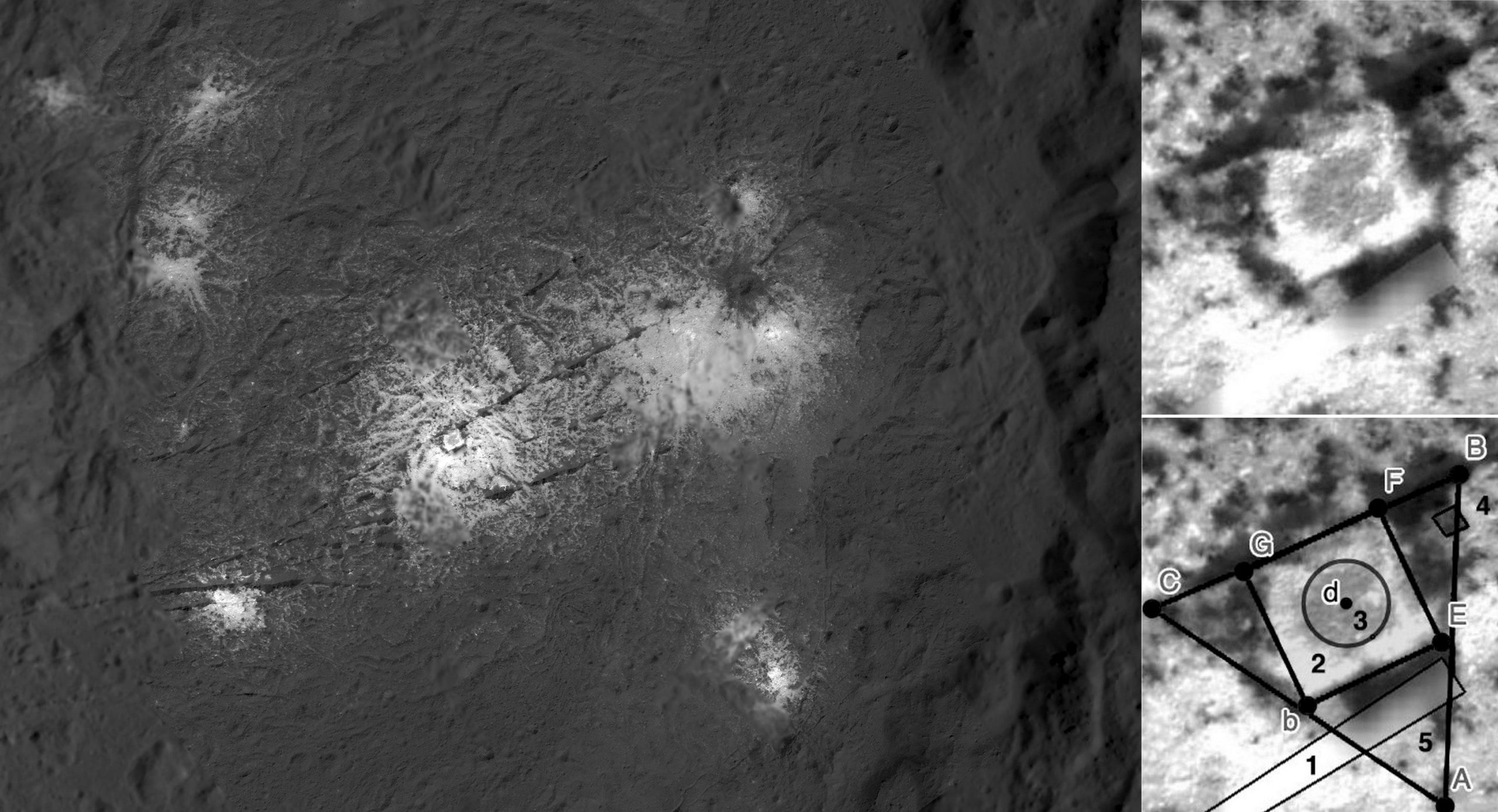
“We weren’t alone in this, some people seemed to discern a square shape in Vinalia Faculae, so we saw it as an opportunity to confront human intelligence with artificial intelligence in a cognitive task of visual perception, not just a routine task, but a challenging one with implications bearing on the search for extraterrestrial life (SETI), no longer based solely on radio waves,” explains Gabriel G. De la Torre.
The team of this neuropsychologist from the University of Cadiz, who has already studied the problem of undetected non-terrestrial intelligent signals (the cosmic gorilla effect), now brought together 163 volunteers with no training in astronomy to determine what they saw in the images of Occator.
They then did the same with an artificial vision system based on convolutional neural networks (CNN), previously trained with thousands of images of squares and triangles so as to be able to identify them.
“Both people and artificial intelligence detected a square structure in the images, but the AI also identified a triangle,” notes De la Torre, “and when the triangular option was shown to humans, the percentage of persons claiming to see it also increased significantly.” The square seemed to be inscribed in the triangle.
These results, published in the Acta Astronautica journal, have allowed researchers to draw several conclusions: “On the one hand, despite being fashionable and having a multitude of applications, artificial intelligence could confuse us and tell us that it has detected impossible or false things,” says De la Torre, “and this therefore compromises its usefulness in tasks such as the search for extra-terrestrial technosignatures in some cases. We must be careful with its implementation and use in SETI.”
“On the other hand,” he adds, “if AI identifies something our mind cannot understand or accept, could it in the future go beyond our level of consciousness and open doors to reality for which we are not prepared? What if the square and triangle of Vinalia Faculae in Ceres were artificial structures?”
Finally, the neuropsychologist points out that AI systems suffer from the same problems as their creators: “The implications of biases in their development should be further studied while they are being supervised by humans.”
De la Torre concludes by acknowledging that, in reality, “we don’t know what it is, but what artificial intelligence has detected in Vinalia Faculae is most probably just a play of light and shadow.”
Reference: “Does artificial intelligence dream of non-terrestrial techno-signatures?” by Gabriel G. De la Torre, 15 November 2019, Acta Astronautica.
DOI: 10.1016/j.actaastro.2019.11.013
Never miss a breakthrough: Join the SciTechDaily newsletter.
Follow us on Google and Google News.
1 Comment
And a circle inside that?