
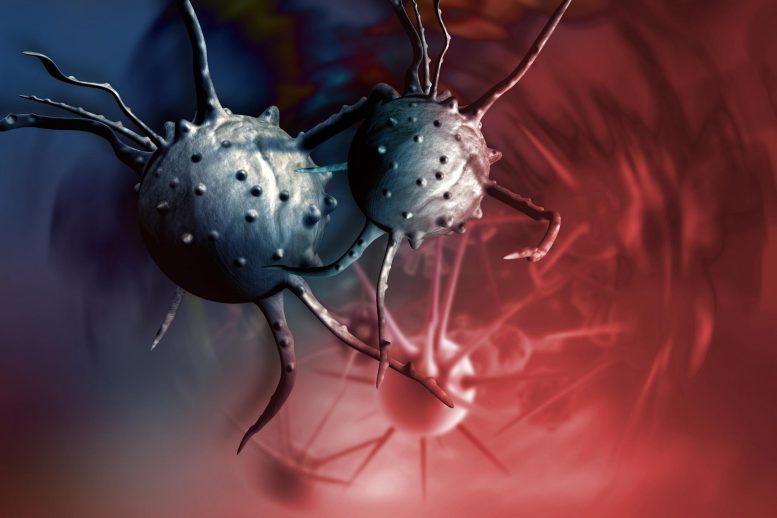
Discovery offers insight into how cancer spreads and provides a tool for developing new treatments.
Scientists have discovered that cancer cells can gravitate toward certain mechanical “sweet spot” environments, providing new insights into how cancer invades the body. The findings could help scientists and engineers better understand how cancer spreads. The discovery could also lead to improved future treatments.
The study was published on July 11, 2022, in Nature Materials, a peer-reviewed, multidisciplinary scientific journal. The work was conducted by an international team of researchers led by University of Minnesota Twin Cities engineers.
According to a previous study by the University of Minnesota-led group, cells have the ability to sense the stiffness of their environment, and their ability to move is dependent upon that environment. This stiffness ranges from stiff (bone tissue) to soft (fatty tissue) to medium stiffness (muscle tissue). Their research demonstrated that the cells can have a “sweet spot” of stiffness, that isn’t too hard or too soft, in which they have better traction and can move faster.
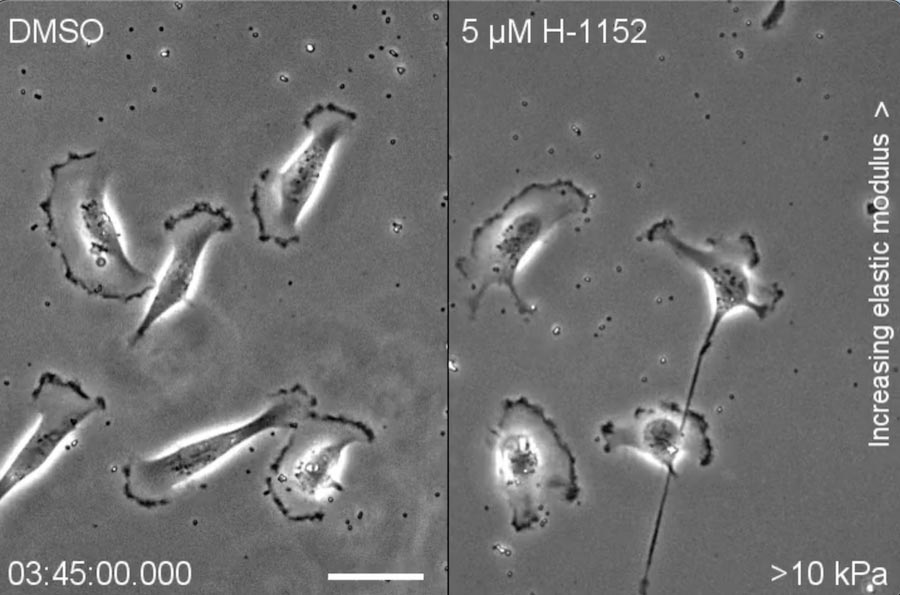
In this study, the scientists discovered that not only does the stiffness of the environment impact the speed at which cells move, but it also affects the direction in which they move.
Challenging Conventional Thinking: Cells Moving Toward Softer Regions
For many years, researchers believed that cells would always gravitate toward a stiffer environment. However, the University of Minnesota scientists observed for the first time that cells can actually move toward a “sweet spot” that’s more in the middle.
“This discovery challenges the current thinking in the field, which is that cells only move toward stiffer environments,” said David Odde, a professor at the University of Minnesota Twin Cities Department of Biomedical Engineering and senior author of the study. “I think that this finding will change how people think about this phenomenon. Our mathematical model predicted, and we’ve shown through experiments, that cells actually can move toward the softer side.”
A new study led by University of Minnesota Twin Cities engineers provides new insights into how cancer cells invade the body, which could help researchers understand the disease and develop treatments for it. The above video shows the migration of cancer cells over a span of 24 hours toward a “sweet spot” in the middle of stiff and soft environments, represented by the gray box at the bottom.
During the study, Odde and his team looked at both brain cancer and breast cancer cells. They placed cells between two environments—a stiffer region and a softer region—and observed where they accumulated.
The research team also found that some cells, like the breast cancer cells they studied, have a feedback mechanism that causes them to grip more strongly onto stiffer environments, which explains why many previous studies showed cells moving to the stiffer side. However, if you turn that mechanism off genetically, the cells will then gravitate more toward the middle.
Decoding Cancer Cell Invasion Mechanisms
“We’re basically decoding how cancer cells invade tissue,” Odde said. “They don’t just move randomly. They actually have particular ways in which they like to move, and if we can understand that, we may be better able to trip them up.”
The next step for the researchers is to use this information to build a simulator that shows how cancer cells move through an entire tumor, which will help them better predict cells’ movements based on their environments.
Reference: “Directed cell migration towards softer environments” by Aleksi Isomursu, Keun-Young Park, Jay Hou, Bo Cheng, Mathilde Mathieu, Ghaidan A. Shamsan, Benjamin Fuller, Jesse Kasim, M. Mohsen Mahmoodi, Tian Jian Lu, Guy M. Genin, Feng Xu, Min Lin, Mark D. Distefano, Johanna Ivaska and David J. Odde, 11 July 2022, Nature Materials.
DOI: 10.1038/s41563-022-01294-2
This research was supported primarily by the National Institutes of Health and the National Science Foundation Science and Technology Center for Engineering Mechanobiology with additional support from the University of Turku Doctoral Programme in Molecular Life Sciences, the Company of Biologists Travelling Fellowship, the Finnish Cultural Foundation, the Academy of Finland, the Sigrid Juselius Foundation, the Finnish Cancer Organization, the National Natural Science Foundation of China, the Natural Science Basic Research Plan in Shaanxi Province of China, the Shaanxi Province Youth Talent Support Program, and the Young Talent Support Plan of Xi’an Jiaotong University.
In addition to Odde, the research team included University of Minnesota Department of Biomedical Engineering researchers Jay Hou, Ghaidan Shamsan, Benjamin Fuller, and Jesse Kasim; University of Minnesota Twin Cities Department of Chemistry researchers Keun-Young Park, M. Mohsen Mahmoodi, and Professor Mark Distefano; University of Turku, Finland, researchers Aleksi Isomursu, Mathilde Mathieu, and Professor Johanna Ivaska; and Xi’an Jiaotong University researchers Bo Cheng, Tian Jian Lu, Guy Genin, Feng Xu, and Professor Min Lin.
Never miss a breakthrough: Join the SciTechDaily newsletter.
Follow us on Google and Google News.
1 Comment
Me & my best friend was just talking about we wanted to know more about how can cell enter the body. I would love to visit the University and get on on the observation of this indepth study.. Wow.. how timely