
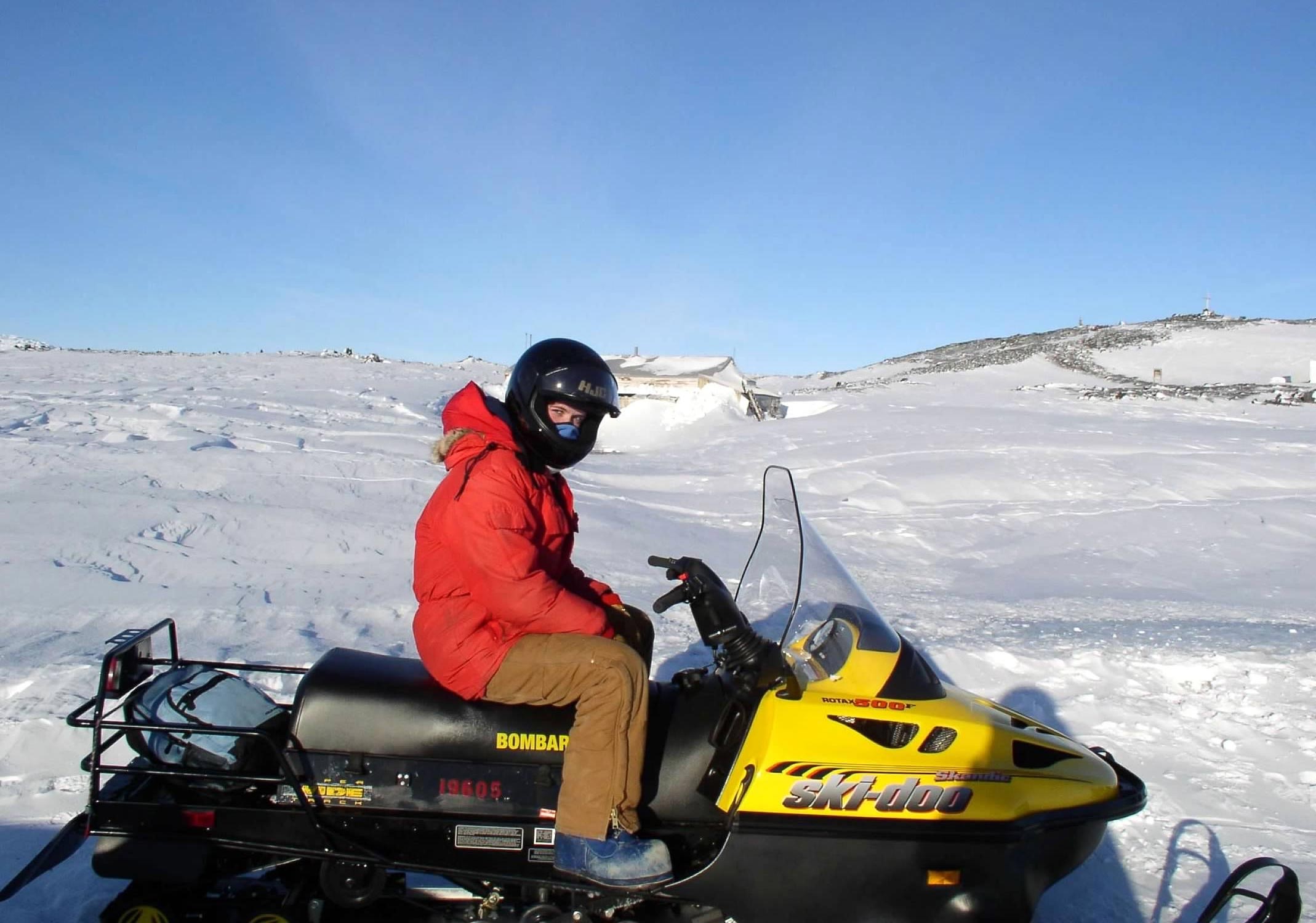
Name: Olivia Billett
Title: Systems Engineer and Lockheed Martin Science Phase Lead for ORISIS-REx.
Education: B.S Physics and Astronomy from Yale. Master’s in Aerospace from Stanford University.
Superpower Skill: Multi-tasking, a basic necessity for systems engineer and a mom
Hobbies: Traveling
Oliva Billett still chuckles about the first time she considered a career in science and engineering. She and nine other top physics students from her high school participated in an engineering competition. “We had no idea what it was about,” said Billett. “I said yes because we got out of school for a day.”
They did problem-solving in the morning. In the afternoon, competition organizers gave the teams a trunk lock and asked them to improve it. “They would ask us if it rained, and this part of your trunk lock got rusted, how would you fix it,” said Billett. “I loved it. I was exposed to engineering as a real-life problem-solving skill as opposed to a class.”
Today, Billett is a systems engineer at Lockheed Martin and the science phase lead for NASA’s first asteroid sample return mission OSIRIS-REx. In 5 days, OSIRIS-REx will touch an asteroid named Bennu, retrieve a sample of pebbles and dirt, and deliver that sample back to Earth in 2023 for study. She is responsible for spacecraft operation near the asteroid Bennu and works with the science and navigation teams to design and plan science activities around the asteroid.
“I love the variety of my job. Our teams are generally small and fast-paced, which requires each of us to understand the entire system to ensure it will all work together, said Billett.”

Billett’s team deals with problems no one has encountered before, tackling each one on the fly.
“I’m often reminded of what a team sport engineering is,” said Billett. “That’s not obvious when you’re choosing a path in college, but it’s clear to me every day at work. Our success is dependent on our ability to work as a team.”
Billett has worked on several planetary orbiters, including the Mars Reconnaissance Orbiter, the Phoenix Mars Lander, the Juno Jupiter mission, and the MAVEN Mars aeronomy mission.
“I came to the mission with a lot of experience with deep-space operations and design,” said Billett. “But that experience was almost in our way because Bennu is not a planet. Understanding how we were going to fly around it took a change in mindset.”
Due to the delicate dance the spacecraft must perform to stay in close proximity to Bennu, the asteroid is a constant threat to OSIRIS-REx. In comparison, Billett says, the Mars orbiters are not at risk from Mars once you get the spacecraft through the Mars Orbit Insertion burn.
OSIRIS-REx circles Bennu about a mile (1.6 kilometers) from its center, where the gravity force is only five-millionths of Earth’s gravity — barely enough gravity to keep a spacecraft in orbit.
Solar radiation pressure or changes in the spacecraft configuration can easily push the spacecraft out of Bennu’s orbit. Small burns can also put the spacecraft in a different orbit and on a different trajectory. That doesn’t happen when orbiting larger, more massive objects like moons and planets and Billett says that requires a new way of thinking.
The OSIRIS-REx trajectory can vary so much that the mission operations team has to be able to respond much more rapidly than other deep-space missions do. Billett’s team has to update the spacecraft pointing for maneuver and science observations within 24 hours of each activity executing onboard. It’s a very rapid turnaround the team does multiple times per week. To ensure they’re prepared if the spacecraft ends up in a range of trajectories over the course of a few weeks, her team regularly conducts parallel analysis to ensure the spacecraft is always safe.
The navigation team corrects the spacecraft orbit using “trim” maneuvers to nudge it in one direction or another. They also have many contingencies on the table, ready to go if a burn doesn’t happen.
Billett loves working closely with science, something she has not done on previous space missions. On other missions, engineers fly the spacecraft, get the scientific data down, and pass it on to the scientists. The science teams take it and work with it. While she sees it occasionally at various quarterly science meetings or when papers come out. However, with OSIRIS-REx, the science of the asteroid is the mission.
“We have gotten to be much more plugged into the data that is coming down,” said Billett. “That is so exciting for me as a space geek and science nerd.”
Billett loves to travel. She has been to six continents, including a year in Antarctica when she worked as a Research Associate at McMurdo Station in 2003 and stayed over during the Antarctic winter.
“It was an incredible experience, to say the least! It was beautiful and unique, and challenging in unexpected ways. The landscape was just stunning,” described Billett. “I was expecting the dark and the cold, which were surprisingly manageable, but the isolation turned out to be the harder part to handle. But the relationship to the environment and the sense of community were amplified.”
Looking back at her childhood, Billett says her family encouraged her interest in science. Her mom was a doctor, and her dad was an engineer in the military. She did a lot of projects with her dad around the house and the yard. Those experiences taught her to be comfortable jumping in and solving problems.
Never miss a breakthrough: Join the SciTechDaily newsletter.
Follow us on Google and Google News.