

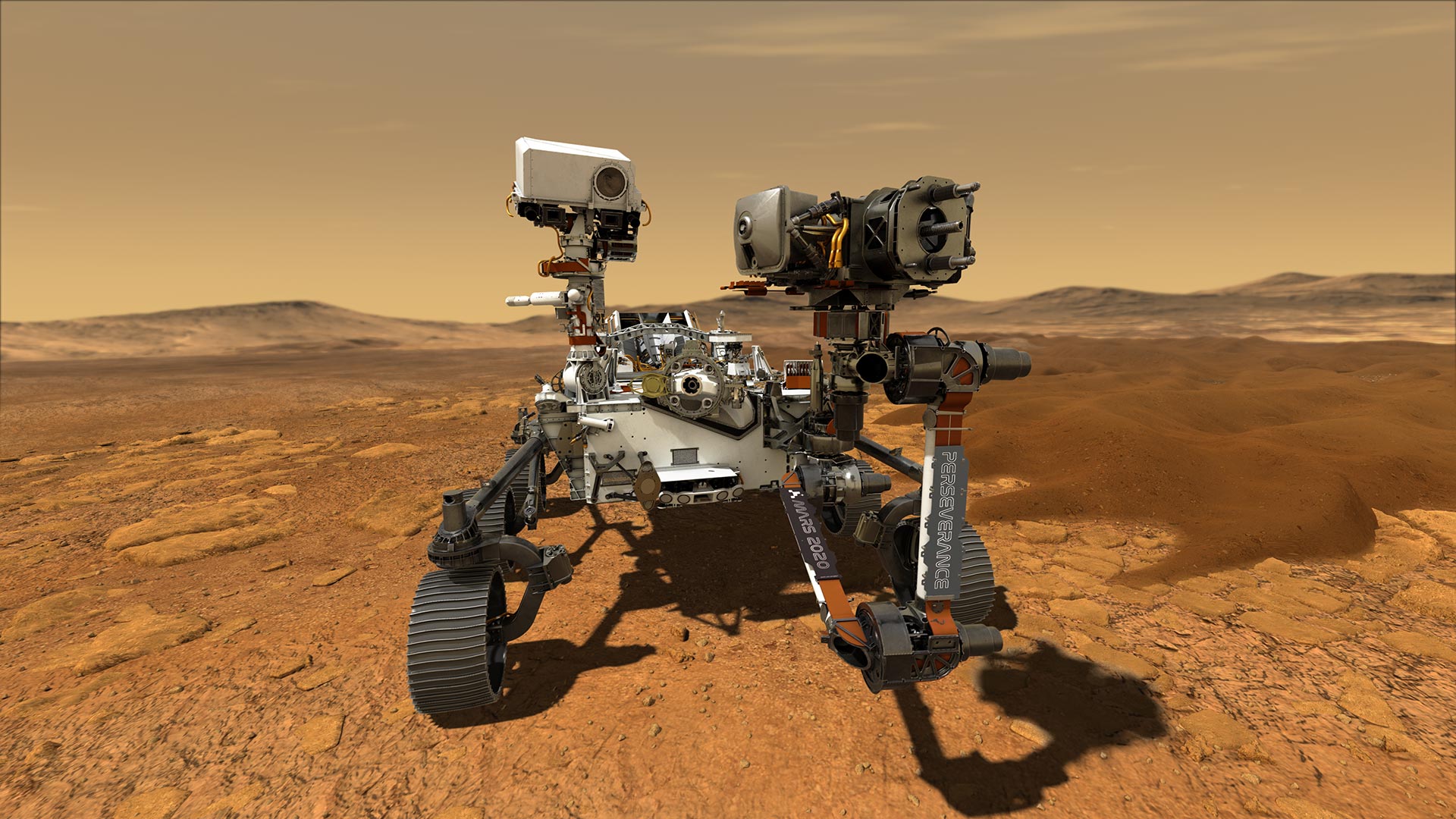
NASA’s Perseverance rover isn’t just hunting for signs of ancient life on Mars, it’s also testing spacesuit materials right on the Red Planet.
After four years of exposure to its harsh environment, scientists are now studying how radiation, extreme cold, and corrosive dust have affected these swatches. What they learn will help design better suits for future astronauts, ensuring they can safely explore Mars despite brutal conditions like intense UV light and toxic salts.
Perseverance’s Dual Mission on Mars
NASA’s Perseverance rover landed on Mars in 2021 with a mission to search for signs of ancient microbial life and to study the planet’s climate and geology. But one of its lesser-known goals is to support future human exploration. As part of that effort, Perseverance carries five small samples of spacesuit materials designed to test how they hold up on the Martian surface.
After four years exposed to Mars’ extreme environment – harsh radiation, fine dust, and temperature swings – these materials are now being analyzed to see how they’ve changed. The goal is to better understand how long a spacesuit could remain functional on Mars.
Building for What’s Next
“This is one of the forward-looking aspects of the rover’s mission – not just thinking about its current science, but also about what comes next,” said planetary scientist Marc Fries of NASA’s Johnson Space Center in Houston, who helped provide the spacesuit materials. “We’re preparing for people to eventually go and explore Mars.”
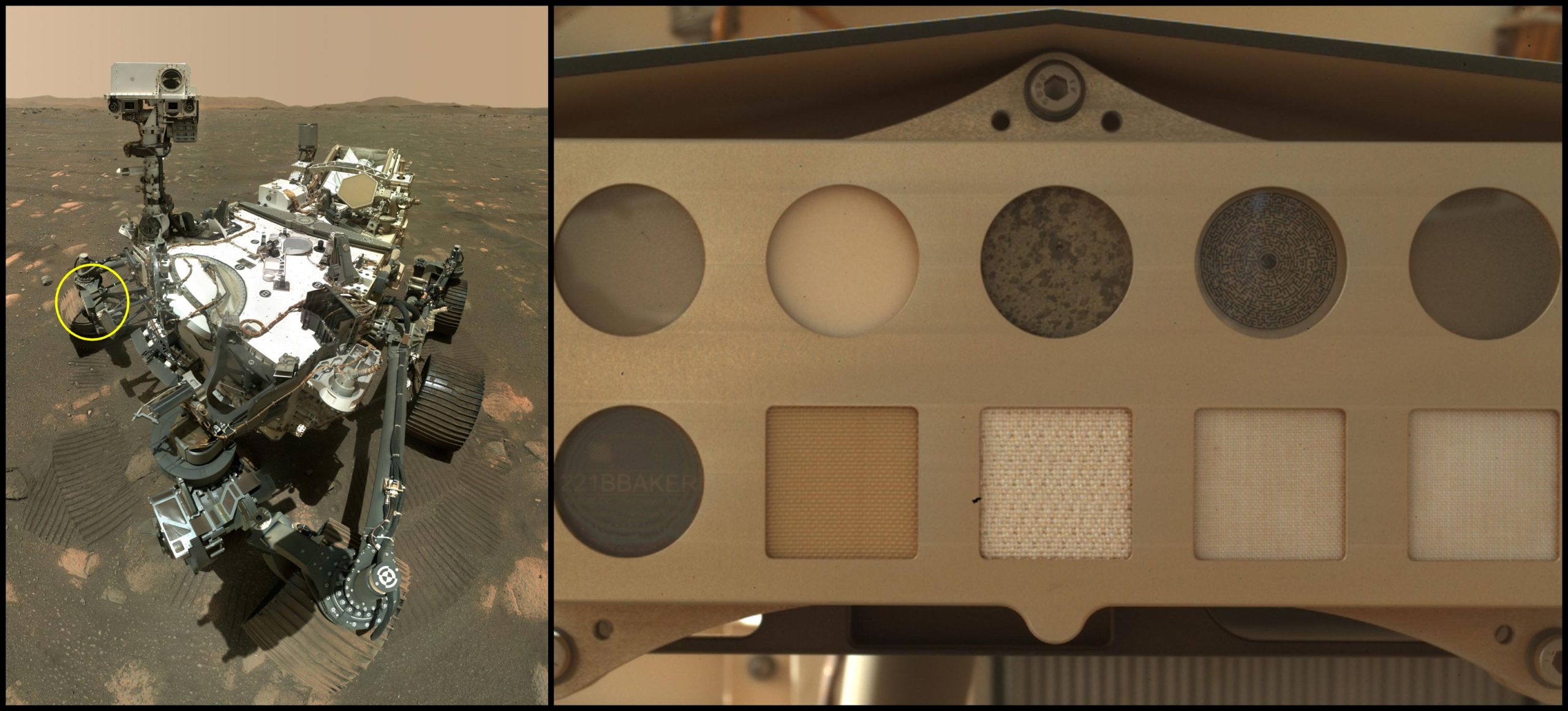
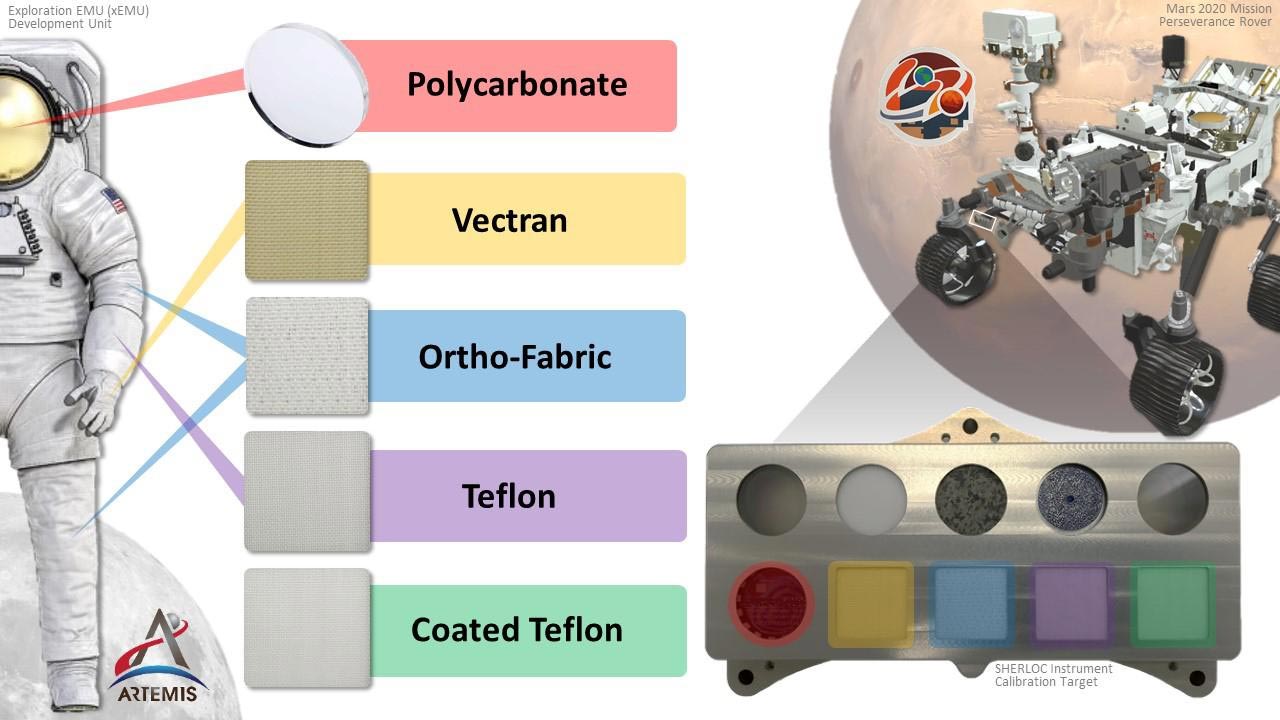
The swatches, each three-quarters of an inch square (20 millimeters square), are part of a calibration target used to test the settings of SHERLOC (Scanning Habitable Environments with Raman & Luminescence for Organics and Chemicals), an instrument on the end of Perseverance’s arm.
The samples include a piece of polycarbonate helmet visor; Vectran, a cut-resistant material used for the palms of astronaut gloves; two kinds of Teflon, which has dust-repelling nonstick properties; and a commonly used spacesuit material called Ortho-Fabric. This last fabric features multiple layers, including Nomex, a flame-resistant material found in firefighter outfits; Gore-Tex, which is waterproof but breathable; and Kevlar, a strong material used in bulletproof vests that makes spacesuits more rip-resistant.
Martian Wear and Tear
Mars is far from hospitable. It has freezing temperatures, fine dust that can stick to solar panels and spacesuits (causing wear and tear on the latter), and a surface rife with perchlorates, a kind of corrosive salt that can be toxic to humans.
There’s also lots of solar radiation. Unlike Earth, which has a magnetic field that deflects much of the Sun’s radiation, Mars lost its magnetic field billions of years ago, followed by much of its atmosphere. Its surface has little protection from the Sun’s ultraviolet light (which is why researchers have looked into how rock formations and caves could provide astronauts with some shielding).
Studying Sunlight’s Impact
“Mars is a really harsh, tough place,” said SHERLOC science team member Joby Razzell Hollis of the Natural History Museum in London. “Don’t underestimate that – the radiation in particular is pretty nasty.”
Razzell Hollis was a postdoctoral fellow at NASA’s Jet Propulsion Laboratory in Southern California from 2018 to 2021, where he helped prepare SHERLOC for arrival on Mars and took part in science operations once the rover landed. A materials scientist, Razzell Hollis has previously studied the chemical effects of sunlight on a new kind of solar panel made from plastic, as well as on plastic pollution floating in the Earth’s oceans.
He likened those effects to how white plastic lawn chairs become yellow and brittle after years in sunlight. Roughly the same thing happens on Mars, but the weathering likely happens faster because of the high exposure to ultraviolet light there.
Speed of Degradation
The key to developing safer spacesuit materials will be understanding how quickly they would wear down on the Martian surface. About 50% of the changes SHERLOC witnessed in the samples happened within Perseverance’s first 200 days on Mars, with the Vectran appearing to change first.
Another nuance will be figuring out how much solar radiation different parts of a spacesuit will have to withstand. For example, an astronaut’s shoulders will be more exposed – and likely encounter more radiation – than his or her palms.
Next Steps
The SHERLOC team is working on a science paper detailing initial data on how the samples have fared on Mars. Meanwhile, scientists at NASA Johnson are eager to simulate that weathering in special chambers that mimic the carbon dioxide atmosphere, air pressure, and ultraviolet light on the Martian surface. They could then compare the results generated on Earth while putting the materials to the test with those seen in the SHERLOC data. For example, the researchers could stretch the materials until they break to check if they become more brittle over time.
“The fabric materials are designed to be tough but flexible, so they protect astronauts but can bend freely,” Fries said. “We want to know the extent to which the fabrics lose their strength and flexibility over time. As the fabrics weaken, they can fray and tear, allowing a spacesuit to leak both heat and air.”
More About Perseverance
NASA’s Perseverance rover is a flagship mission on Mars, launched in 2020 as part of the agency’s broader Mars Exploration Program and its Moon to Mars strategy. Built and operated by NASA’s Jet Propulsion Laboratory in Pasadena, California, Perseverance is exploring the Jezero Crater, a site believed to have once hosted a lake.
A key goal of the mission is astrobiology, particularly the search for signs of ancient microbial life. The rover is also studying Mars’ geology and past climate to better understand the planet’s history and to help prepare for future human exploration.
Perseverance is the first mission to collect and cache samples of Martian rock and soil, which are being sealed in tubes for a future return to Earth. These samples are intended for retrieval through the planned Mars Sample Return campaign—a collaborative effort between NASA and the European Space Agency (ESA) that will allow scientists to study Mars materials in unprecedented detail here on Earth.
Never miss a breakthrough: Join the SciTechDaily newsletter.
Follow us on Google and Google News.
27 Comments
What is happening with the research involving organisms that eat perclorates. This should be a serious option to detoxify mars
“For example, an astronaut’s shoulders will be more exposed – and likely encounter more radiation – than his or her palms.”
How about easily replaceable, UV-resistant shoulder covers, like wide epaulets, held in place by Velcro?
They haven’t even figured this one out yet. They have figured out nothing yet, but we keep hearing promises of crewed Mars missions by the end of the decade.
That sure as sh!t ain’t this decade.
I mean, I don’t care. Let them just figure out the propulsion part. Then please strap Elon Musk to that rocket and fire him off in the general Mars direction, so we may never hear from him again.
He said that the radiation isn’t a big deal so he should be fine…
Thanks, right on.
It’s so frustrating when you hear the most ignorant people on earth keep giving credit to Elon Musk for inventions of Tesla, Twitter, SpaceX etc…, when in reality Musk did not create anything, he is a risk taking investor.
After years and years of NASA’s scientists and engineers expensive research, studies and exploration I’m sure Musk will try to get all the credit for sending Man to Mars.
You must be pessimistic and leftist with the fake agendas of the Democrats. Useless nonsenses on this planet.
Huh?
Get work Carhartt maybe North Face share some tech and let’s do this already…I didn’t want to die before I see someone on Mars thank you very much!
I agree 100% with Mary M. S.
Child.
I love to hear grown men cry, or maybe they aren’t grown yet, over someone’s having made it and they didn’t.
Lol Fred
Donno man, probably mask is using private money in stead of tax money. They got jelly. Or some negative propaganda by nasa and others. Anyways mask is gradually leaving other nations behind in the space run
@ Creazymadman: SpaceX is heavily subsidized by the government. NASA is not “spreading anti-SpaceX propaganda” and it can’t be “jelly” at SpaceX when NASA is the one awarding SpaceX government contracts.
Musk is not the one leading the space race. The Chinese are. Musk is just blowing things up.
What is possessing us to send any one to a literally God forsaken planet? We have all the life we need here on this beautiful planet.
And what are we doing with it?
Destroying it. Destroying the air, not to mention all the people that are killed in wars or destroyed before they have the chance to be born.
Ghandi was right. It’s not that there are too many poor people, there are too many rich people.
And to quote the great man again,
There is enough for everybody’s need but not enough for everybody’s greed.
Don’t you realize that all you left wing kooks sounds like stupid spoiled children when you say things like that??? I don’t believe that there is a cure for your disease… seek help and meds…. It’s all you’ve got!
It’s always best to first model the behavior you would like to see.
Elon musk is the greatest mind of our country and will continue to create and exceed our expectations for his entire life and our country will benefit most
The problem with orbital mechanics is that if you miss, he will come back eventually. So you absolutely do want to do it right and hit something.
I mean maybe they just some dragon skin, Kevlar skin
Blah-blah-blah Trump blah-blah-blah Musk blah-blah-blah-blah-blah…..
This is why I don’t watch Colbert anymore. It’s tiresome.
Study indicates there is alot of work missimg. Life in Mars is very dangerous. It will be not haponed due to Mars own nature. Not fit to br live there.
Study indicates there is a battle for human life. On Earth, so many african countries lack of food, lack of energy, lack of pure drinking water, human life suffering badly. Life in danger zone for them. Please do it for these countries. Proof it we can make better life first for human on Earth first. What we have first protect our environment.
What about doggi style necked, having some sex under mars climatology.?… that’s will be a nicevexperience for a couple just happy married…😅🤣🤣😂🤣😅😂😂🤣🤣🤣🤣🤣😅😅
What about doggi style necked, having some sex under mars climatology.?… that’s will be a nicevexperience for a couple just happy married…😅🤣🤣😂🤣😅😂😂🤣🤣🤣🤣🤣😅😅
The earth is flat, covered by a solid firmament.
We have never been past it.
Wake up
Once we understand this galaxy we’ll find the rest to be endless void still we get to the next one.
Why use money, just start working on our endless troubles with not having funds to travel to the store!
Already made complaints no one will ever oblige!