
Close Menu
    Facebook X (Twitter) Instagram
    SciTechDaily
    • Biology
    • Chemistry
    • Earth
    • Health
    • Physics
    • Science
    • Space
    • Technology
    Facebook X (Twitter) Pinterest YouTube RSS
    SciTechDaily
    Home»Biology»How Plant Biology Could Revolutionize Renewable Energy
    Biology

    How Plant Biology Could Revolutionize Renewable Energy

    By American Institute of PhysicsMay 28, 2024No Comments4 Mins Read
    Facebook Twitter Pinterest Telegram LinkedIn WhatsApp Email Reddit
    Share
    Facebook Twitter LinkedIn Pinterest Telegram Email Reddit
    Plant Hydraulics Biological Process Cover
    A groundbreaking study demonstrates that plants can generate electricity that varies with their circadian rhythms, opening up new possibilities for environmentally sustainable energy production. Credit: Aniruddha Guha, edited

    New research has revealed that the hydraulic systems of plants generate a streaming electric potential in sync with their circadian rhythms, presenting innovative opportunities for sustainable energy production.

    When plants draw water from their roots to nourish their stems and leaves, they produce an electric potential that could be harnessed as a renewable energy source. However, like all living things, plants are subject to a circadian rhythm — the biological clock that runs through day and night cycles and influences biological processes. In plants, this daily cycle includes capturing light energy for photosynthesis and absorbing water and nutrients from the soil during the day, and slowing its growth processes at night.

    Study Insights on Electrical Potential in Plants

    In a new study published this week in Physics of Fluids, by AIP Publishing, the researchers from the Indian Institute of Technology Kharagpur detailed how biological processes produce voltage in plants and the impact of the cyclic day and night changes on this voltage.

    “This streaming potential, essentially a consequence of the natural energy gathered in the plant, offers a renewable energy source that is continuous and can be sustainable over long periods,” author Suman Chakraborty said. “The question we wanted to answer was how much potential it can produce, and how is electric potential influenced by the plant’s biological clock?”
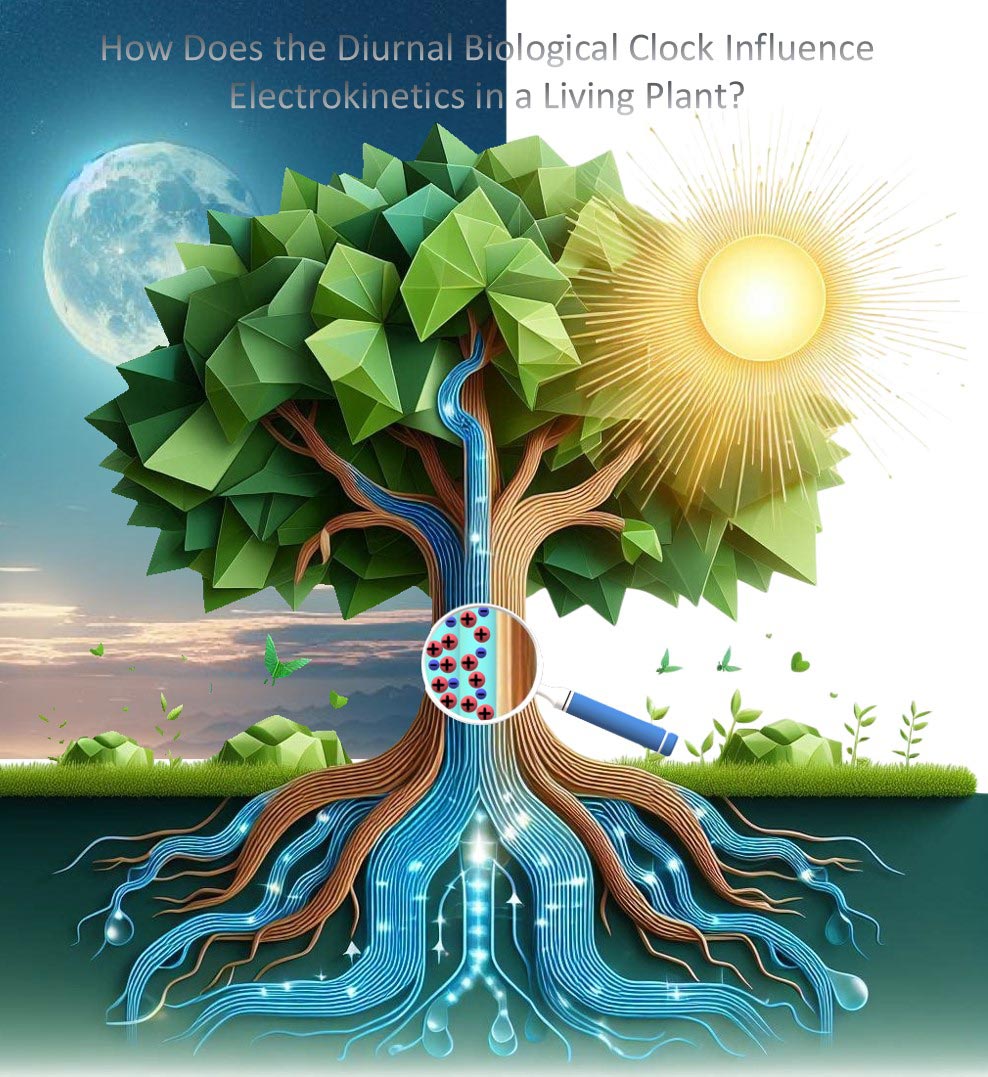
    Plant Hydraulics Biological Process
    Plant hydraulics drive the biological process that moves fluids from roots to plant stems and leaves, creating streaming electric potential, or voltage, in the process. This study closely examined the differences in voltage caused by the concentrations of ions, types of ions, and pH of the fluid plants transport, tying the voltage changes to the plant’s circadian rhythm that causes adjustments day and night. According to the authors, this consistent, cyclic voltage creation could be harnessed as an energy source. Credit: Aniruddha Guha

    Methodology and Discoveries

    To find out, the authors inserted electrodes into the stems of water hyacinths and attached reservoirs with electrodes to pieces of lucky bamboo to closely examine how electrical potential changes depending on types of ions, ion concentration, and the pH of the fluid flowing through the plants.

    “Our eureka moment was when our first experiments showed it is possible to produce electricity in a cyclic rhythm and the precise linkage between this and the plant’s inherent daily rhythm,” Chakraborty said. “We could exactly pinpoint how this is related to water transpiration and the ions the plant carries via the ascent of sap.”

    The study quantified the voltage response originating from the movement of ions through the plant’s pathways that align uniquely with the plant’s daily rhythms.

    Potential for Sustainable Energy Harvesting

    The authors discovered plants can actively moderate the flow of fluid or sap in sync with the day and night cycles. They also found the electric streaming potential increases with decreased concentration of ions or increased pH in the fluid.

    “We not only rediscovered the plant’s electrical rhythm, articulating it in terms of voltages and currents, but we also provided insight into potentially tapping electrical power output from plants in a sustainable manner with no environmental impact and no disruption to the ecosystem,” Chakraborty said.

    “The findings could help develop biomimetic, nature-inspired systems that can address the global energy crisis with an eco-friendly, sustainable solution in which planting a tree not only relieves the crises of climate change and declining environmental quality, but also provides a way to harness electricity from it.”

    Reference: “How does the diurnal biological clock influence electrokinetics in a living plant?” by Aniruddha Guha, Saumyadwip Bandyopadhyay, Chirodeep Bakli, and Suman Chakraborty, 28 May 2024, Physics of Fluids.
    DOI: 10.1063/5.0195088

    Never miss a breakthrough: Join the SciTechDaily newsletter.
    Follow us on Google and Google News.

    American Institute of Physics Circadian Rhythm Green Energy Photosynthesis Plant Science Popular
    Share. Facebook Twitter Pinterest LinkedIn Email Reddit

    Related Articles

    The Photosynthesis Upgrade: Creating Super Crops for a Changing World

    Common Weed Discovered To Be a “Super Plant”

    Artificial Photosynthesis Promises Clean, Sustainable Source of Energy

    Arabidopsis Clock: Plants Set a “Bedtime” Alarm to Ensure Their Survival

    Saving Bats From Wind Turbine Death – “Green-Green Dilemma”

    Scientists Shocking Discovery That Babies in the Womb May See Much More Than We Thought

    Elusive Photosynthesis Details Unlocked With Rapid X-Ray Pulses

    Meet the “Extinct Species” That Was Just Rediscovered After 200 Years

    Powered by Sunlight, ‘Artificial Leaf’ Successfully Produces Clean Gas From CO2 and Water

    Leave A Reply Cancel Reply

    • Facebook
    • Twitter
    • Pinterest
    • YouTube

    Don't Miss a Discovery

    Subscribe for the Latest in Science & Tech!

    Trending News

    Mezcal “Worm” in a Bottle Mystery: DNA Testing Reveals a Surprise

    New Research Reveals That Your Morning Coffee Activates an Ancient Longevity Switch

    This Is What Makes You Irresistible to Mosquitoes

    Shockingly Powerful Giant Octopuses Ruled the Seas 100 Million Years Ago

    Scientists Stunned by New Organic Molecules Found on Mars

    Rewriting Dinosaur Evolution: Scientists Unearth Remarkable 150-Million-Year-Old Stegosaur Skull

    Omega-3 Supplements Linked to Cognitive Decline in Surprising New Study

    First-of-Its-Kind Discovery: Homer’s Iliad Found Embedded in a 1,600-Year-Old Egyptian Mummy

    Follow SciTechDaily
    • Facebook
    • Twitter
    • YouTube
    • Pinterest
    • Newsletter
    • RSS
    SciTech News
    • Biology News
    • Chemistry News
    • Earth News
    • Health News
    • Physics News
    • Science News
    • Space News
    • Technology News
    Recent Posts
    • Male Birth Control Breakthrough: Scientists Find Way To Turn Sperm Production Off and Back On
    • A Common Vitamin Could Hold the Key to Treating Fatty Liver Disease
    • New Research Shows Vitamin B12 May Hold the Key to Healthy Aging
    • Scientists Map Thousands of Brain Connections With RNA Barcodes
    • This Gene Tweak Turns Strawberries Into Healthier, Tastier Superfruit
    Copyright © 1998 - 2026 SciTechDaily. All Rights Reserved.
    • Science News
    • About
    • Contact
    • Editorial Board
    • Privacy Policy
    • Terms of Use

    Type above and press Enter to search. Press Esc to cancel.