
Close Menu
    Facebook X (Twitter) Instagram
    SciTechDaily
    • Biology
    • Chemistry
    • Earth
    • Health
    • Physics
    • Science
    • Space
    • Technology
    Facebook X (Twitter) Pinterest YouTube RSS
    SciTechDaily
    Home»Biology»How Spiders Can Distinguish Living From Non-Living Objects in Their Peripheral Vision
    Biology

    How Spiders Can Distinguish Living From Non-Living Objects in Their Peripheral Vision

    By PLOSJuly 19, 20211 Comment3 Mins Read
    Facebook Twitter Pinterest Telegram LinkedIn WhatsApp Email Reddit
    Share
    Facebook Twitter LinkedIn Pinterest Telegram Email Reddit
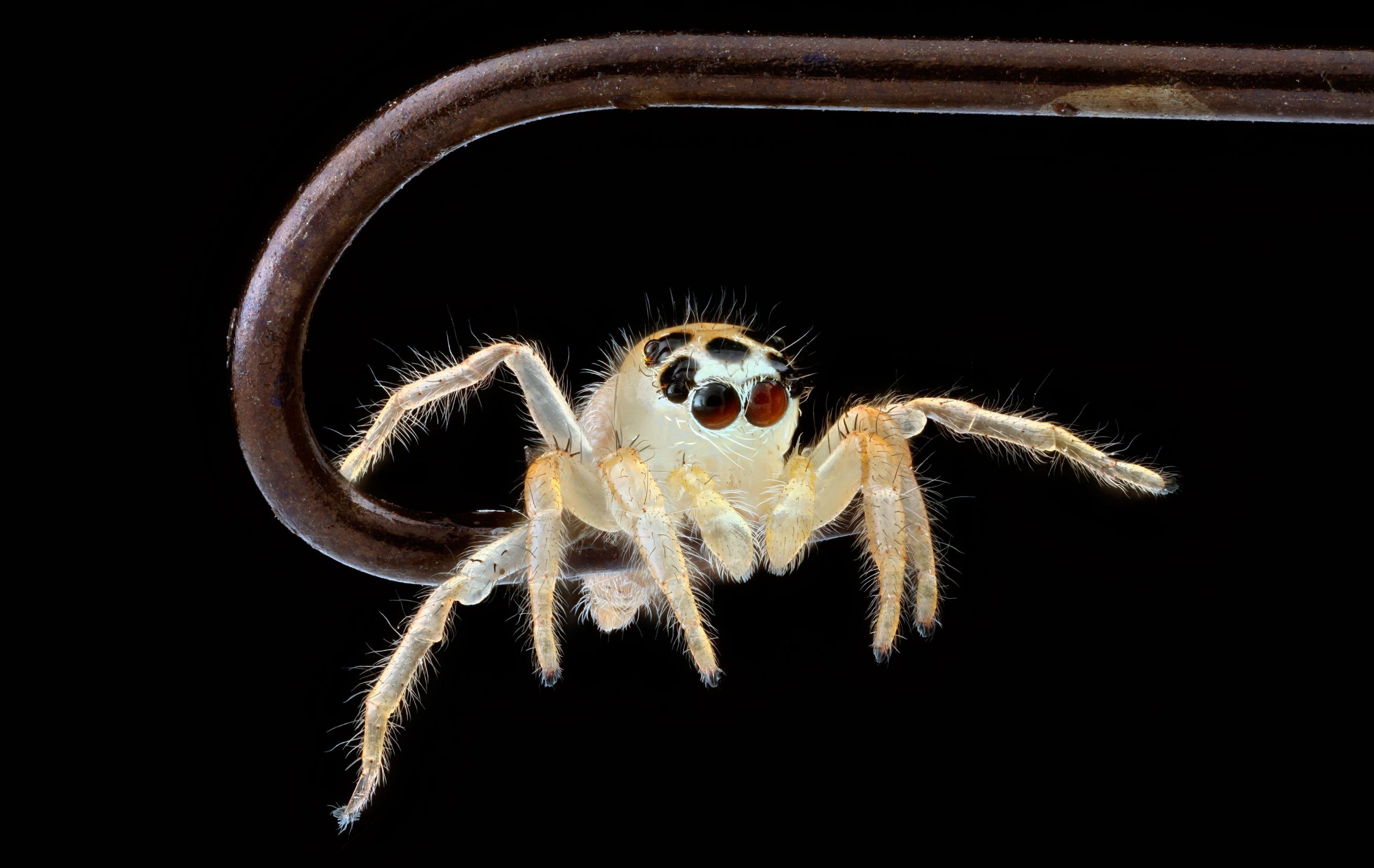
    Unknown Jumping Spider
    Unknown Jumping spider, August 2012, Beltsville, Maryland, Benjamin A Coulter helped narrow this down to perhaps an immature Thiodina sylvana. Credit: Sam Droege, USGS Bee Inventory and Monitoring Lab, Flickr

    Ability to identify other animals from relative positioning of the joints not unique to vertebrates.

    Jumping spiders can distinguish living from non-living objects in their peripheral vision using the same cues used by humans and other vertebrate animals, according to a study published on July 15,  2021, in the open-access journal PLOS Biology by Massimo De Agrò of Harvard University in the United States.

    The ability to detect other living creatures in your surroundings is a key skill for any animal — it is crucial for finding mates, avoiding predators, and catching prey. The movements of vertebrates and invertebrates are distinct from inanimate objects because their rigid, jointed bones and exoskeletons constrain the relative positioning of certain body parts. Most vertebrates can recognize this biological pattern of movement from very limited visual information, such as a point-light display, which shows dots representing the positions of the main joints.

    To investigate this phenomenon in invertebrates for the first time, researchers partially restrained 60 wild-caught jumping spiders (Menemerus semilimbatus) on a spherical treadmill and used a computer screen to show point-light displays on each side of their peripheral vision (only visible to their lateral eyes). They found that spiders were more likely to try to turn and face displays that showed random movements, compared to those that moved in a more biological way, with the distances between joints constrained.

    Evolutionary Implications of Visual Perception

    The result seems contrary to the expectation that spiders should focus their attention on objects in their surroundings that appear to be living — potential prey, mate or predator. However, the authors suggest that this behavior may allow the spiders to focus their forward-facing primary eyes on unidentifiable objects to get a better look. Complex vision evolved independently in vertebrates and arthropods and so the ability to distinguish living from non-living motion using the relative positioning of the joints has most likely arisen convergently in the two groups of animals.

    “Jumping spiders’ secondary eyes confirm themselves to be a marvelous tool,” the researchers add. “In this experiment, we observed how they alone can tell apart living from non-living organisms, using the semi-rigid pattern of motion that characterize the formers and without the aid of any shape cue. Finding the presence of this skill, previously known only in vertebrates, opens up new and exciting perspectives on the evolution of visual perception. My co-authors and I can’t wait to see what other visual cues can be perceived and understood by these tiny creatures.”

    Reference: “Perception of biological motion by jumping spiders” by Massimo De Agrò, Daniela C. Rößler, Kris Kim and Paul S. Shamble, 15 July 2021, PLOS Biology.
    DOI: 10.1371/journal.pbio.3001172

    Never miss a breakthrough: Join the SciTechDaily newsletter.
    Follow us on Google and Google News.

    Biomechanics Evolution PLOS Spiders Vision
    Share. Facebook Twitter Pinterest LinkedIn Email Reddit

    Related Articles

    Revealing the “Waist-Less” Gene: A Breakthrough in Spider Biology

    Harvard Researchers Discover a New Real-Life Spidey Sense

    Evolution of One of the Fastest Jaws in the Natural World: Function Before Form in Trap-Jaw Ants

    Hummingbirds See Spectacular Colors Humans Can Only Imagine – Comparatively, We’re Color-Blind

    Scientists Built an Underwater Theater and Attached 3D Glasses to Cuttlefish – Here’s What They Learned

    Fascinating Experiment Shows Orb-Weaver Spiders’ Distinct Yellow/Black Pattern Essential for Luring Prey

    Jaw-Some Wombats: Flexible Jaws May Help Wombats Survive Change

    Females Distinguish Colors Better While Men Excel At Tracking Fast Moving Objects

    Adanson’s Jumping Spiders Hunt Using Unusual Depth Perception

    1 Comment

    1. Smudgy on July 24, 2021 10:42 pm

      This isnt true. theres a youtube channel called Deep Look (PBS) and they show the spiders cant tell the difference…..like, on video..
      This is extremely misleading to the point you could just say, “nope, not true.”

      Reply
    Leave A Reply Cancel Reply

    • Facebook
    • Twitter
    • Pinterest
    • YouTube

    Don't Miss a Discovery

    Subscribe for the Latest in Science & Tech!

    Trending News

    The Strange “Spacetime Crystal” That Can Suddenly Turn Into a Black Hole

    The Surprising Way Asteroids May Have Helped Life Begin on Earth

    Vast Hidden Structure Discovered Under Miles of Ice in East Antarctica

    A Surprising Discovery Suggests Autism Is Not One Condition

    New Alzheimer’s Discovery Could Change How Scientists Fight the Disease

    Yale Discovery Overturns Long-Held “Evolutionary Dead End” Theory

    UCLA Scientists Uncover a “Hidden Weakness” in Some of the World’s Deadliest Cancers

    Humpback Whale Stuns Scientists With 15,000 Kilometer Journey Across Oceans

    Follow SciTechDaily
    • Facebook
    • Twitter
    • YouTube
    • Pinterest
    • Newsletter
    • RSS
    SciTech News
    • Biology News
    • Chemistry News
    • Earth News
    • Health News
    • Physics News
    • Science News
    • Space News
    • Technology News
    Recent Posts
    • Food Waste Becomes a Powerful Carbon Trap in Climate Breakthrough
    • Battery-Free Artificial Photosynthesis Turns Sunlight, Water, and CO2 Into Fuel
    • How Ancient People Moved a 6-Ton Stone 700 Kilometers to Stonehenge
    • Scientists Finally See How Antibodies Really Attack Viruses
    • The Unexpected Gut Health Risk of Cutting Out Sugar
    Copyright © 1998 - 2026 SciTechDaily. All Rights Reserved.
    • Science News
    • About
    • Contact
    • Editorial Board
    • Privacy Policy
    • Terms of Use

    Type above and press Enter to search. Press Esc to cancel.