

NASA’s Perseverance rover, with help from QUT scientists, has uncovered layered evidence of ancient water activity beneath the Martian surface, using a groundbreaking crystal-mapping technique.
This new approach reveals not one, but two separate mineral-forming events, hinting at multiple potentially life-supporting environments in Mars’ deep past. The discovery, made in the Shenandoah formation, strengthens the case for ancient habitability — and boosts Australia’s growing role in space exploration.
Martian Clues Beneath the Surface
A research team led by Queensland University of Technology has uncovered strong evidence of multiple mineral-forming events just beneath the surface of Mars, using data from NASA’s Perseverance rover. The discovery brings scientists a step closer to answering one of the biggest questions in planetary science: did life ever exist on Mars?
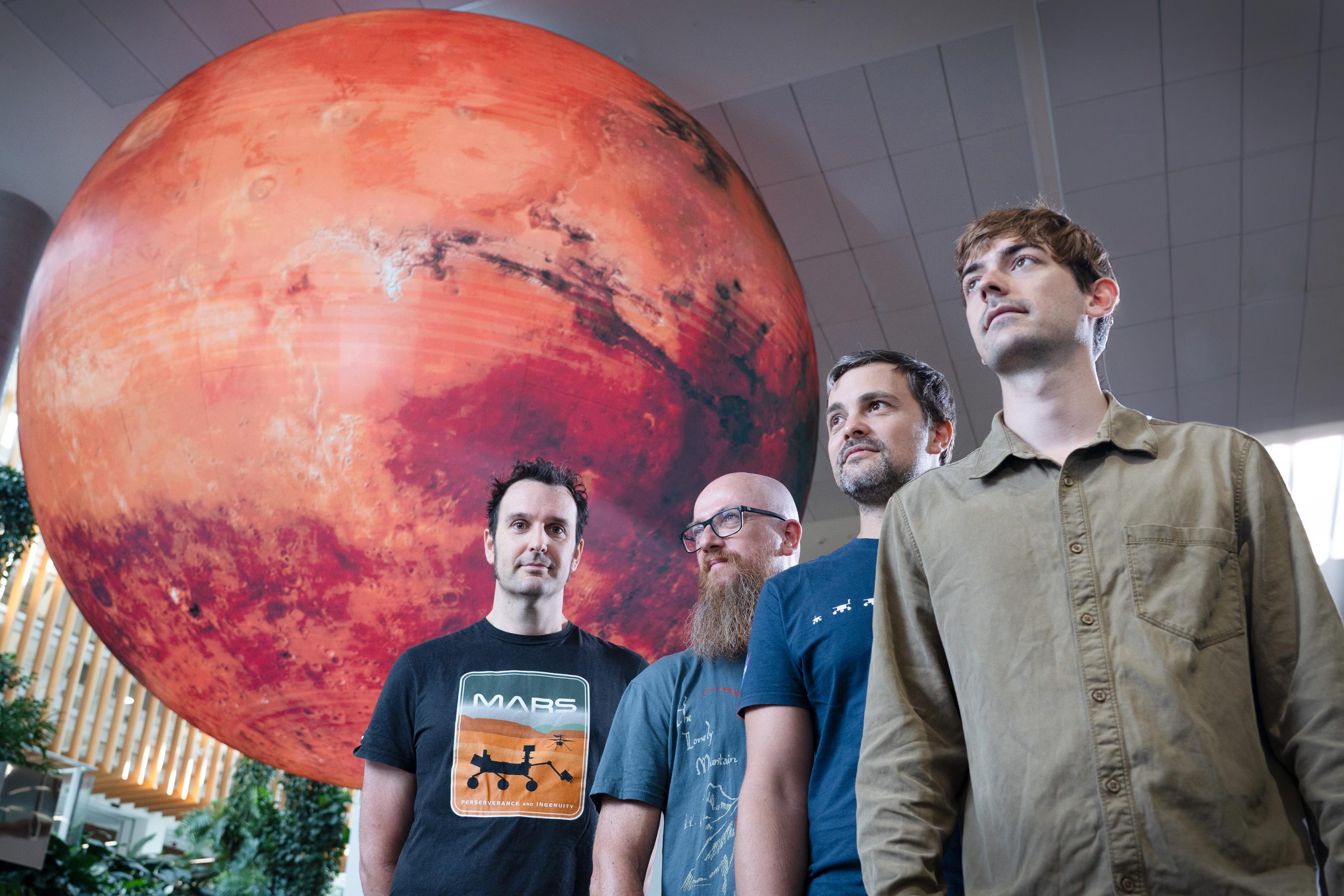
The team, headed by Dr. Michael Jones from QUT’s Central Analytical Research Facility and the School of Chemistry and Physics, includes Associate Professors David Flannery and Christoph Schrank, along with Brendan Orenstein, Peter Nemere, and collaborators from North America and Europe.
Their findings were published on April 16 in the journal Science Advances.
Mapping Water’s Ancient Footprints
“Sulfate minerals exist with different amounts of water in most regions on Mars and allow us to understand how water moved around the planet, which is key to understanding its past habitability,” Dr. Jones said.
“However, we don’t yet fully understand how or when these minerals formed. Our team found a way to measure the internal crystal structure of these minerals directly in the rock, which had thought to be impossible on the surface of Mars.”
The team adapted a new analytical method called X-ray Backscatter Diffraction Mapping (XBDM) developed by Dr. Jones and Professor Schrank at the Australian Synchrotron to Perseverance’s onboard PIXL instrument, developed by QUT alumna Abigail Allwood.
Fingerprints of Martian History
This allowed the team to determine the orientation of the crystal structures, essentially providing a fingerprint of how and when they grew, and what the environment on Mars was like at that time.
Two separate generations of calcium-sulfate minerals were uncovered at Hogwallow Flats and Yori Pass in the Shenandoah formation, part of the sedimentary fan in Jezero crater: one formed just beneath the surface and the other formed deeper underground, at least 80 meters down.
Life-Friendly Windows in Mars’ Timeline
“This discovery highlights the diversity of environments that existed in the Shenandoah formation’s history — indicating multiple potential windows when life might have been possible on Mars,” Dr. Jones said.
Since its landing in Jezero Crater in February 2021, the Perseverance rover has been exploring a wide variety of Martian rock types, from ancient lava flows to sedimentary layers left behind by a long-vanished lake and river delta.
One of its key mission goals is to study environments that could have supported microbial life – and collect samples that might someday be returned to Earth.
QUT’s Role in the Red Planet’s Story
The QUT research team is part of the multidisciplinary QUT Planetary Surface Exploration Research Group, which focuses on interplanetary science and is actively involved in projects within NASA and the Australian Space Agency.
Professor Flannery, long-term planner for the NASA Perseverance mission, said QUT is at the forefront of planetary science in Australia.
“Experience gained by QUT researchers exposed to the cutting edge of the robotics, automation, data science, and astrobiology fields has the potential to kick start Australia’s space industry,” he said.
Reference: “In situ crystallographic mapping constrains sulfate precipitation and timing in Jezero crater, Mars” by Michael W. M. Jones, David T. Flannery, Joel A. Hurowitz, Mike T. Tice, Christoph E. Schrank, Abigail C. Allwood, Nicholas J. Tosca, David C. Catling, Scott J. VanBommel, Abigail L. Knight, Briana Ganly, Kirsten L. Siebach, Kathleen C. Benison, Adrian P. Broz, Maria-Paz Zorzano, Chris M. Heirwegh, Brendan J. Orenstein, Benton C. Clark, Kimberly P. Sinclair, Andrew O. Shumway, Lawrence A. Wade, Scott Davidoff, Peter Nemere, Austin P. Wright, Adrian E. Galvin, Nicholas Randazzo, Jesús Martinez-Frias and Lauren P. O’Neil, 16 April 2025, Science Advances.
DOI: 10.1126/sciadv.adt3048
Never miss a breakthrough: Join the SciTechDaily newsletter.
Follow us on Google and Google News.