
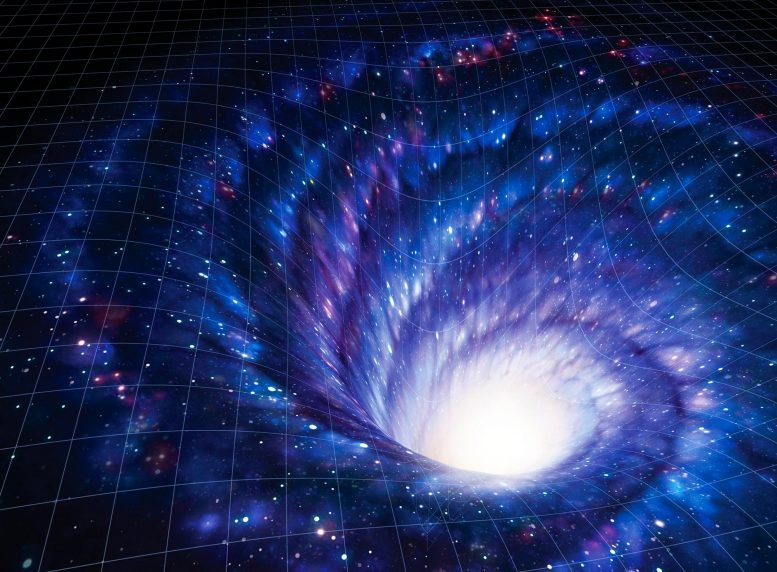
In a theoretical study, physicists propose that perturbations in the orbit of stars near supermassive black holes could be used to detect wormholes.
A new study outlines a method for detecting a speculative phenomenon that has long captured the imagination of sci-fi fans: wormholes, which form a passage between two separate regions of spacetime.
Such pathways could connect one area of our universe to a different time and/or place within our universe, or to a different universe altogether.
Whether wormholes exist is up for debate. But in a paper published on October 10, 2019, in Physical Review D, physicists describe a technique for detecting these bridges.
The method focuses on spotting a wormhole around Sagittarius A*, an object that’s thought to be a supermassive black hole at the heart of the Milky Way galaxy. While there’s no evidence of a wormhole there, it’s a good place to look for one because wormholes are expected to require extreme gravitational conditions, such as those present at supermassive black holes.
In the new paper, scientists write that if a wormhole does exist at Sagittarius A*, nearby stars would be influenced by the gravity of stars at the other end of the passage. As a result, it would be possible to detect the presence of a wormhole by searching for small deviations in the expected orbit of stars near Sagittarius A*.
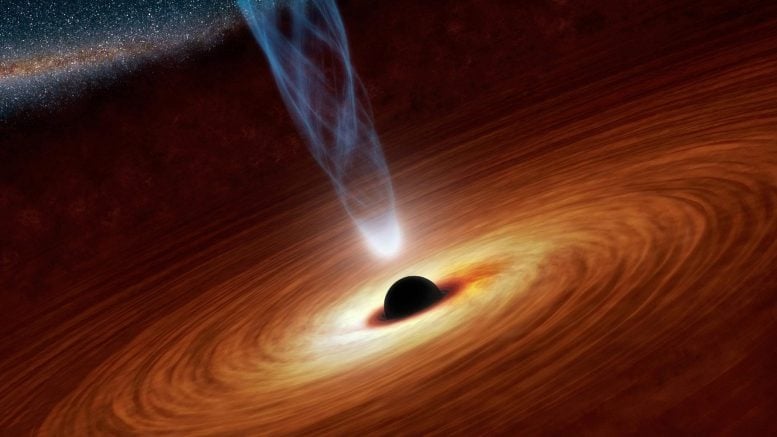
“If you have two stars, one on each side of the wormhole, the star on our side should feel the gravitational influence of the star that’s on the other side. The gravitational flux will go through the wormhole,” says Dejan Stojkovic, Ph.D., cosmologist and professor of physics at the University at Buffalo College of Arts and Sciences. “So if you map the expected orbit of a star around Sagittarius A*, you should see deviations from that orbit if there is a wormhole there with a star on the other side.”
Stojkovic conducted the study with first author De-Chang Dai, Ph.D., of Yangzhou University in China and Case Western Reserve University.
A close look at S2, a star orbiting Sagittarius A*
Stojkovic notes that if wormholes are ever discovered, they’re not going to be the kind that science fiction often envisions.
“Even if a wormhole is traversable, people and spaceships most likely aren’t going to be passing through,” he says. “Realistically, you would need a source of negative energy to keep the wormhole open, and we don’t know how to do that. To create a huge wormhole that’s stable, you need some magic.”
Nevertheless, wormholes — traversable or not — are an interesting theoretical phenomenon to study. While there is no experimental evidence that these passageways exist, they are possible — according to theory. As Stojkovic explains, wormholes are “a legitimate solution to Einstein’s equations.”
The research in Physical Review D focuses on how scientists could hunt for a wormhole by looking for perturbations in the path of S2, a star that astronomers have observed orbiting Sagittarius A*.
While current surveillance techniques are not yet precise enough to reveal the presence of a wormhole, Stojkovic says that collecting data on S2 over a longer period of time or developing techniques to track its movement more precisely would make such a determination possible. These advancements aren’t too far off, he says, and could happen within one or two decades.
Stojkovic cautions, however, that while the new method could be used to detect a wormhole if one is there, it will not strictly prove that a wormhole is present.
“When we reach the precision needed in our observations, we may be able to say that a wormhole is the most likely explanation if we detect perturbations in the orbit of S2,” he says. “But we cannot say that, ‘Yes, this is definitely a wormhole.’ There could be some other explanation, something else on our side perturbing the motion of this star.”
Though the paper focuses on traversable wormholes, the technique it outlines could indicate the presence of either a traversable or non-traversable wormhole, Stojkovic says. He explains that because gravity is the curvature of spacetime, the effects of gravity are felt on both sides of a wormhole, whether objects can pass through or not.
###
Reference: “Observing a wormhole” by De-Chang Dai and Dejan Stojkovic, 10 October 2019, Physical Review D.
DOI: 10.1103/PhysRevD.100.083513
Dai’s work was supported by the National Science Foundation of China, the National Basic Research Program of China, the Shanghai Academic/Technology Research Leader program, and Stojkovic’s work by the U.S. National Science Foundation.
Never miss a breakthrough: Join the SciTechDaily newsletter.
Follow us on Google and Google News.