
Close Menu
    Facebook X (Twitter) Instagram
    SciTechDaily
    • Biology
    • Chemistry
    • Earth
    • Health
    • Physics
    • Science
    • Space
    • Technology
    Facebook X (Twitter) Pinterest YouTube RSS
    SciTechDaily
    Home»Space»Hubble Captures a Stunning Cosmic Cloud That Builds Stars
    Space

    Hubble Captures a Stunning Cosmic Cloud That Builds Stars

    By ESA/HubbleFebruary 10, 20252 Comments2 Mins Read
    Facebook Twitter Pinterest Telegram LinkedIn WhatsApp Email Reddit
    Share
    Facebook Twitter LinkedIn Pinterest Telegram Email Reddit
    Swirling Clouds of Gas and Dust Near Tarantula Nebula
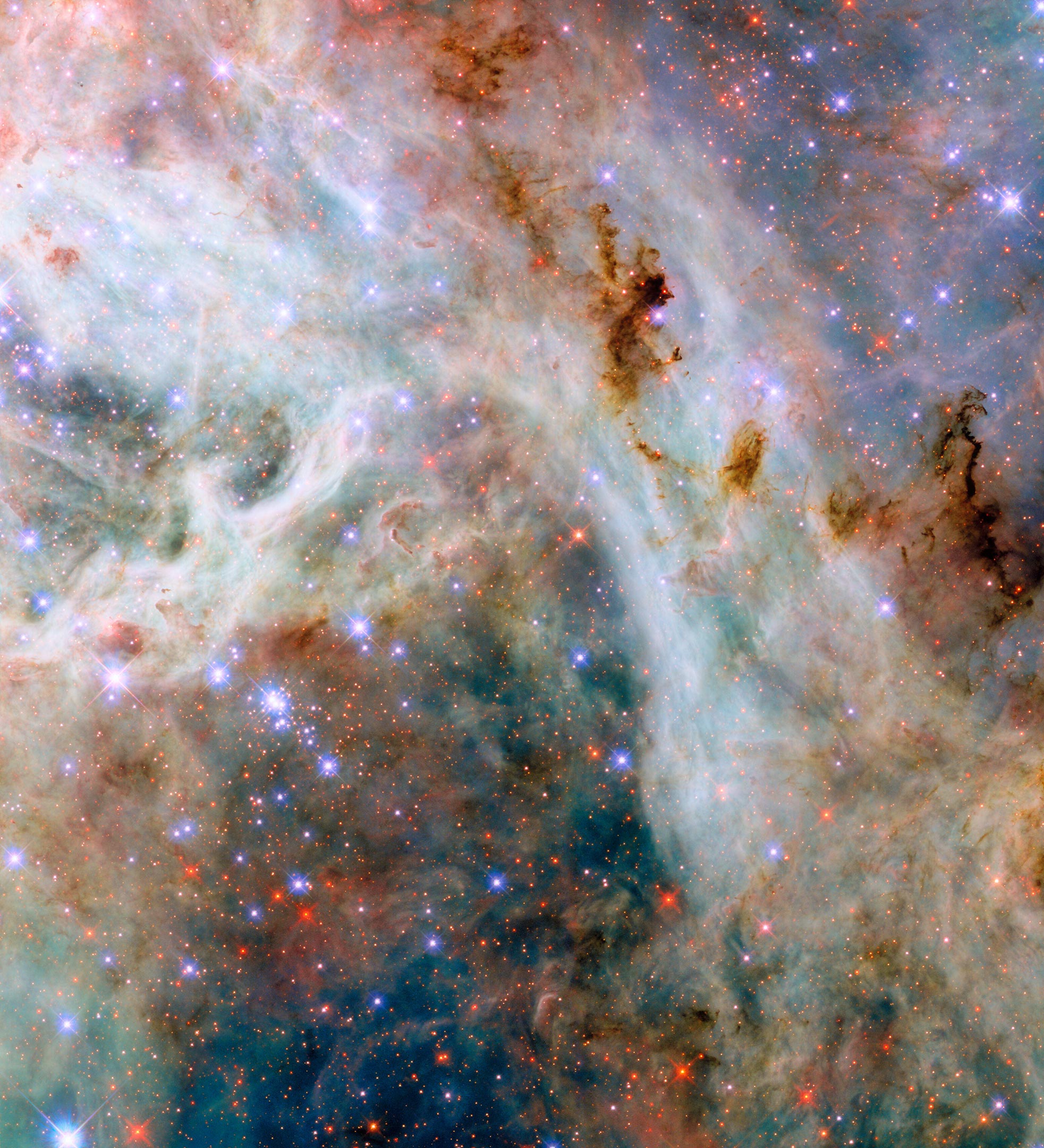
    Hubble’s latest image reveals the Tarantula Nebula’s mesmerizing swirls of cosmic dust, a key ingredient in the formation of stars and planets. Unlike Earthly dust, this celestial material consists of silicates and carbon, playing a crucial role in cooling gas clouds and sparking new molecular bonds across the Universe. Credit: ESA/Hubble & NASA, C. Murray

    The Universe is full of dust, and a striking new image from the Hubble Space Telescope highlights just how important it is. The image showcases swirling clouds of gas and dust near the Tarantula Nebula, a vast star-forming region within the Large Magellanic Cloud — a neighboring galaxy located about 160,000 light-years away in the constellations Dorado and Mensa. The Tarantula Nebula is the most active stellar nursery in our cosmic neighborhood, producing some of the most massive stars ever observed.

    These colorful clouds are threaded with delicate tendrils and dense, dark patches of dust. Unlike the dust found in homes — made up of skin cells, soil, and even plastic — cosmic dust consists mainly of carbon and silicate molecules, which contain silicon and oxygen. The data used to create this image come from an ongoing research project aimed at studying the properties of cosmic dust in the Large Magellanic Cloud and other nearby galaxies.

    Dust plays several important roles in the Universe. Even though individual dust grains are incredibly tiny, far smaller than the width of a single human hair, dust grains in discs around young stars clump together to form larger grains and eventually planets. Dust also helps cool clouds of gas so that they can condense into new stars. Dust even plays a role in making new molecules in interstellar space, providing a venue for individual atoms to find each other and bond together in the vastness of space.

    Never miss a breakthrough: Join the SciTechDaily newsletter.
    Follow us on Google and Google News.

    Astronomy Hubble Space Telescope
    Share. Facebook Twitter Pinterest LinkedIn Email Reddit

    Related Articles

    Hubble Views Magnificent Lopsided Galaxy NGC 2276

    Hubble Captures Fantastic Detail of Eponymous Spiral Galaxy NGC 691

    Spectacular Image Captured by Hubble Shows a Strangely Contorted Spiral Galaxy

    A Distant Spiral in Virgo: Extraordinary Detail Seen in a Galaxy 150 Million Light-Years Away From Earth

    Magnetic Monsters: Hubble Tracks Down Location of Mysterious Radio Signals From Intergalactic Space

    A Menagerie of Galaxies: Hubble Captures a Cluster With Galaxies of All Shapes and Sizes

    How Habitable Are Planets That Orbit Red Dwarfs – The Most Common Type of Stars in the Galaxy?

    Cosmic Silver Lining: Hubble Spots V565 Surrounded by Four Prominent Diffraction Spikes

    Our Giant Universe: Hubble Spots Massive Galaxy Cluster With a Wealth of Exciting Possibilities

    2 Comments

    1. Freddy on February 11, 2025 2:59 am

      A clear picture of what just happened please

      Reply
    2. Clinton Jay Sumapig Cabrera on February 11, 2025 8:17 am

      I think its road to supply what needs to planets and aviod danger dont be judge what you see…

      Reply
    Leave A Reply Cancel Reply

    • Facebook
    • Twitter
    • Pinterest
    • YouTube

    Don't Miss a Discovery

    Subscribe for the Latest in Science & Tech!

    Trending News

    Your Blood Pressure Reading Could Be Wrong Because of One Simple Mistake

    Astronomers Stunned by Ancient Galaxy With No Spin

    Physicists May Be on the Verge of Discovering “New Physics” at CERN

    Scientists Solve 320-Million-Year Mystery of Reptile Skin Armor

    Scientists Say This Daily Walking Habit May Be the Secret to Keeping Weight Off After Dieting

    New Therapy Rewires the Brain To Restore Joy in Depression Patients

    Giant Squid Detected off Western Australia in Stunning Deep-Sea Discovery

    Popular Sugar-Free Sweetener Linked to Liver Disease, Study Warns

    Follow SciTechDaily
    • Facebook
    • Twitter
    • YouTube
    • Pinterest
    • Newsletter
    • RSS
    SciTech News
    • Biology News
    • Chemistry News
    • Earth News
    • Health News
    • Physics News
    • Science News
    • Space News
    • Technology News
    Recent Posts
    • New Stroke Study Challenges Decades-Old Medical Beliefs
    • These Simple Plant Foods Are Linked to Lower Blood Pressure
    • Common Blood Pressure Drug Supercharges Cancer Treatment in Surprising New Study
    • Key Magic Mushroom Ingredient Increases Laziness and Reduces Aggression
    • Researchers Solve 15-Year Mystery Behind Cancer-Causing Gut Toxin
    Copyright © 1998 - 2026 SciTechDaily. All Rights Reserved.
    • Science News
    • About
    • Contact
    • Editorial Board
    • Privacy Policy
    • Terms of Use

    Type above and press Enter to search. Press Esc to cancel.