
Close Menu
    Facebook X (Twitter) Instagram
    SciTechDaily
    • Biology
    • Chemistry
    • Earth
    • Health
    • Physics
    • Science
    • Space
    • Technology
    Facebook X (Twitter) Pinterest YouTube RSS
    SciTechDaily
    Home»Space»Hubble Gazes on Ring Galaxy Zw II 28
    Space

    Hubble Gazes on Ring Galaxy Zw II 28

    By NASAMarch 18, 2013No Comments2 Mins Read
    Facebook Twitter Pinterest Telegram LinkedIn WhatsApp Email Reddit
    Share
    Facebook Twitter LinkedIn Pinterest Telegram Email Reddit
    Hubble Views Ring Galaxy Zw II 28
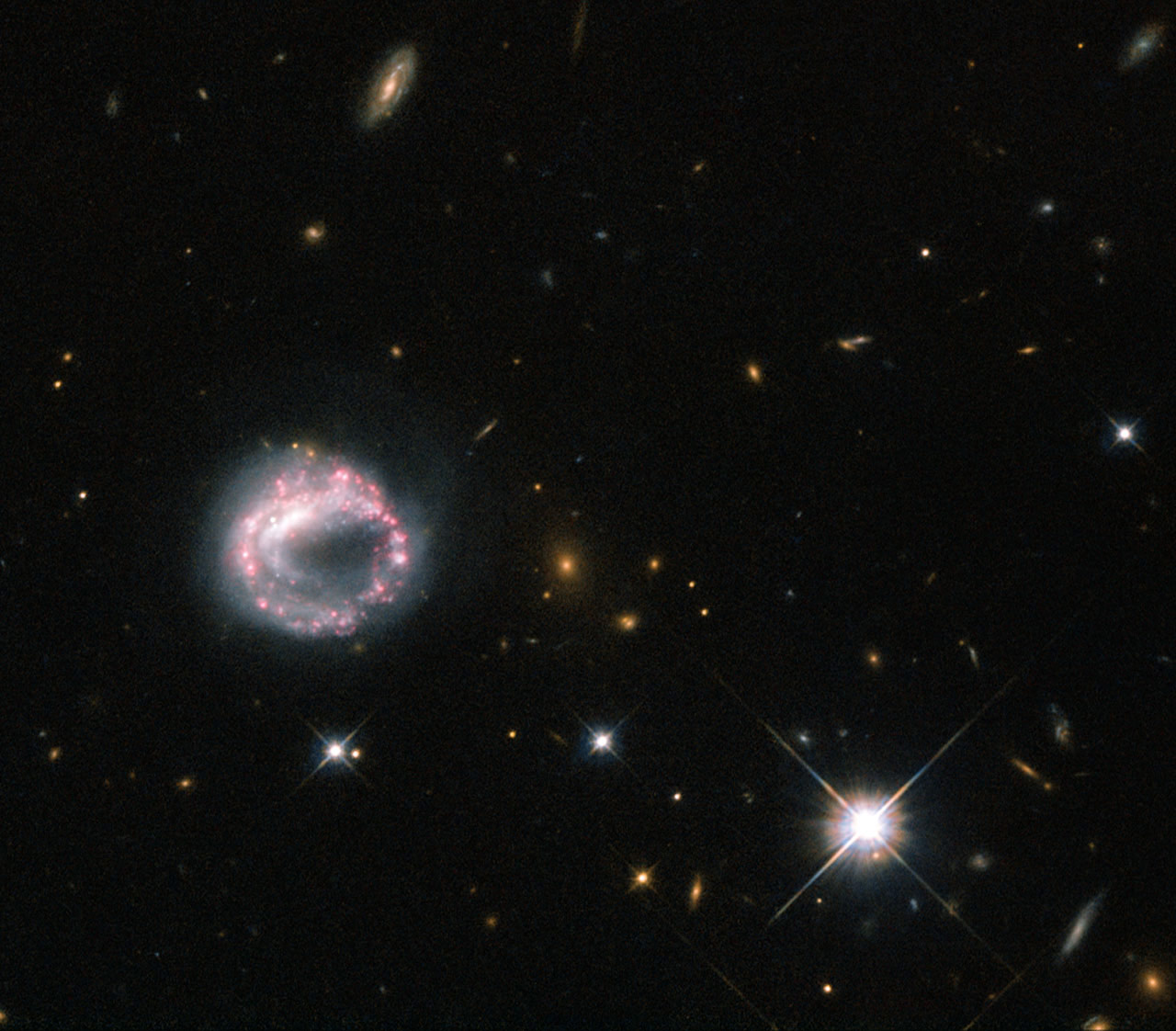
    Hubble Space Telescope image of ring galaxy Zw II 28. Credit: European Space Agency

    Hubble takes a closer look at ring galaxy Zw II 28 in this newly released image.

    Galaxies can take many forms — elliptical blobs, swirling spiral arms, bulges, and disks are all known components of the wide range of galaxies we have observed using telescopes like the NASA/ESA Hubble Space Telescope. However, some of the more intriguing objects in the sky around us include ring galaxies like the one pictured above — Zw II 28.

    Ring galaxies are mysterious objects. They are thought to form when one galaxy slices through the disk of another, larger, one — as galaxies are mostly empty space, this collision is not as aggressive or as destructive as one might imagine. The likelihood of two stars physically colliding is minimal, and it is instead the gravitational effects of the two galaxies that cause the disruption.

    This disruption upsets the material in both galaxies, and redistributes it forming a dense central core, encircled by bright stars. All this commotion causes clouds of gas and dust to collapse and triggers new periods of intense star formation in the outer ring, which is full of hot, young, blue stars and regions that are actively giving rise to new stars.

    The sparkling pink and purple loop of Zw II 28 is not a typical ring galaxy due to its lack of a visible central companion. For many years it was thought to be a lone circle on the sky, but observations using Hubble have shown that there may be a possible companion lurking just inside the ring, where the loop appears to double back on itself. The galaxy has a knot-like, swirling ring structure, with some areas appearing much brighter than others.

    Never miss a breakthrough: Join the SciTechDaily newsletter.
    Follow us on Google and Google News.

    Astronomy Astrophysics European Space Agency Hubble Space Telescope
    Share. Facebook Twitter Pinterest LinkedIn Email Reddit

    Related Articles

    Hubble Captures a Dangerous Dance Over 100 Million Light-Years From Earth

    Hubble Captures the Final Acts of a Monster Star

    Hubble Find Surprises Astronomers: White Dwarfs Can Still Undergo Stable Thermonuclear Activity

    First Evidence of Water Vapor at Jupiter’s Moon Ganymede – May Hold More Water Than All of Earth’s Oceans

    Our Giant Universe: Hubble Spots Massive Galaxy Cluster With a Wealth of Exciting Possibilities

    Tantrums of a Baby Star: Herbig-Haro Objects

    Unexpected Discovery: Hubble Space Telescope Uncovers Concentration of Small Black Holes

    “Unprecedented” – Unusual Planetary Nebula Fades Mere Decades After It Arrived

    Hubble Captures Unprecedented Fading of Stingray Nebula – “This Is Very, Very Dramatic, and Very Weird”

    Leave A Reply Cancel Reply

    • Facebook
    • Twitter
    • Pinterest
    • YouTube

    Don't Miss a Discovery

    Subscribe for the Latest in Science & Tech!

    Trending News

    New Study Reveals Why Ozempic Works Better for Some People Than Others

    Climate Change Is Altering a Key Greenhouse Gas in a Way Scientists Didn’t Expect

    New Study Suggests Gravitational Waves May Have Created Dark Matter

    Scientists Discover Why the Brain Gets Stuck in Schizophrenia

    Scientists Engineer “Tumor-Eating” Bacteria That Devour Cancer From Within

    Even “Failed” Diets May Deliver Long-Term Health Gains, Study Finds

    NIH Scientists Discover Powerful New Opioid That Relieves Pain Without Dangerous Side Effects

    Collapsing Plasma May Hold the Key to Cosmic Magnetism

    Follow SciTechDaily
    • Facebook
    • Twitter
    • YouTube
    • Pinterest
    • Newsletter
    • RSS
    SciTech News
    • Biology News
    • Chemistry News
    • Earth News
    • Health News
    • Physics News
    • Science News
    • Space News
    • Technology News
    Recent Posts
    • The Surprising Reason You Might Want To Sleep Without a Pillow
    • Household Cats Could Hold the Secret to Fighting Breast Cancer
    • Scientists Say This Natural Hormone Reverses Obesity by Targeting the Brain
    • This 15,000-Year-Old Discovery Changes What We Know About Early Human Creativity
    • 35-Million-Year-Old Mystery: Strange Arachnid Discovered Preserved in Amber
    Copyright © 1998 - 2026 SciTechDaily. All Rights Reserved.
    • Science News
    • About
    • Contact
    • Editorial Board
    • Privacy Policy
    • Terms of Use

    Type above and press Enter to search. Press Esc to cancel.