
Close Menu
    Facebook X (Twitter) Instagram
    SciTechDaily
    • Biology
    • Chemistry
    • Earth
    • Health
    • Physics
    • Science
    • Space
    • Technology
    Facebook X (Twitter) Pinterest YouTube RSS
    SciTechDaily
    Home»Space»Hubble Image of the Week – Monster in the Deep
    Space

    Hubble Image of the Week – Monster in the Deep

    By Mathias Jäger, ESA/HubbleApril 30, 2018No Comments2 Mins Read
    Facebook Twitter Pinterest Telegram LinkedIn WhatsApp Email Reddit
    Share
    Facebook Twitter LinkedIn Pinterest Telegram Email Reddit
    Hubble Views a Giant Galaxy Custer
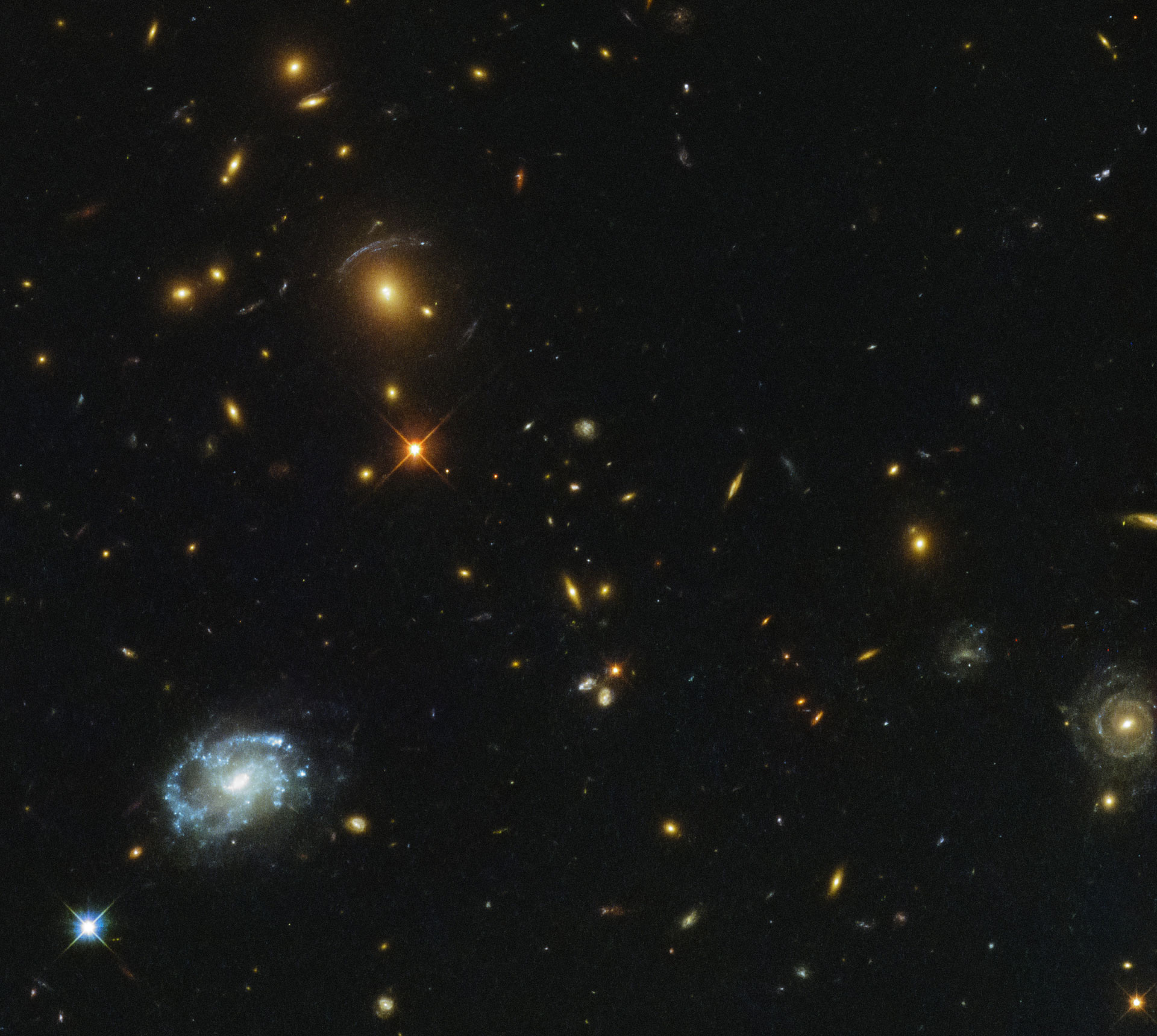
    The light from distant galaxies in the upper part of the frame has been distorted into odd shapes, arcs, and streaks, indicating the presence of a massive galaxy cluster that bends the light from galaxies behind it due to its formidable gravitational force. Credit: ESA/Hubble & NASA, Acknowledgment: Judy Schmidt

    Though the bright, light-speckled foreground galaxy on the left is eye-catching, it is far from the most intriguing object in this NASA/ESA Hubble Space Telescope image. In the upper part of the frame, the light from distant galaxies has been smeared and twisted into odd shapes, arcs, and streaks. This phenomenon indicates the presence of a giant galaxy cluster, which is bending the light coming from the galaxies behind it with its monstrous gravitational influence.

    This cluster, called SDSSJ0150+2725, lies some three billion light-years away and was first documented by the Sloan Digital Sky Survey (SDSS), hence its name. The SDSS uses a 2.5-meter optical telescope located at the Apache Point Observatory in New Mexico to observe millions of objects and create detailed 3D maps of the Universe. This particular cluster was part of the Sloan Giant Arcs Survey (SGAS), which detected galaxy clusters with strong lensing properties; their gravity stretches and warps the light of more distant galaxies sitting behind them, creating weird and spectacular arcs such as those seen here.

    The Hubble data on of SDSSJ0150+2725 were part of a study of star formation in brightest cluster galaxies (called BCGs), lying between approximately 2 and 6 billion light-years away. This study found the star formation rate in these galaxies to be low, which is consistent with models that suggest that most stars in such galaxies form very early on. These BCGs also emit strong radio signals thought to be from active galactic nuclei (AGN) at their centers, suggesting that the activity from both the AGN and any ongoing star formation is fuelled by cold gas found within the host galaxies.

    Never miss a breakthrough: Join the SciTechDaily newsletter.
    Follow us on Google and Google News.

    Astronomy Hubble Space Telescope
    Share. Facebook Twitter Pinterest LinkedIn Email Reddit

    Related Articles

    A Morphing Spiral Galaxy Amongst Friends

    Hubble Views Magnificent Lopsided Galaxy NGC 2276

    Hubble Captures Fantastic Detail of Eponymous Spiral Galaxy NGC 691

    Spectacular Image Captured by Hubble Shows a Strangely Contorted Spiral Galaxy

    A Distant Spiral in Virgo: Extraordinary Detail Seen in a Galaxy 150 Million Light-Years Away From Earth

    Magnetic Monsters: Hubble Tracks Down Location of Mysterious Radio Signals From Intergalactic Space

    A Menagerie of Galaxies: Hubble Captures a Cluster With Galaxies of All Shapes and Sizes

    How Habitable Are Planets That Orbit Red Dwarfs – The Most Common Type of Stars in the Galaxy?

    Cosmic Silver Lining: Hubble Spots V565 Surrounded by Four Prominent Diffraction Spikes

    Leave A Reply Cancel Reply

    • Facebook
    • Twitter
    • Pinterest
    • YouTube

    Don't Miss a Discovery

    Subscribe for the Latest in Science & Tech!

    Trending News

    Scientists Say This Natural Hormone Reverses Obesity by Targeting the Brain

    35-Million-Year-Old Mystery: Strange Arachnid Discovered Preserved in Amber

    Is AI Really Just a Tool? It Could Be Altering How You See Reality

    JWST Reveals a “Forbidden” Planet With a Baffling Composition

    The Protein “Sabotaging” Aging Muscle Recovery Could Be Key to Surviving Aging

    This Diet–Gut Interaction Could Transform Fat Into a Calorie-Burning Machine

    Scientists Discover Hidden Virus Linked to Colorectal Cancer

    Scientists Discover 132-Million-Year-Old Dinosaur Tracks on South Africa’s Coast

    Follow SciTechDaily
    • Facebook
    • Twitter
    • YouTube
    • Pinterest
    • Newsletter
    • RSS
    SciTech News
    • Biology News
    • Chemistry News
    • Earth News
    • Health News
    • Physics News
    • Science News
    • Space News
    • Technology News
    Recent Posts
    • Scientists Create “Optical Tornadoes” That Twist Light Into a Swirling Vortex
    • Scientists Uncover Hidden Superconductivity in Material Once Thought Only Magnetic
    • Scientists Baffled by Bizarre “Living Fossil” From 275 Million Years Ago
    • 500 Million Years Ago, Life Changed Forever: Scientists Reveal the DNA Changes That Helped Animals Move Onto Land
    • Surprise RNA Discovery Challenges Long-Held Beliefs About How Genes Work
    Copyright © 1998 - 2026 SciTechDaily. All Rights Reserved.
    • Science News
    • About
    • Contact
    • Editorial Board
    • Privacy Policy
    • Terms of Use

    Type above and press Enter to search. Press Esc to cancel.