
Close Menu
    Facebook X (Twitter) Instagram
    SciTechDaily
    • Biology
    • Chemistry
    • Earth
    • Health
    • Physics
    • Science
    • Space
    • Technology
    Facebook X (Twitter) Pinterest YouTube RSS
    SciTechDaily
    Home»Space»Hubble Image of the Week – Spiral Galaxy ESO 486-21
    Space

    Hubble Image of the Week – Spiral Galaxy ESO 486-21

    By SciTechDailyJune 19, 2017No Comments2 Mins Read
    Facebook Twitter Pinterest Telegram LinkedIn WhatsApp Email Reddit
    Share
    Facebook Twitter LinkedIn Pinterest Telegram Email Reddit
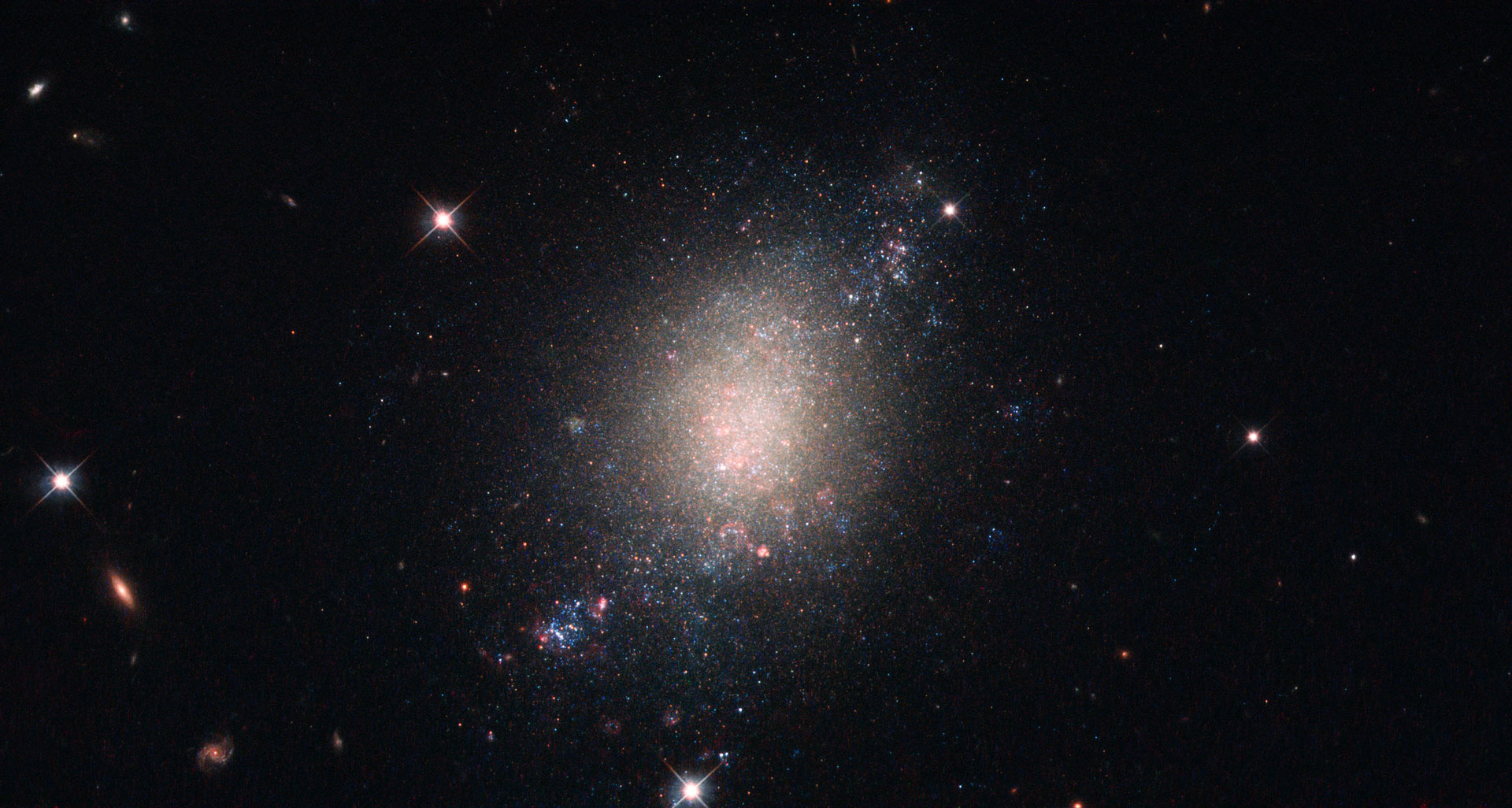
    Hubble Image of Spiral Galaxy ESO 486-21
    Located around 30 million light-years away from Earth, spiral galaxy ESO 486-21 has an ill-defined, somewhat irregular structure. Credit: ESA/Hubble & NASA

    This Hubble image of the week shows spiral galaxy ESO 486-21. ESO 486-21 is somewhat irregular with its ill-defined structure and is located some 30 million light-years from Earth.

    The NASA/ESA Hubble Space Telescope observed this object while performing a survey — the Legacy ExtraGalactic UV Survey (LEGUS) — of 50 nearby star-forming galaxies. The LEGUS sample was selected to cover a diverse range of galactic morphologies, star formation rates, galaxy masses, and more. Astronomers use such data to understand how stars form and evolve within clusters, and how these processes affect both their home galaxy and the wider Universe. ESO 486-21 is an ideal candidate for inclusion in such a survey as it is known to be in the process of forming new stars, which are created when large clouds of gas and dust (seen here in pink) within the galaxy crumple inwards upon themselves.

    LEGUS made use of Hubble’s Wide Field Camera 3 (WFC3) and Advanced Camera for Surveys (ACS). The WFC3 obtained detailed observations of the target objects while the ACS obtained what are known as parallel fields — instead of leaving ACS idle, it was instead trained on a small patch of sky just offset from the target field itself, allowing it to gather additional valuable information while the primary target was being observed by WFC3. Parallel fields played an important role in Hubble’s Frontier Fields program, which used the magnifying power of large galaxy clusters (via a phenomenon known as gravitational lensing) to explore objects in the distant Universe.


    Never miss a breakthrough: Join the SciTechDaily newsletter.
    Follow us on Google and Google News.

    Astronomy Hubble Space Telescope
    Share. Facebook Twitter Pinterest LinkedIn Email Reddit

    Related Articles

    A Morphing Spiral Galaxy Amongst Friends

    Hubble Views Magnificent Lopsided Galaxy NGC 2276

    Hubble Captures Fantastic Detail of Eponymous Spiral Galaxy NGC 691

    Spectacular Image Captured by Hubble Shows a Strangely Contorted Spiral Galaxy

    A Distant Spiral in Virgo: Extraordinary Detail Seen in a Galaxy 150 Million Light-Years Away From Earth

    Magnetic Monsters: Hubble Tracks Down Location of Mysterious Radio Signals From Intergalactic Space

    A Menagerie of Galaxies: Hubble Captures a Cluster With Galaxies of All Shapes and Sizes

    How Habitable Are Planets That Orbit Red Dwarfs – The Most Common Type of Stars in the Galaxy?

    Cosmic Silver Lining: Hubble Spots V565 Surrounded by Four Prominent Diffraction Spikes

    Leave A Reply Cancel Reply

    • Facebook
    • Twitter
    • Pinterest
    • YouTube

    Don't Miss a Discovery

    Subscribe for the Latest in Science & Tech!

    Trending News

    Why Popular Diabetes Drugs Like Ozempic Don’t Work for Everyone: The “Genetic Glitch”

    Scientists Stunned After Finding Plant Thought Extinct for 60 Years

    Scientists Discover Tiny New Spider That Hunts Prey 6x Its Size

    Natural Component From Licorice Shows Promise for Treating Inflammatory Bowel Disease

    Scientists Warn: Popular Sweetener Linked to Dangerous Metabolic Effects

    Monster Storms on Jupiter Unleash Lightning Beyond Anything on Earth

    Scientists Create “Liquid Gears” That Spin Without Touching

    The Simple Habit That Could Help Prevent Cancer

    Follow SciTechDaily
    • Facebook
    • Twitter
    • YouTube
    • Pinterest
    • Newsletter
    • RSS
    SciTech News
    • Biology News
    • Chemistry News
    • Earth News
    • Health News
    • Physics News
    • Science News
    • Space News
    • Technology News
    Recent Posts
    • Trees Emit Tiny Lightning Flashes During Storms and Scientists Finally Prove It
    • Forget Chemicals. This Plant Removes Microplastics From Water
    • Breakthrough Crystal Lets Scientists “Write” Nanoscale Patterns With Light
    • Pomegranate Compound Could Help Protect Against Heart Disease
    • Your Blood Test Might Already Show Alzheimer’s Risk
    Copyright © 1998 - 2026 SciTechDaily. All Rights Reserved.
    • Science News
    • About
    • Contact
    • Editorial Board
    • Privacy Policy
    • Terms of Use

    Type above and press Enter to search. Press Esc to cancel.