
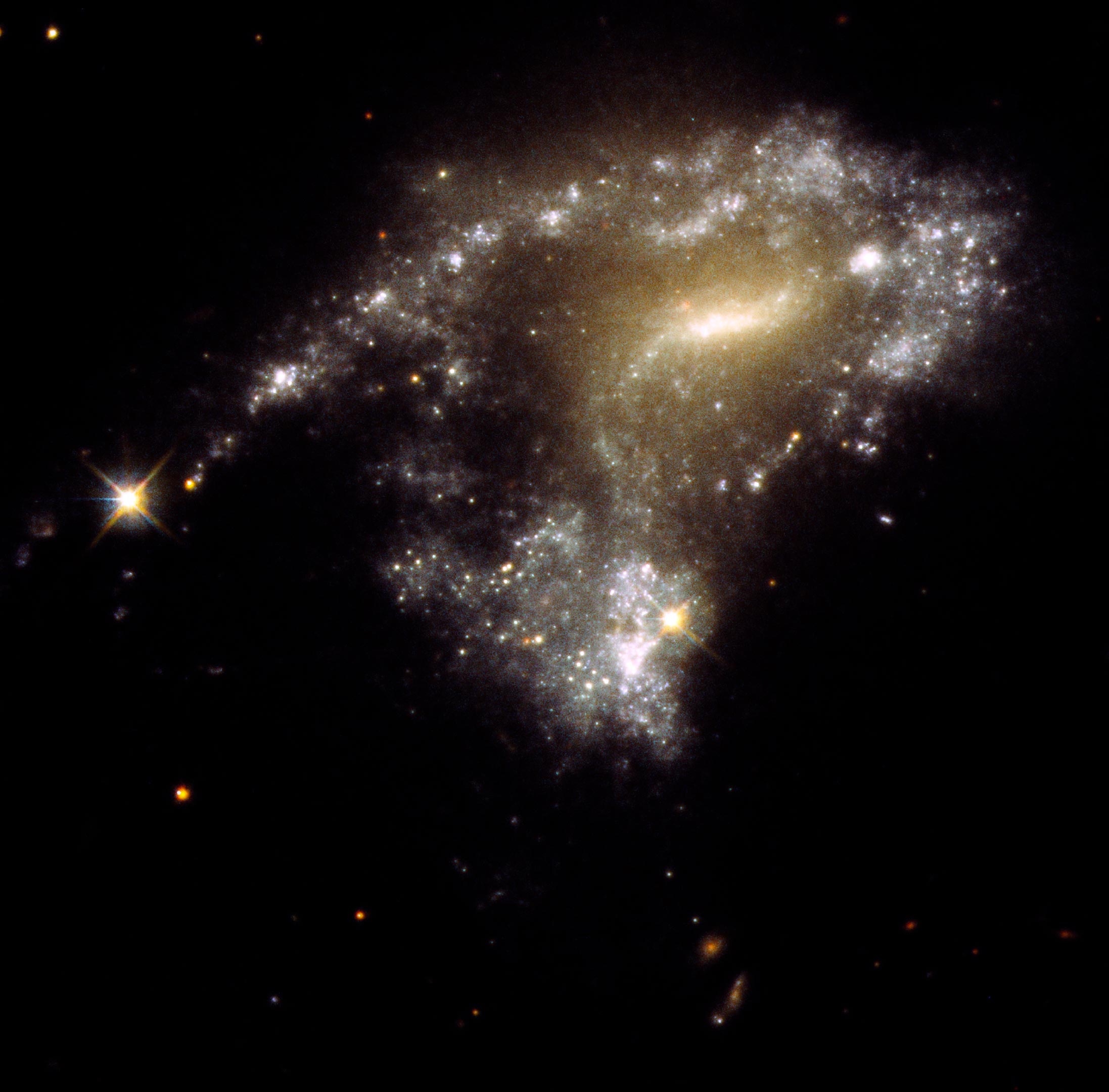
A study leveraging NASA’s Hubble Space Telescope has revealed that galaxy collisions, contrary to destroying stars, actually create conditions conducive to the formation of millions of stars.
The collision of galaxies does not destroy stars as one might initially think, but in fact creates the conditions to create millions of stars, and presumably accompanying planets. In a new study, a team led by Penn State researchers used NASA’s Hubble Space Telescope to home in on 12 galaxies that have long, tadpole-like tidal tails of gas, dust, and stars generated from such collisions. The team found 425 clusters of newborn stars along these tails, each containing as many as 1 million newborn stars.
Insights Into Star Formation
“As galaxies merge, clouds of gas collide and collapse, creating a high-pressure environment where stars could form,” said Jane Charlton, professor of astronomy and astrophysics at Penn State and a member of the research team. “The interiors of these mergers have been well studied, but less was known about possible star formation in the debris that results from these mergers, such as in the tidal tails.”
When galaxies interact, gravitational tidal forces pull out long streamers of gas and dust. The gravitational tug-of-war between the interacting galaxies stretches the galaxy’s spiral arm like taffy, and the star clusters along the tail appear almost like a string of pearls. Two well-known examples of galaxies with these tidal tails are the Antennae and Mice galaxies, each with long, narrow, finger-like projections.
Study Findings and Implications
In the new study, the research team used a combination of new observations and archival data from Hubble to determine the age and mass of star clusters within the 12 tidal tails. They then identified the rate of star formation using data from two ultraviolet space telescopes orbiting Earth, one aboard the now decommissioned Galaxy Evolution Explorer (Galex) and one aboard the Neil Gehrels Swift Observatory, whose Mission Operations Center is located at Penn State.
The team found that many of the tidal tail star clusters are very young — only 10 million years old. Additionally, the clusters seem to be forming at the same rate along the entirety of tails that stretch for thousands of light-years. They published their results in the Monthly Notices of the Royal Astronomical Society.
“It’s surprising to see lots of the young objects in the tails. It tells us a lot about cluster formation efficiency,” said lead author Michael Rodruck, lecturer and director of the Keeble Observatory at Randolph-Macon College in Ashland, Virginia, who was a graduate student at Penn State at the time of the research. “With tidal tails, you will build up new generations of stars that otherwise might not have existed.”
Before the mergers, the galaxies were rich in dusty clouds of molecular hydrogen that may have remained inert. As the clouds jostled and bumped into each other during the collision, the hydrogen was compressed to the point where it precipitated a firestorm of star birth.
According to the researchers, the fate of these strung-out clusters is uncertain. They may stay gravitationally intact and evolve into globular star clusters, such as those that orbit outside the plane of our Milky Way galaxy. Or they may disperse to form a halo of stars around a spiral galaxy or get cast off to become wandering intergalactic stars.
“We think that star clusters in tidal tails may have been more common in the early universe, when the universe was smaller and galaxy collisions were more frequent,” Charlton said.
For more on this study, see Galaxies Collide, Stars Awaken: Hubble’s Stunning Revelation.
Reference: “Star clusters in tidal debris” by Michael Rodruck, Jane Charlton, Sanchayeeta Borthakur, Aparna Chitre, Patrick R Durrell, Debra Elmegreen, Jayanne English, Sarah C Gallagher, Caryl Gronwall, Karen Knierman, Iraklis Konstantopoulos, Yuexing Li, Moupiya Maji, Brendan Mullan, Gelys Trancho and William Vacca, 29 September 2023, Monthly Notices of the Royal Astronomical Society.
DOI: 10.1093/mnras/stad2886
The research team at Penn State also included Caryl Gronwall, research professor of astronomy and astrophysics, and Yuexing Li, associate professor of astronomy and astrophysics. The team also included Sanchayeeta Borthakur and Karen Knierman at Arizona State University; Aparna Chitre at the Space Telescope Science Institute; Patrick R. Durrell at Youngstown State University; Debra Elmegreen at Vassar College; Jayanne English at the University of Manitoba; Sarah Gallagher at the University of Western Ontario; Iraklis Konstantopoulos, an independent scholar in New Zealand; Moupiya Maji at the Inter-University Centre for Astronomy and Astrophysics in India; Brendan Mullan at Carnegie Mellon University; Gelys Trancho at the Thirty Meter Telescope International Observatory; and William Vacca at the NASA Ames Research Center.
This work was funded by NASA through the Space Telescope Science Institute.
Never miss a breakthrough: Join the SciTechDaily newsletter.
Follow us on Google and Google News.