
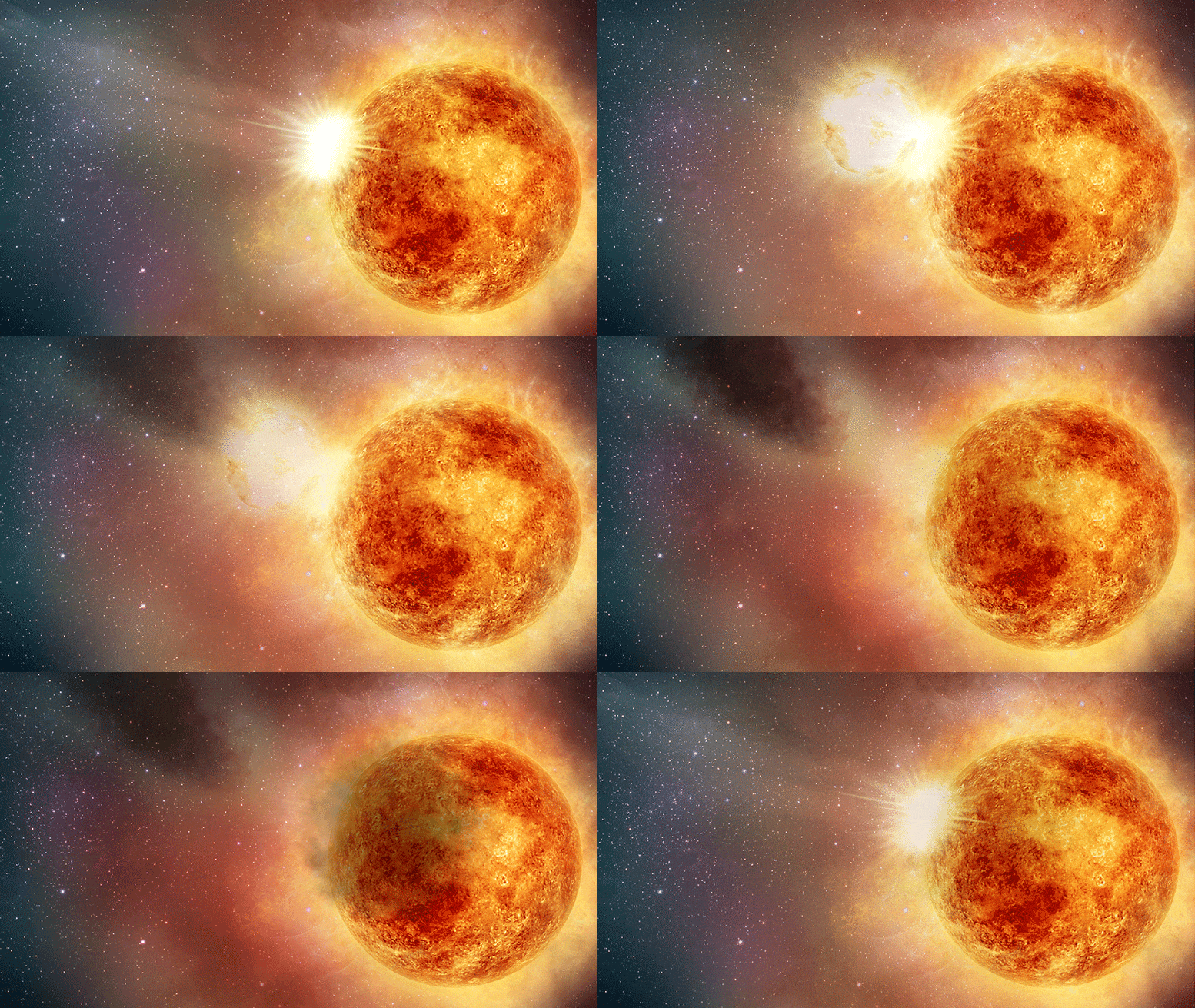
Monster Star Had Never-Seen-Before Titanic Eruption
Betelgeuse, a red supergiant star, appears as a brilliant, ruby-red, twinkling spot of light in the upper right shoulder of the winter constellation Orion the Hunter. However, when viewed close up, astronomers know that it is a seething monster with a 400-day-long heartbeat of regular pulsations. This aging star is classified as a supergiant because it has swelled up to an astonishing diameter of approximately 1 billion miles. If placed at the center of our solar system it would reach out to the orbit of Jupiter.
The star’s ultimate fate is to explode as a supernova. When that eventually happens it will be briefly visible in the daytime sky from Earth. But there are a lot of fireworks going on now before the final detonation. Astronomers using Hubble and other telescopes have deduced that the star blew off a huge piece of its visible surface in 2019. This has never before been seen on a star. Our petulant Sun routinely goes through mass ejections of its outer atmosphere, the corona. But those events are orders of magnitude weaker than what was seen on Betelgeuse.
The first clue came when the star mysteriously darkened in late 2019. An immense cloud of obscuring dust formed from the ejected surface as it cooled. Astronomers have now pieced together a scenario for the upheaval. And the star is still slowly recovering; the photosphere is rebuilding itself. And the interior is reverberating like a bell that has been hit with a sledgehammer, disrupting the star’s normal cycle. This doesn’t mean the monster star is going to explode any time soon, but the late-life convulsions may continue to amaze astronomers.

Hubble Sees Red Supergiant Star Betelgeuse Slowly Recovering After Blowing Its Top
After analyzing data from NASA’s Hubble Space Telescope and several other observatories, astronomers have concluded that the bright red supergiant star Betelgeuse quite literally blew its top in 2019, losing a substantial part of its visible surface and producing a gigantic Surface Mass Ejection (SME). This is something never before seen in a normal star’s behavior.
Our Sun routinely blows off parts of its tenuous outer atmosphere, the corona, in an event known as a Coronal Mass Ejection (CME). However, the Betelgeuse SME blasted off 400 billion times as much mass as a typical CME!
The monster star is still slowly recovering from this catastrophic upheaval. “Betelgeuse continues doing some very unusual things right now; the interior is sort of bouncing,” said Andrea Dupree of the Center for Astrophysics | Harvard & Smithsonian in Cambridge, Massachusetts.
These new observations yield clues as to how red stars lose mass late in their lives as their nuclear fusion furnaces burn out, before exploding as supernovae. The amount of mass loss significantly affects their fate. However, Betelgeuse’s surprisingly petulant behavior is not evidence the star is about to blow up anytime soon. So the mass-loss event is not necessarily the signal of an imminent explosion.
Dupree is now pulling together all the puzzle pieces of the star’s petulant behavior before, after, and during the eruption into a coherent story of a never-before-seen titanic convulsion in an aging star.
This includes new spectroscopic and imaging data from the STELLA robotic observatory, the Fred L. Whipple Observatory’s Tillinghast Reflector Echelle Spectrograph (TRES), NASA’s Solar Terrestrial Relations Observatory spacecraft (STEREO-A), NASA’s Hubble Space Telescope, and the American Association of Variable Star Observers (AAVSO). Dupree emphasizes that the Hubble data was pivotal to helping sort out the mystery.
“We’ve never before seen a huge mass ejection of the surface of a star. We are left with something going on that we don’t completely understand. It’s a totally new phenomenon that we can observe directly and resolve surface details with Hubble. We’re watching stellar evolution in real-time.”
A Convective Plume Triggers the Massive Explosion
The titanic outburst in 2019 was possibly caused by a convective plume, more than a million miles across, bubbling up from deep inside the star. It produced shocks and pulsations that blasted off the chunk of the photosphere leaving the star with a large cool surface area under the dust cloud that was produced by the cooling piece of photosphere. Betelgeuse is now struggling to recover from this injury.
Weighing roughly several times as much as our Moon, the fractured piece of photosphere sped off into space and cooled to form a dust cloud that blocked light from the star as seen by Earth observers. The dimming, which began in late 2019 and lasted for a few months, was easily noticeable even by backyard observers watching the star change brightness. One of the brightest stars in the sky, Betelgeuse is easily found in the right shoulder of the constellation Orion.
Even more incredible, the supergiant’s 400-day pulsation rate is now gone, perhaps at least temporarily. For almost 200 years astronomers have measured this rhythm as evident in changes in Betelgeuse’s brightness variations and surface motions. Its disruption attests to the ferocity of the blowout.
The star’s interior convection cells, which drive the regular pulsation may be sloshing around like an imbalanced washing machine tub, Dupree suggests. TRES and Hubble spectra imply that the outer layers may be back to normal, but the surface is still bouncing like a plate of gelatin dessert as the photosphere rebuilds itself.
Surface Mass Ejection
Though our Sun has coronal mass ejections that blow off small pieces of the outer atmosphere, astronomers have never witnessed such a large amount of a star’s visible surface get blasted into space. Therefore, surface mass ejections and coronal mass ejections may be different events.
Betelgeuse is now so huge now that if it replaced the Sun at the center of our solar system, its outer surface would extend past the orbit of Jupiter. Dupree used Hubble to resolve hot spots on the star’s surface in 1996. This was the first direct image of a star other than the Sun.
NASA’s Webb Space Telescope may be able to detect the ejected material in infrared light as it continues moving away from the star.
The Hubble Space Telescope is a project of international cooperation between NASA and ESA (European Space Agency). NASA’s Goddard Space Flight Center in Greenbelt, Maryland, manages the telescope. The Space Telescope Science Institute (STScI) in Baltimore, Maryland, conducts Hubble science operations. STScI is operated for NASA by the Association of Universities for Research in Astronomy, in Washington, D.C.
Never miss a breakthrough: Join the SciTechDaily newsletter.
Follow us on Google and Google News.
2 Comments
I wonder where the geocenter of its solar system was relative to where the eruption happened.
Darn! I didn’t have Supernova for August in the office pool. 😔