
Close Menu
    Facebook X (Twitter) Instagram
    SciTechDaily
    • Biology
    • Chemistry
    • Earth
    • Health
    • Physics
    • Science
    • Space
    • Technology
    Facebook X (Twitter) Pinterest YouTube RSS
    SciTechDaily
    Home»Space»Hubble Sees the Eerie Glow of a Dead Star
    Space

    Hubble Sees the Eerie Glow of a Dead Star

    By Ray Villard, Space Telescope Science InstituteOctober 27, 2016No Comments4 Mins Read
    Facebook Twitter Pinterest Telegram LinkedIn WhatsApp Email Reddit
    Share
    Facebook Twitter LinkedIn Pinterest Telegram Email Reddit
    A Dead Star's Ghostly Glow
    Astronomers discovered a real “tell-tale heart” in space, 6,500 light-years from Earth. The “heart” is the crushed core of a long-dead star, called a neutron star, which exploded as a supernova and is now still beating with rhythmic precision. Evidence of its heartbeat are rapid-fire, lighthouse-like pulses of energy from the fast-spinning neutron star. The stellar relic is embedded in the center of the Crab Nebula, the expanding, tattered remains of the doomed star.

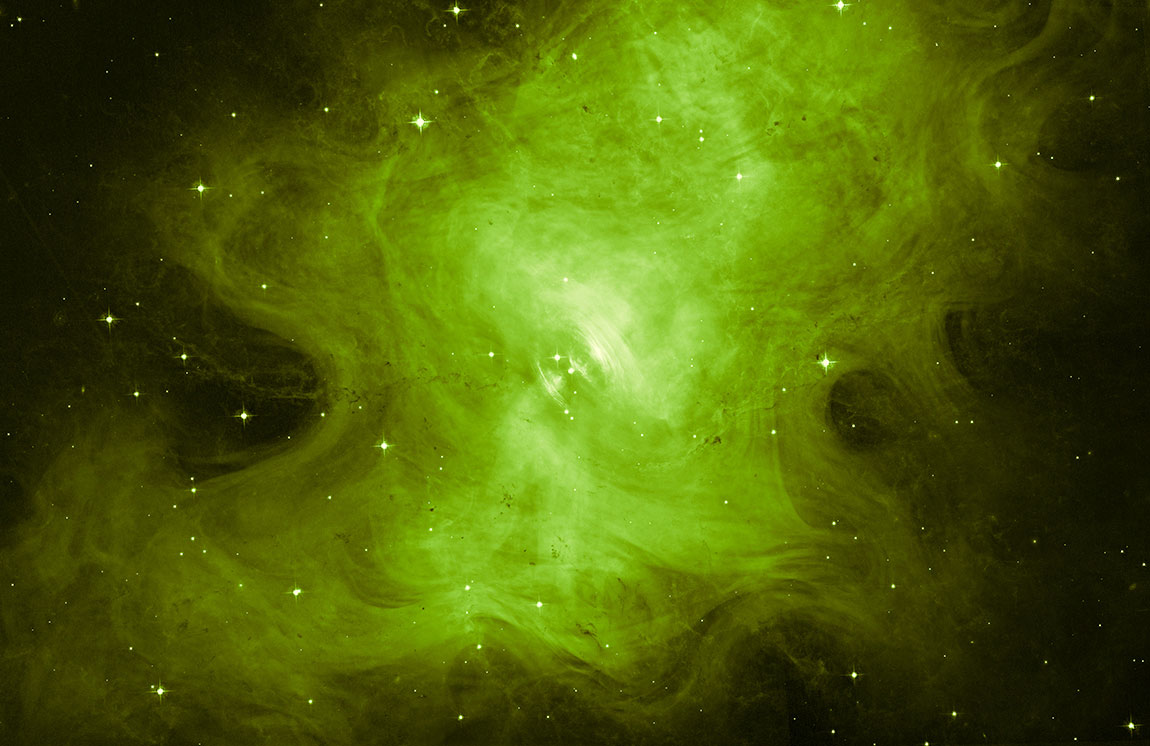
    This newly released Hubble image of the Crab Nebula shows the eerie glow of a dead star, which exploded long ago as a supernova. But don’t be fooled; this ghoulish-looking object still has a pulse. Buried at its center is the star’s tell-tale heart, which beats with rhythmic precision.

    The “heart” is the crushed core of the exploded star. Called a neutron star, it has about the same mass as the sun but is squeezed into an ultra-dense sphere that is only a few miles across and 100 billion times stronger than steel. The tiny powerhouse is the bright star-like object near the center of the image

    This surviving remnant is a tremendous dynamo, spinning 30 times a second. The wildly whirling object produces a deadly magnetic field that generates an electrifying 1 trillion volts. This energetic activity unleashes wisp-like waves that form an expanding ring, most easily seen to the upper right of the pulsar.
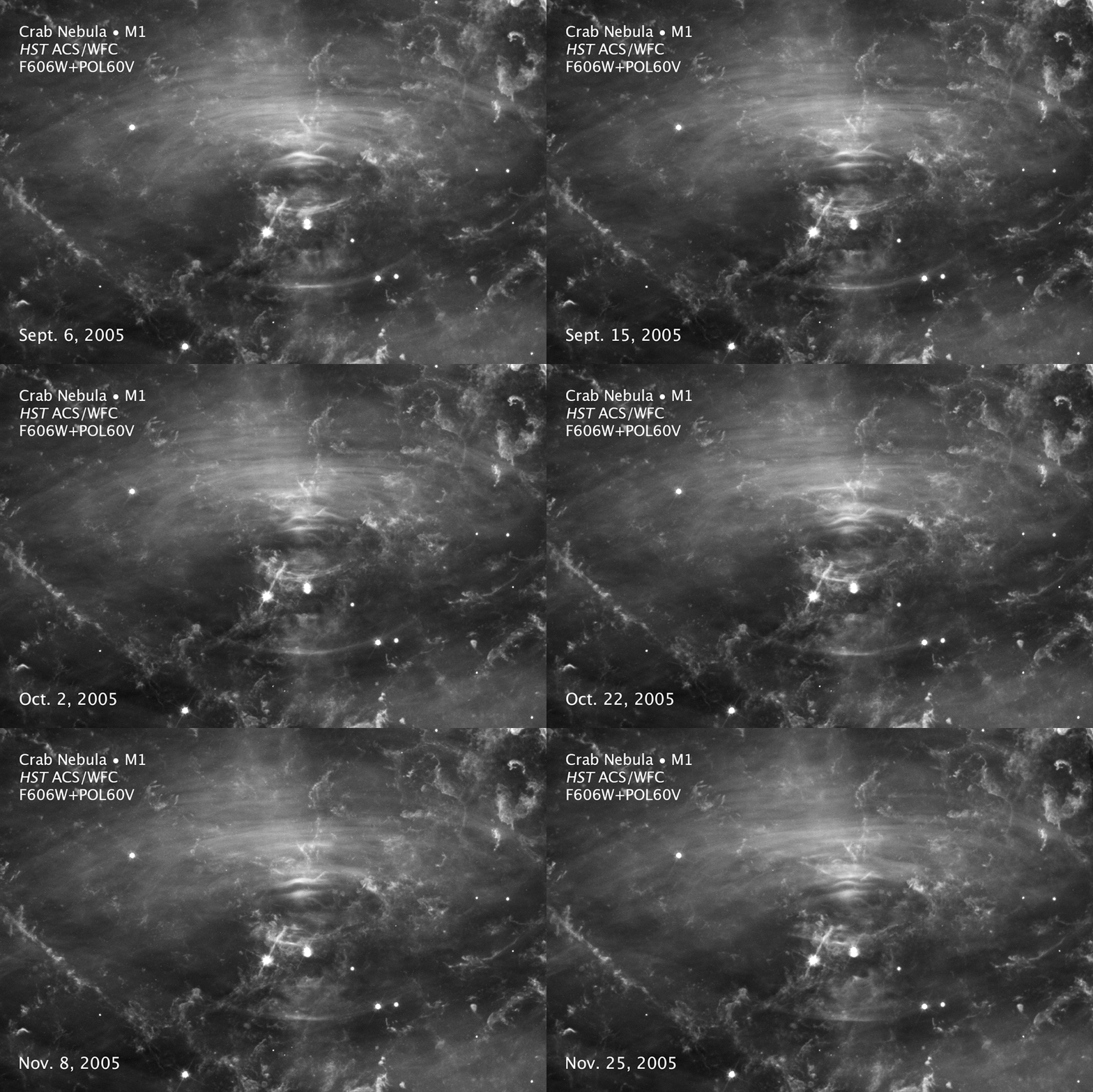
    Time-Lapse Movie of the Crab Nebula
    This time-lapse movie of the Crab Nebula, made from NASA Hubble Space Telescope observations, reveals wave-like structures expanding outward from the “heart” of an exploded star. The waves look like ripples in a pond. The heart is the crushed core of the exploded star, or supernova. Called a neutron star, it has about the same mass as the sun but is squeezed into an ultra-dense sphere that is only a few miles across and 100 billion times stronger than steel. This surviving relic is a tremendous dynamo, spinning 30 times a second. The rapidly spinning neutron star is visible in the image as the bright object just below center. The bright object to the left of the neutron star is a foreground or background star. The movie is assembled from 10 Hubble exposures taken between September and November 2005 by the Advanced Camera for Surveys.

    The nebula’s hot gas glows in radiation across the electromagnetic spectrum, from radio to X-rays. The Hubble exposures were taken in visible light as black-and-white exposures. The Advanced Camera for Surveys made the observations between January and September 2012. The green hue that gives the nebula a Halloween theme, represents the color range of the filter used in the observation.

    The Crab Nebula is one of the most historic and intensively studied supernova remnants. Observations of the nebula date back to 1054 A.D., when Chinese astronomers first recorded seeing a “guest star” during the daytime for 23 days. The star appeared six times brighter than Venus. Japanese, Arabic, and Native American stargazers also recorded seeing the mystery star. In 1758, while searching for a comet, French astronomer Charles Messier discovered a hazy nebula near the location of the long-vanished supernova. He later added the nebula to his celestial catalog as “Messier 1,” marking it as a “fake comet.” Nearly a century later British astronomer William Parsons sketched the nebula. Its resemblance to a crustacean led to M1’s other name, the Crab Nebula. In 1928 astronomer Edwin Hubble first proposed associating the Crab Nebula to the Chinese “guest star” of 1054.

    The nebula, bright enough to be visible in amateur telescopes, is located 6,500 light-years away in the constellation Taurus.

    Never miss a breakthrough: Join the SciTechDaily newsletter.
    Follow us on Google and Google News.

    Astronomy Cosmology Hubble Space Telescope Supernova
    Share. Facebook Twitter Pinterest LinkedIn Email Reddit

    Related Articles

    New Clues About Eta Carinae – The Star That Wouldn’t Die

    Astronomers View Hubble Images of a Gravitationally Lensed Type Ia Supernova for the First Time

    3D Model Lets Astronomers Explore Supernova 1987a Like Never Before

    Astronomers Discover Supernovae in ‘Wrong Place at Wrong Time’

    Hubble Views Supernova Remnant SNR 0519

    Hubble Views Supernova That Exploded Over 10 Billion Years Ago

    12 Billion-Year Old Supernova Discovered by Astronomers

    Links Between Core Collapse Supernovae and Star Formation Established

    SN Primo Is Farthest Type Ia Supernova Discovered

    Leave A Reply Cancel Reply

    • Facebook
    • Twitter
    • Pinterest
    • YouTube

    Don't Miss a Discovery

    Subscribe for the Latest in Science & Tech!

    Trending News

    Scientists May Have Found the Key to Jupiter and Saturn’s Moon Mystery

    Scientists Uncover Brain Changes That Link Pain to Depression

    Saunas May Do More Than Raise Body Temperature – They Activate Your Immune System

    Exercise in a Pill? Metformin Shows Surprising Effects in Cancer Patients

    Hidden Oceans of Magma Could Be Protecting Alien Life

    New Study Challenges Alzheimer’s Theories: It’s Not Just About Plaques

    Artificial Sweeteners May Harm Future Generations, Study Suggests

    Splashdown! NASA Artemis II Returns From Record-Breaking Moon Mission

    Follow SciTechDaily
    • Facebook
    • Twitter
    • YouTube
    • Pinterest
    • Newsletter
    • RSS
    SciTech News
    • Biology News
    • Chemistry News
    • Earth News
    • Health News
    • Physics News
    • Science News
    • Space News
    • Technology News
    Recent Posts
    • Ancient DNA Reveals Irish Goats Have a 3,000-Year-Old Lineage Still Alive Today
    • Historians Reveal Secrets of the Strange Hat Wars That Shook Early Modern England
    • “A Plague Is Upon Us”: The Mass Death That Changed an Ancient City Forever
    • This Strange Material Can Turn Superconductivity on and off Like a Switch
    • Scientists Discover Game-Changing New Way To Treat High Cholesterol
    Copyright © 1998 - 2026 SciTechDaily. All Rights Reserved.
    • Science News
    • About
    • Contact
    • Editorial Board
    • Privacy Policy
    • Terms of Use

    Type above and press Enter to search. Press Esc to cancel.