
Close Menu
    Facebook X (Twitter) Instagram
    SciTechDaily
    • Biology
    • Chemistry
    • Earth
    • Health
    • Physics
    • Science
    • Space
    • Technology
    Facebook X (Twitter) Pinterest YouTube RSS
    SciTechDaily
    Home»Space»Hubble Spots a Galaxy Where Old and New Stars Collide in Color
    Space

    Hubble Spots a Galaxy Where Old and New Stars Collide in Color

    By ESA/HubbleOctober 5, 20251 Comment3 Mins Read
    Facebook Twitter Pinterest Telegram LinkedIn WhatsApp Email Reddit
    Share
    Facebook Twitter LinkedIn Pinterest Telegram Email Reddit
    Spiral Galaxy NGC 6000
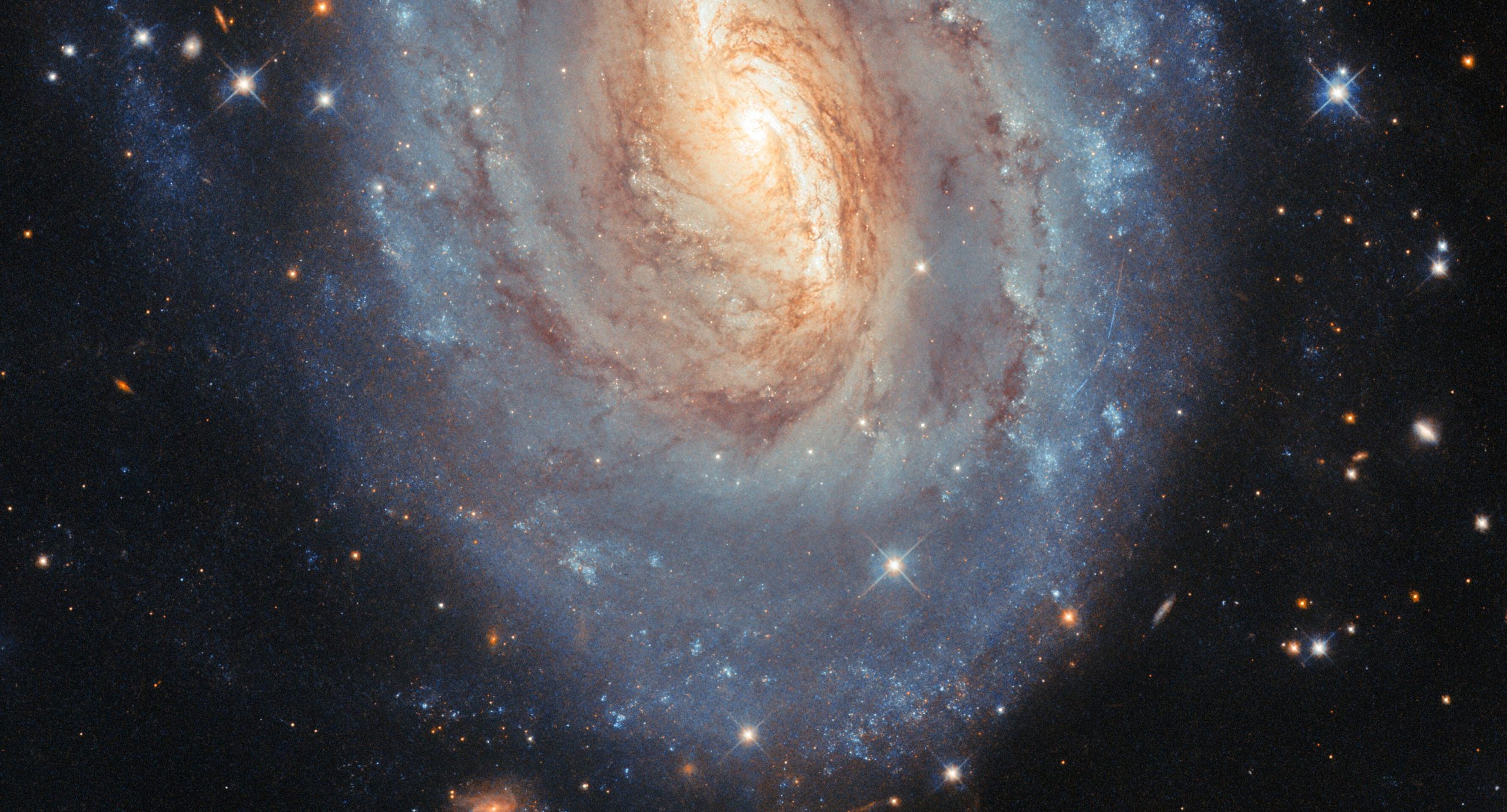
    Hubble’s image of NGC 6000 reveals a glowing galactic masterpiece filled with both old red stars and young blue ones. Among the cosmic beauty, scientists also spotted the afterglow of past supernovae and a passing asteroid’s colorful tracks. Credit: ESA/Hubble & NASA, A. Filippenko, Acknowledgment: M. H. Özsaraç

    Hubble’s latest image captures the dazzling spiral galaxy NGC 6000, lying 102 million light-years away in Scorpius. Its golden core and bright blue arms reveal a striking contrast between old, cool stars at the center and young, hot stars in the outskirts.

    The Stellar Story Told by Color

    This spiral galaxy features a bright golden core surrounded by shimmering blue arms. These vivid hues reveal differences in the ages, sizes, and temperatures of its stars. Near the center, most stars are older and smaller, glowing with a warmer, yellowish light. Smaller stars are cooler than large, massive ones, and although it may seem surprising, cooler stars appear redder while hotter ones shine blue. Along NGC 6000’s sweeping arms, clusters of young, massive stars radiate a striking blue light, marking areas of active star formation.

    Tracing the Echoes of Supernovae

    To capture this image, Hubble observed NGC 6000 as part of a survey of galaxies that have recently hosted supernova explosions. This particular galaxy has witnessed two in recent years: SN 2007ch (in 2007) and SN 2010as (in 2010). Hubble’s highly sensitive instruments allow scientists to detect the lingering glow from these events long after the explosions fade. Studying this faint light helps astronomers estimate the original masses of the stars that exploded and determine whether those stars once had close companions.

    When an Asteroid Photobombs Hubble

    By zooming in on the right side of the galaxy’s disc in this image, you may see something else yellow and blue: a set of four thin lines. This is an asteroid in our Solar System, which was drifting across Hubble’s field of view as it gazed at NGC 6000. The four streaks are due to different exposures that were recorded one after another with slight pauses in between. These were combined to create this final image. The colors appear this way because each exposure used a filter to collect only very specific wavelengths of light, in this case, around red and blue. Having these separate exposures is important to study and compare stars by their colors — but it also makes asteroid interlopers very obvious!

    Never miss a breakthrough: Join the SciTechDaily newsletter.
    Follow us on Google and Google News.

    Astronomy European Space Agency Hubble Space Telescope
    Share. Facebook Twitter Pinterest LinkedIn Email Reddit

    Related Articles

    A Diamond Necklace of Cosmic Proportions

    Hubble Snaps a Stunning Close-Up of a Magnificent Spiral Galaxy

    Extraordinary Hubble Image: Light Bends From the Beyond

    Hubble Space Telescope Sees Volcanic Activity Reforming the Atmosphere on a Rocky Exoplanet

    Hubble Spies a Luminous Heart With Dark Tendrils

    Spectacular Return to the Veil Nebula

    Hubble Spots a Peculiar Sight: Unusual Spiral Galaxy With a Heavy Arm

    A Flash of Life: Hubble Spies an Unusual Planetary Nebula

    Through the Cosmic Clouds: Hubble Spots a Beautiful Stellar Nursery

    1 Comment

    1. Eric M. Jones on October 5, 2025 6:50 am

      And yet contemporary estimates say that when two galaxies collide, none of the stars will collide?

      Reply
    Leave A Reply Cancel Reply

    • Facebook
    • Twitter
    • Pinterest
    • YouTube

    Don't Miss a Discovery

    Subscribe for the Latest in Science & Tech!

    Trending News

    Your Blood Pressure Reading Could Be Wrong Because of One Simple Mistake

    Astronomers Stunned by Ancient Galaxy With No Spin

    Physicists May Be on the Verge of Discovering “New Physics” at CERN

    Scientists Solve 320-Million-Year Mystery of Reptile Skin Armor

    Scientists Say This Daily Walking Habit May Be the Secret to Keeping Weight Off After Dieting

    New Therapy Rewires the Brain To Restore Joy in Depression Patients

    Giant Squid Detected off Western Australia in Stunning Deep-Sea Discovery

    Popular Sugar-Free Sweetener Linked to Liver Disease, Study Warns

    Follow SciTechDaily
    • Facebook
    • Twitter
    • YouTube
    • Pinterest
    • Newsletter
    • RSS
    SciTech News
    • Biology News
    • Chemistry News
    • Earth News
    • Health News
    • Physics News
    • Science News
    • Space News
    • Technology News
    Recent Posts
    • Hidden Warm Water Beneath Antarctica Could Rapidly Raise Global Sea Levels
    • Scientists Revive Ancient Chemistry Trick To Engineer Next-Generation Glass
    • Scientists Use AI To Supercharge Ultrafast Laser Simulations by More Than 250x
    • Scientists Just Found a Surprising Way To Destroy “Forever Chemicals”
    • Popular Supplement Ingredient Linked to Shorter Lifespan in Men
    Copyright © 1998 - 2026 SciTechDaily. All Rights Reserved.
    • Science News
    • About
    • Contact
    • Editorial Board
    • Privacy Policy
    • Terms of Use

    Type above and press Enter to search. Press Esc to cancel.