
Close Menu
    Facebook X (Twitter) Instagram
    SciTechDaily
    • Biology
    • Chemistry
    • Earth
    • Health
    • Physics
    • Science
    • Space
    • Technology
    Facebook X (Twitter) Pinterest YouTube RSS
    SciTechDaily
    Home»Space»Hubble Telescope Image of the Week – Crowded Cluster
    Space

    Hubble Telescope Image of the Week – Crowded Cluster

    By Hubble Space TelescopeApril 22, 20193 Comments2 Mins Read
    Facebook Twitter Pinterest Telegram LinkedIn WhatsApp Email Reddit
    Share
    Facebook Twitter LinkedIn Pinterest Telegram Email Reddit
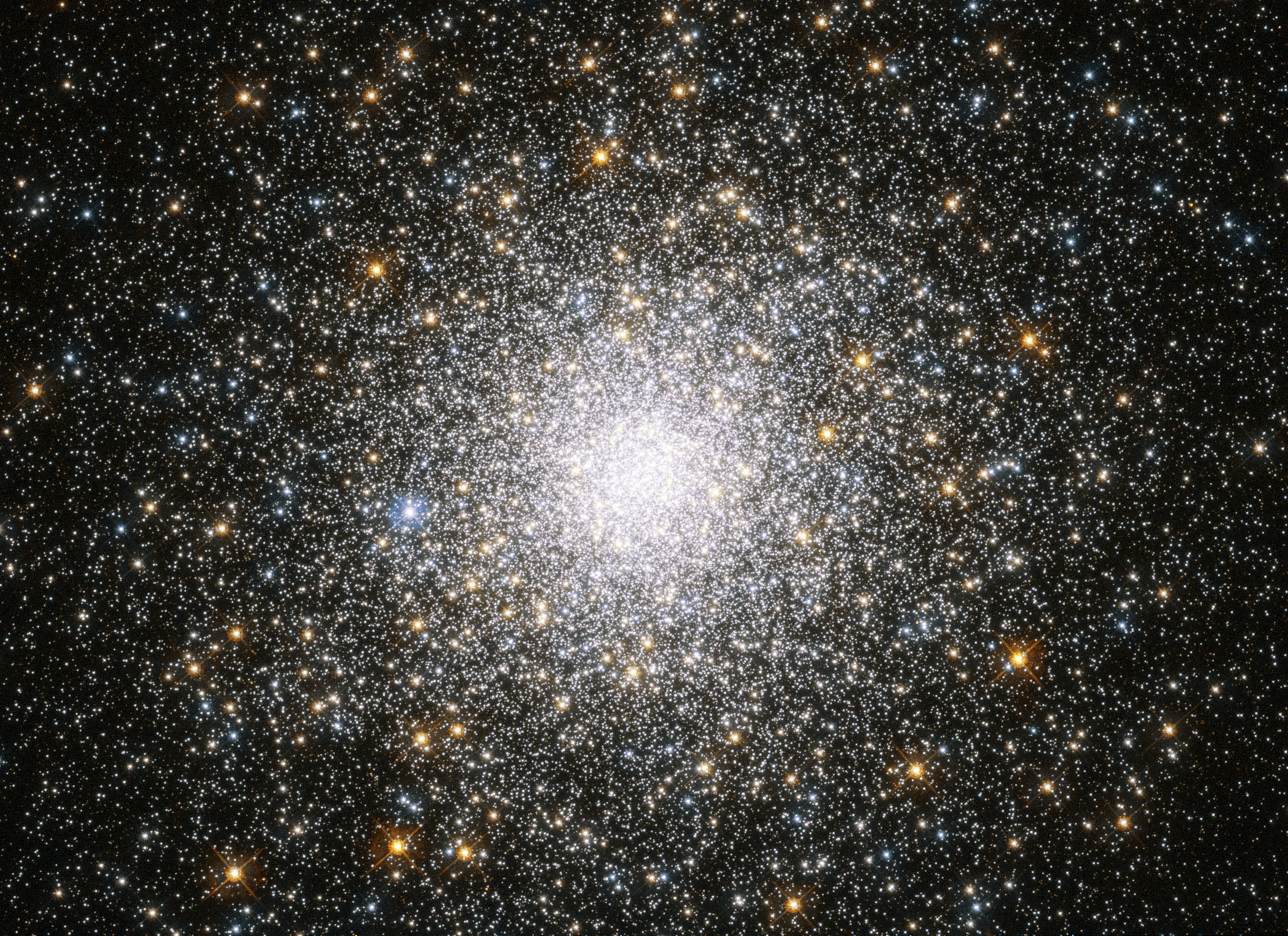
    Messier 75 Hubble Image
    Messier 75 lies in the constellation of Sagittarius (The Archer), around 67 000 light-years away from Earth. It is one of the most densely populated clusters ever found, with a phenomenal luminosity of some 180 000 times that of the Sun. Credit: ESA/Hubble & NASA, F. Ferraro et al.

    This sparkling burst of stars is Messier 75. It is a globular cluster: a spherical collection of stars bound together by gravity. Clusters like this orbit around galaxies and typically reside in their outer and less-crowded areas, gathering to form dense communities in the galactic suburbs.

    Messier 75 lies in the constellation of Sagittarius (The Archer), around 67 000 light-years away from Earth. The majority of the cluster’s stars, about 400 000 in total, are found in its core; it is one of the most densely populated clusters ever found, with a phenomenal luminosity of some 180 000 times that of the Sun. No wonder it photographs so well!

    Discovered in 1780 by Pierre Méchain, Messier 75 was also observed by Charles Messier and added to his catalog later that year. This image of Messier 75 was captured by the NASA/ESA Hubble Space Telescope’s Advanced Camera for Surveys.

    Never miss a breakthrough: Join the SciTechDaily newsletter.
    Follow us on Google and Google News.

    Astronomy Hubble Space Telescope
    Share. Facebook Twitter Pinterest LinkedIn Email Reddit

    Related Articles

    A Morphing Spiral Galaxy Amongst Friends

    Hubble Views Magnificent Lopsided Galaxy NGC 2276

    Hubble Captures Fantastic Detail of Eponymous Spiral Galaxy NGC 691

    Spectacular Image Captured by Hubble Shows a Strangely Contorted Spiral Galaxy

    A Distant Spiral in Virgo: Extraordinary Detail Seen in a Galaxy 150 Million Light-Years Away From Earth

    Magnetic Monsters: Hubble Tracks Down Location of Mysterious Radio Signals From Intergalactic Space

    A Menagerie of Galaxies: Hubble Captures a Cluster With Galaxies of All Shapes and Sizes

    How Habitable Are Planets That Orbit Red Dwarfs – The Most Common Type of Stars in the Galaxy?

    Cosmic Silver Lining: Hubble Spots V565 Surrounded by Four Prominent Diffraction Spikes

    3 Comments

    1. Barry Redmond on April 22, 2019 10:31 pm

      TRULY MAGNIFICENT REFLECTING THE GREAT CREATOR.

      Reply
    2. Edward Gazsi on April 23, 2019 2:44 pm

      I’m right there with you, Barry. “Stars bound together by gravity.” These clusters are said to be billions of years in age. If gravity is at work, why have the clusters not collapsed and formed massive black holes? All the stars in a cluster should be pulled toward the center, where the stars are most compact, and yet no collapse. Could it be that there has not been enough time since their creation by Almighty God for these clusters to have collapsed? After all, our sun supposedly contracted from simple hydrogen gas. How much more when one considers the weight of the stars in a cluster.

      Reply
    3. David J Wilson on May 1, 2019 10:33 pm

      Well, the first two commenters are brain-dead, so all I need do to re-establish the primacy of science is say, “2+2=4.”

      Reply
    Leave A Reply Cancel Reply

    • Facebook
    • Twitter
    • Pinterest
    • YouTube

    Don't Miss a Discovery

    Subscribe for the Latest in Science & Tech!

    Trending News

    What if Time Isn’t Fundamental? Physicists Just Tested the Idea in the Lab

    Scientists Say We’ve Been Wrong About the Aging Brain

    68 Quadrillion Miles: Scientists Map Earth’s Vast Hidden Fungal Network for the First Time

    Hidden Damage From Youth May Explode Into Disease Later in Life

    Climate Models May Be Wrong About How Trees Store Carbon

    Scientists Discover Brain-Protecting Peptide That Could Change Parkinson’s Treatment

    This Copper Drug Clears Alzheimer’s Brain Toxins and Boosts Memory

    Adults Over 65 Lost Massive Amounts of Weight With Ozempic

    Follow SciTechDaily
    • Facebook
    • Twitter
    • YouTube
    • Pinterest
    • Newsletter
    • RSS
    SciTech News
    • Biology News
    • Chemistry News
    • Earth News
    • Health News
    • Physics News
    • Science News
    • Space News
    • Technology News
    Recent Posts
    • Scientists Discover a Gene That Boosts Youth – but It Comes With a Cost
    • A Decade-Long Physics Mystery May Finally Be Solved
    • AI Cracks the Secrets of How the Universe’s Heaviest Elements Are Forged
    • After 50 Years, Astronomers Finally Found What the Milky Way’s Black Hole Was Hiding
    • Scientists Discover Immune Cells That Can Fight Both Measles and Nipah
    Copyright © 1998 - 2026 SciTechDaily. All Rights Reserved.
    • Science News
    • About
    • Contact
    • Editorial Board
    • Privacy Policy
    • Terms of Use

    Type above and press Enter to search. Press Esc to cancel.