
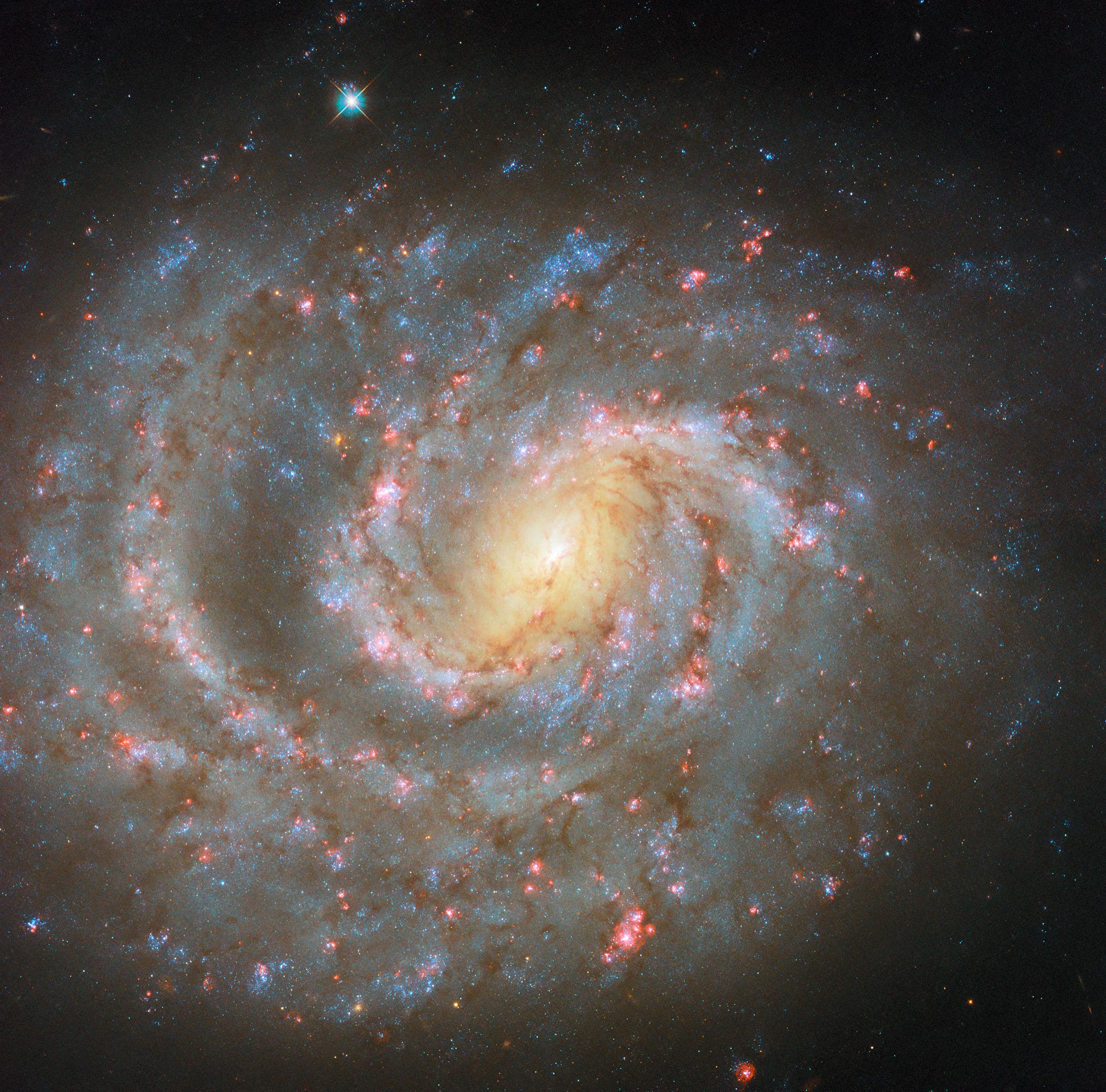
Spiral Galaxy NGC 1637 showcases ongoing star formation and the effects of supernovae like SN 1999EM in shaping galactic structure and stellar evolution.
This new Hubble Space Telescope image highlights NGC 1637, a spiral galaxy located 38 million light-years away in the constellation Eridanus.
The image is part of a research program focused on studying star formation in nearby galaxies. Stars are born in cold, dusty clouds of gas that collapse under the pull of their own gravity. As these young stars grow, they influence their surroundings by emitting starlight, producing stellar winds, and releasing powerful outflows. These processes collectively regulate how quickly new generations of stars can form, shaping the galaxy’s future.
Evidence of star formation is scattered all around NGC 1637, if you know where to look. The galaxy’s spiral arms are dotted with what appear to be pink clouds, many of which are accompanied by bright blue stars. The pinkish color comes from hydrogen atoms that have been excited by ultraviolet light from young, massive stars. This contrasts with the warm yellow glow of the galaxy’s center, which is home to a densely packed collection of older, redder stars.
The stars that set their birthplaces aglow are comparatively short-lived, and many of these stars will explode as supernovae just a few million years after they’re born. In 1999, NGC 1637 played host to a supernova, pithily named SN 1999EM, that was lauded as the brightest supernova seen that year. When a massive star expires as a supernova, the explosion outshines its entire home galaxy for a short time. While a supernova marks the end of a star’s life, it can also jump-start the formation of new stars by compressing nearby clouds of gas, beginning the stellar lifecycle anew.
Never miss a breakthrough: Join the SciTechDaily newsletter.
Follow us on Google and Google News.
1 Comment
The act of deleting comments can be perceived as evasive and unprofessional, akin to the proverbial ostrich burying its head in the sand.
Scientific research guided by correct theories can help people avoid detours, failures, and exaggeration. The physical phenomena observed by researchers in experiments are always appearances, never the natural essence of things. The natural essence of things needs to be extracted and sublimated based on mathematical theories via appearances , rather than being imagined arbitrarily.
Please respect the interaction and balance between topological vortices and their fractal structures.