
Close Menu
    Facebook X (Twitter) Instagram
    SciTechDaily
    • Biology
    • Chemistry
    • Earth
    • Health
    • Physics
    • Science
    • Space
    • Technology
    Facebook X (Twitter) Pinterest YouTube RSS
    SciTechDaily
    Home»Space»Hubble Views Spiral Galaxy IC 2233
    Space

    Hubble Views Spiral Galaxy IC 2233

    By NASADecember 24, 20122 Comments2 Mins Read
    Facebook Twitter Pinterest Telegram LinkedIn WhatsApp Email Reddit
    Share
    Facebook Twitter LinkedIn Pinterest Telegram Email Reddit
    The Needle Galaxy
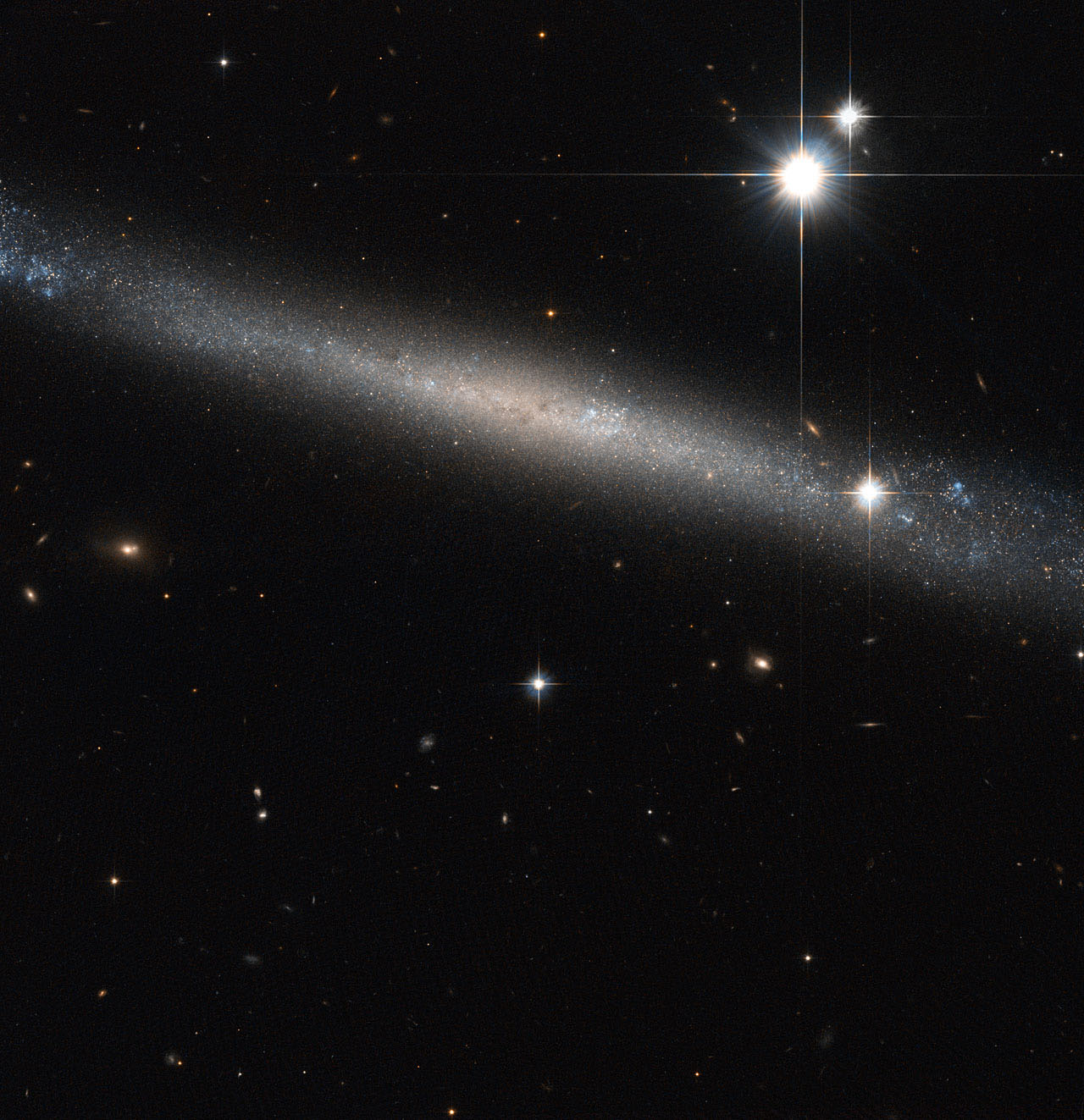
    Hubble Space Telescope image of spiral galaxy IC 2233. Credit: ESA/Hubble & NASA

    This new image from Hubble shows spiral galaxy IC 2233, which is one of the flattest galaxies known and is located about 40 million light-years away from Earth in the constellation of Lynx.

    Like finding a silver needle in the haystack of space, the NASA/ESA Hubble Space Telescope has produced this beautiful image of the spiral galaxy IC 2233, one of the flattest galaxies known.

    Typical spiral galaxies like the Milky Way are usually made up of three principal visible components: the disk where the spiral arms and most of the gas and dust is concentrated; the halo, a rough and sparse sphere around the disk that contains little gas, dust or star formation; and the central bulge at the heart of the disk, which is formed by a large concentration of ancient stars surrounding the Galactic Center.

    However, IC 2233 is far from being typical. This object is a prime example of a super-thin galaxy, where the galaxy’s diameter is at least ten times larger than the thickness. These galaxies consist of a simple disk of stars when seen edge-on. This orientation makes them fascinating to study, giving another perspective on spiral galaxies. An important characteristic of this type of objects is that they have a low brightness and almost all of them have no bulge at all.

    The bluish color that can be seen along the disk gives evidence of the spiral nature of the galaxy, indicating the presence of hot, luminous, young stars, born out of clouds of interstellar gas. In addition, unlike typical spirals, IC 2233 shows no well-defined dust lane. Only a few small patchy regions can be identified in the inner regions both above and below the galaxy’s mid-plane.

    Lying in the constellation of Lynx, IC 2233 is located about 40 million light-years away from Earth. This galaxy was discovered by British astronomer Isaac Roberts in 1894.

    This image was taken with Hubble’s Advanced Camera for Surveys (ACS), combining visible and infrared exposures. The field of view in this image is approximately 3.4 by 3.4 arcminutes.

    Never miss a breakthrough: Join the SciTechDaily newsletter.
    Follow us on Google and Google News.

    Astronomy Hubble Space Telescope Popular
    Share. Facebook Twitter Pinterest LinkedIn Email Reddit

    Related Articles

    Astronomers Puzzled by Dark Storm’s U-Turn on Neptune, Appearance of New Dark Spot

    Rings of Relativity: A Truly Strange and Very Rare Phenomenon

    Hubble Discovers a Strange Exoplanet That Resembles the Long-Sought “Planet Nine”

    Ethereal Orange Glow Radiates From Heart of Stellar Forge

    Hubble Captures Unprecedented Fading of Stingray Nebula – “This Is Very, Very Dramatic, and Very Weird”

    Hubble Space Telescope Explains Oddball Galaxy’s Missing Dark Matter

    ULLYSES: Hubble Embarks on Largest Observing Program of Its Career

    Hubble Spots a Gorgeous Waterfall of Stars

    Hubble Spots Giant Space “Pumpkin” [Video]

    2 Comments

    1. jaime on December 1, 2013 7:11 pm

      photos

      Reply
    2. jaime on December 1, 2013 7:12 pm

      deep

      Reply
    Leave A Reply Cancel Reply

    • Facebook
    • Twitter
    • Pinterest
    • YouTube

    Don't Miss a Discovery

    Subscribe for the Latest in Science & Tech!

    Trending News

    Nanoscale “Defects” Unlock a Major Heat Transfer Breakthrough

    Adults Taking More Vitamin D Scored 13% Higher on a Cognitive Test

    A 35,000-Year-Old Neanderthal Pelvis May Explain Why Men and Women Walk Differently

    Dual Stem Cell Treatment Restores Vision in First Human Trial

    Your Waist Size May Reveal More About Your Health Than You Think

    Scientists Turn Red Strawberries White With a Single Gene Edit

    A SpaceX Falcon 9 Rocket Hit the Moon and Blasted Open a 60-Foot Crater

    Study Reveals Your Organs May Be Aging at Very Different Speeds

    Follow SciTechDaily
    • Facebook
    • Twitter
    • YouTube
    • Pinterest
    • Newsletter
    • RSS
    SciTech News
    • Biology News
    • Chemistry News
    • Earth News
    • Health News
    • Physics News
    • Science News
    • Space News
    • Technology News
    Recent Posts
    • 125-Million-Year-Old Crocodile Fossil Reveals Astonishing New Secrets
    • Scientists Discover an “Impossible” Way Muscle Filaments Can Grow
    • Scientists Discover a Mysterious New Snake Species Hiding in New Guinea
    • Bats Have a Secret Immune System Scientists Have Never Seen in Any Other Mammal
    • A Star’s Spin Could Solve a Longstanding Black Hole Mystery
    Copyright © 1998 - 2026 SciTechDaily. All Rights Reserved.
    • Science News
    • About
    • Contact
    • Editorial Board
    • Privacy Policy
    • Terms of Use

    Type above and press Enter to search. Press Esc to cancel.