
Close Menu
    Facebook X (Twitter) Instagram
    SciTechDaily
    • Biology
    • Chemistry
    • Earth
    • Health
    • Physics
    • Science
    • Space
    • Technology
    Facebook X (Twitter) Pinterest YouTube RSS
    SciTechDaily
    Home»Space»Hubble Views Spiral Galaxy NGC 4183
    Space

    Hubble Views Spiral Galaxy NGC 4183

    By NASAOctober 1, 2012No Comments2 Mins Read
    Facebook Twitter Pinterest Telegram LinkedIn WhatsApp Email Reddit
    Share
    Facebook Twitter LinkedIn Pinterest Telegram Email Reddit
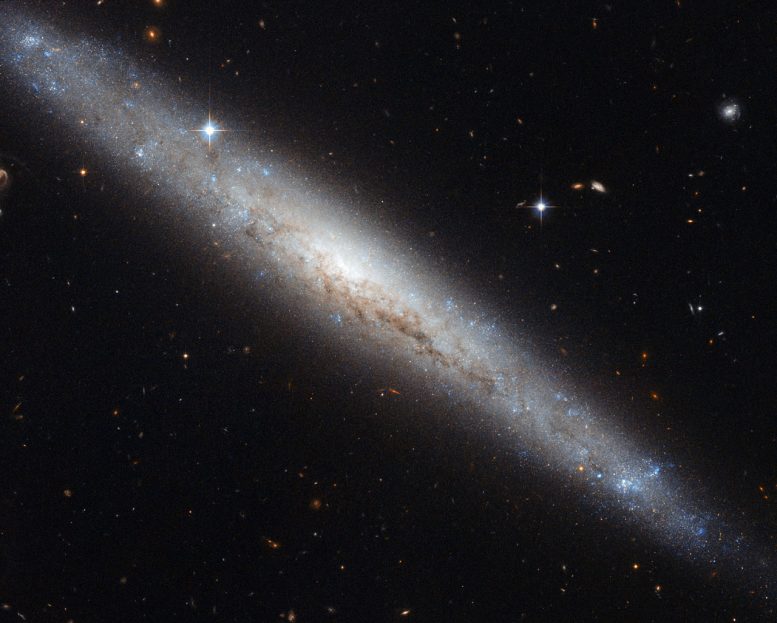
    Galaxy NGC 4183
    Hubble Space Telescope image of spiral galaxy NGC 4183. Credit: ESA/Hubble & NASA, Acknowledgment: Luca Limatola

    First observed by the British astronomer William Herschel on January 14, 1778, and now seen in this new image from Hubble, spiral galaxy NGC 4183 is located about 55 million light-years from the sun and spans roughly eighty thousand light-years.

    The NASA/ESA Hubble Space Telescope has provided us with another outstanding image of a nearby galaxy. This week, we highlight the galaxy NGC 4183, seen here with a beautiful backdrop of distant galaxies and nearby stars. Located about 55 million light-years from the sun and spanning about eighty thousand light-years, NGC 4183 is a little smaller than the Milky Way. This galaxy, which belongs to the Ursa Major Group, lies in the northern constellation of Canes Venatici (The Hunting Dogs).

    NGC 4183 is a spiral galaxy with a faint core and an open spiral structure. Unfortunately, this galaxy is viewed edge-on from the Earth, and we cannot fully appreciate its spiral arms. But we can admire its galactic disk.

    The disks of galaxies are mainly composed of gas, dust, and stars. There is evidence of dust over the galactic plane, visible as dark intricate filaments that block the visible light from the core of the galaxy. In addition, recent studies suggest that this galaxy may have a bar structure. Galactic bars are thought to act as a mechanism that channels gas from the spiral arms to the center, enhancing star formation, which is typically more pronounced in the spiral arms than in the bulge of the galaxy.

    British astronomer William Herschel first observed NGC 4183 on January 14, 1778.

    This picture was created from visible and infrared images taken with the Wide Field Channel of the Advanced Camera for Surveys. The field of view is approximately 3.4 arcminutes wide.

    This image uses data identified by Luca Limatola in the Hubble’s Hidden Treasures image processing competition.

    Never miss a breakthrough: Join the SciTechDaily newsletter.
    Follow us on Google and Google News.

    Astronomy Galaxy Hubble Space Telescope NASA
    Share. Facebook Twitter Pinterest LinkedIn Email Reddit

    Related Articles

    The Most Extraordinary Example Yet – Tiny, Hidden Galaxy Provides a Portal Into the Distant Past

    Hubble Helps Solve the Mystery of Why Ultra-Faint Dwarf Galaxies Contain Few Stars

    A Vapor of Stars from Galaxy DDO 82

    Hubble Spots Extremely Rare Gravitational Arc

    Hubble Image Shows Chance Alignment Between Galaxies

    Hubble Captures Image of Compact Blue Dwarf Galaxy UGC 5497

    A Spiral Within a Spiral, Galaxy ESO 498-G5

    Hubble Captures New Image of Messier 9

    Hubble Observes Rare Blue Stars in Andromeda’s Core

    Leave A Reply Cancel Reply

    • Facebook
    • Twitter
    • Pinterest
    • YouTube

    Don't Miss a Discovery

    Subscribe for the Latest in Science & Tech!

    Trending News

    Wasp Colonies Explode Into Violence After Losing Their Queen

    Scientists Create “Living Plastic” That Self-Destructs in Just Six Days

    Your Blood May Carry a 700-Million-Year-Old Secret

    Scientists Discover Some “Zombie Cells” May Actually Help You Live Longer

    Earth May Be Seeding Venus With Life, According to New Research

    What Scientists Found Inside a 117-Year-Old Woman Reveals New Clues to Long Life

    Scientists Discover Mysterious Creature Living in the Great Salt Lake – and It Exists Nowhere Else on Earth

    It’s Alive? Surprising Discovery Changes What We Know About Fog

    Follow SciTechDaily
    • Facebook
    • Twitter
    • YouTube
    • Pinterest
    • Newsletter
    • RSS
    SciTech News
    • Biology News
    • Chemistry News
    • Earth News
    • Health News
    • Physics News
    • Science News
    • Space News
    • Technology News
    Recent Posts
    • Researchers Suspected Brain Inflammation in Long COVID but Found Something Else
    • Goodbye CPAP? New Pill Shows Major Promise for Sleep Apnea
    • Largest Known Wild Chimpanzee Community Breaks Apart After Decades of Unity
    • Scientists Turn Mice Transparent to Uncover Obesity’s Secret Effects on Nerves
    • Scientists Discover a Hidden Cause of Cellular Aging That Can Be Reversed
    Copyright © 1998 - 2026 SciTechDaily. All Rights Reserved.
    • Science News
    • About
    • Contact
    • Editorial Board
    • Privacy Policy
    • Terms of Use

    Type above and press Enter to search. Press Esc to cancel.