
Climate change threatens krill with major decline, but nature’s fluctuations may mask the danger until it’s nearly too late.
In the heart of their Antarctic habitat, krill populations are projected to decline about 30% this century due to widespread negative effects from human-driven climate change. However, these effects on this small but significant species will be largely indistinguishable from natural variability in the region’s climate until late in the 21st century, finds new University of Colorado Boulder research.
Published today in Frontiers in Marine Science, the study has important implications for not only the local food web, but for the largest commercial fishery in the Southern Ocean: A booming $2 billion fish oil industry, sold as Omega-3 supplements in retail giants like Costco.
“Krill are what links the ecosystem together,” said Zephyr Sylvester, lead author on the paper and graduate student in environmental studies. “They’re really important to the Southern Ocean for pretty much every predator species.”
Because these tiny animals live in one of the most sensitive areas in the world to climate change, explicitly separating trends associated with human-driven warming from those arising naturally in krill habitat is a crucial step for planning and mapping harvest limits.
This study is also the first of its kind to use a group of climate models to demonstrate that climate change has the potential to dramatically alter Antarctic marine ecosystems, but that natural climate variability can obscure human-driven trends.
Small but Significant
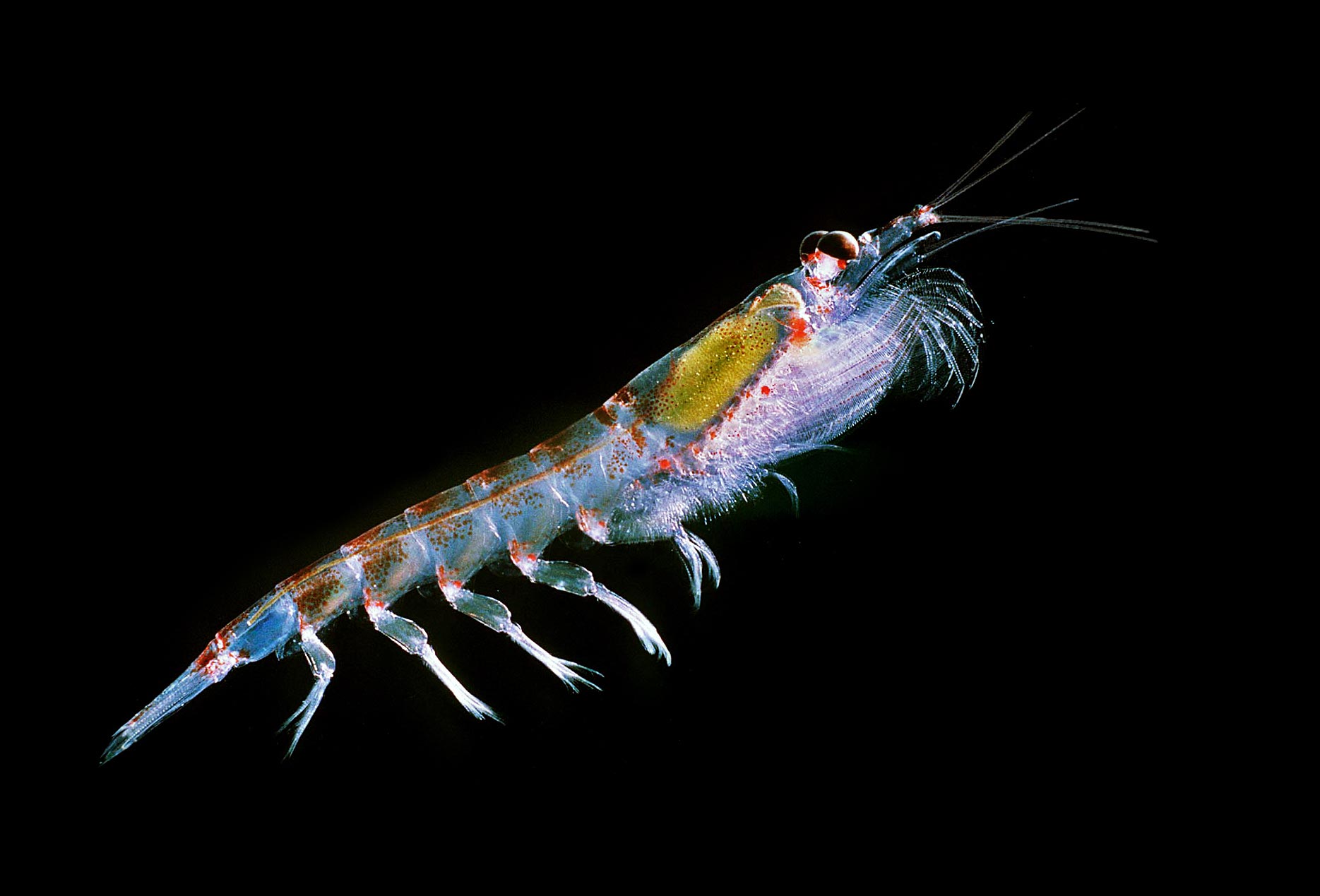
Krill are about 2.5 inches (6 cm) long, fast-swimming zooplankton that live in large groups. They’re key to the region’s food chain, eaten by just about everything that lives in the waters surrounding Antarctica: Penguins, seals, fish and whales, some of which are still recovering from overharvesting in previous centuries.
But while they are one of the most abundant species on Earth–their total biomass estimated at 300 to 500 million tons–krill can only survive in a narrow temperature range and are strongly affected by variables in their underwater environment.
Currently, fishing in the Southern Ocean is managed by the Convention on the Conservation of Antarctic Marine Living Resources, known as CCAMLR (pronounced “cam-ah-lar”), an international body established as part of the Antarctic Treaty System.
The first item on their agenda? Krill. Yet 40 years after their founding, their catch limits on this creature are still only set using a stock assessment that does not account for natural environmental variability or climate change impacts.
While today there is widespread international recognition of the importance of understanding the impacts of climate change on this marine ecosystem, knowing how the climate naturally varies is an important prerequisite, according to Sylvester.
“The thing that we really have to understand is: Is there enough krill to feed everything that needs to eat it in the Southern Ocean, as well as humans?” said Cassandra Brooks, co-author on the paper and assistant professor of environmental studies. “My hope is that we can take this as a first step to understanding how to manage krill better.”
What is Natural Variability?
Every environment on Earth naturally varies a bit each year in its weather, temperature, and precipitation. For example, some winters in Colorado have more snowfall, some have less. Some will be a bit warmer, some colder. Human-driven climate change aside, each year in the state has a unique pattern of precipitation and temperature due to natural variability.
But separating the effects of human-driven climate change from natural changes in a region is no easy task. To be able to pull apart the variables affecting the Southern Ocean over this century, the researchers ran a larger group of models many times, known as a large ensemble Earth system model. It’s the first time this has been done for the Southern Ocean and for krill.
“Then we were able to look at the different trends and quantify how much the natural variability was masking the signal for climate change,” said Sylvester.
This research addresses one of the biggest disconnects between scientists and fishery managers: understanding and communicating uncertainty. By being able to quantify how much change is likely to occur from natural variability, and separately from climate change, it allows everyone involved to plan better for the future and sustain krill for those who depend on it, according to Brooks.
“Even if we won’t see this really strong signal from climate change until later, what’s important for us to understand is that the Southern Ocean is a very dynamic system and we absolutely have to be managing for natural variability,” said Brooks. “And we should be ready to manage for the broader impacts of climate change.”
Reference: “Detecting Climate Signals in Southern Ocean Krill Growth Habitat” by Zephyr T. Sylvester, Matthew C. Long and Cassandra M. Brooks, 15 June 2021, Frontiers in Marine Science.
DOI: 10.3389/fmars.2021.669508
Matthew Long at the National Center for Atmospheric Research is a co-author on this publication.
Never miss a breakthrough: Join the SciTechDaily newsletter.
Follow us on Google and Google News.
1 Comment
“This study is also the first of its kind to use a group of climate models to demonstrate that climate change has the POTENTIAL to dramatically alter Antarctic marine ecosystems, but that natural climate variability can obscure human-driven trends.”
All but the Russian model are known to run warm compared to observations, and often the models use the RCP8.5 scenario that has been shown to be highly improbable. The predictions are no better than the models being used!