
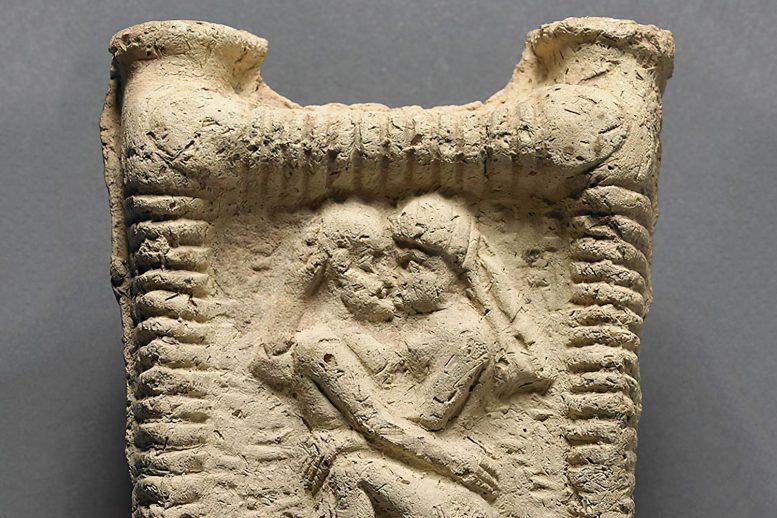
Written sources document that kissing was practiced by the peoples of the ancient Middle East 4,500 years ago, conclude researchers from the University of Copenhagen and University of Oxford in a new article published in the journal Science.
Researchers from the University of Copenhagen and the University of Oxford have published a new article in the journal Science presenting evidence that kissing was practiced in the ancient Middle East 4,500 years ago, predating previous theories by about 1,000 years. The team relied on written sources from Mesopotamian societies, which documented the act of kissing in various social contexts. The researchers suggest that the act of kissing is a fundamental human behavior, as demonstrated in studies of our closest animal relatives, bonobos, and chimpanzees. They also discussed the possibility that kissing could have played a role in the transmission of diseases like the herpes simplex virus 1, although they caution against assuming direct causation.
Recent research has hypothesized that the earliest evidence of human lip kissing originated in a very specific geographical location in South Asia 3,500 years ago, from where it may have spread to other regions, simultaneously accelerating the spread of the herpes simplex virus 1.
But according to Dr. Troels Pank Arbøll and Dr. Sophie Lund Rasmussen, who in a new article in the journal Science draw on a range of written sources from the earliest Mesopotamian societies, kissing was already a well-established practice 4,500 years ago in the Middle East. And probably much earlier, moving the earliest documentation for kissing back 1,000 years compared to what was previously acknowledged in the scientific community.
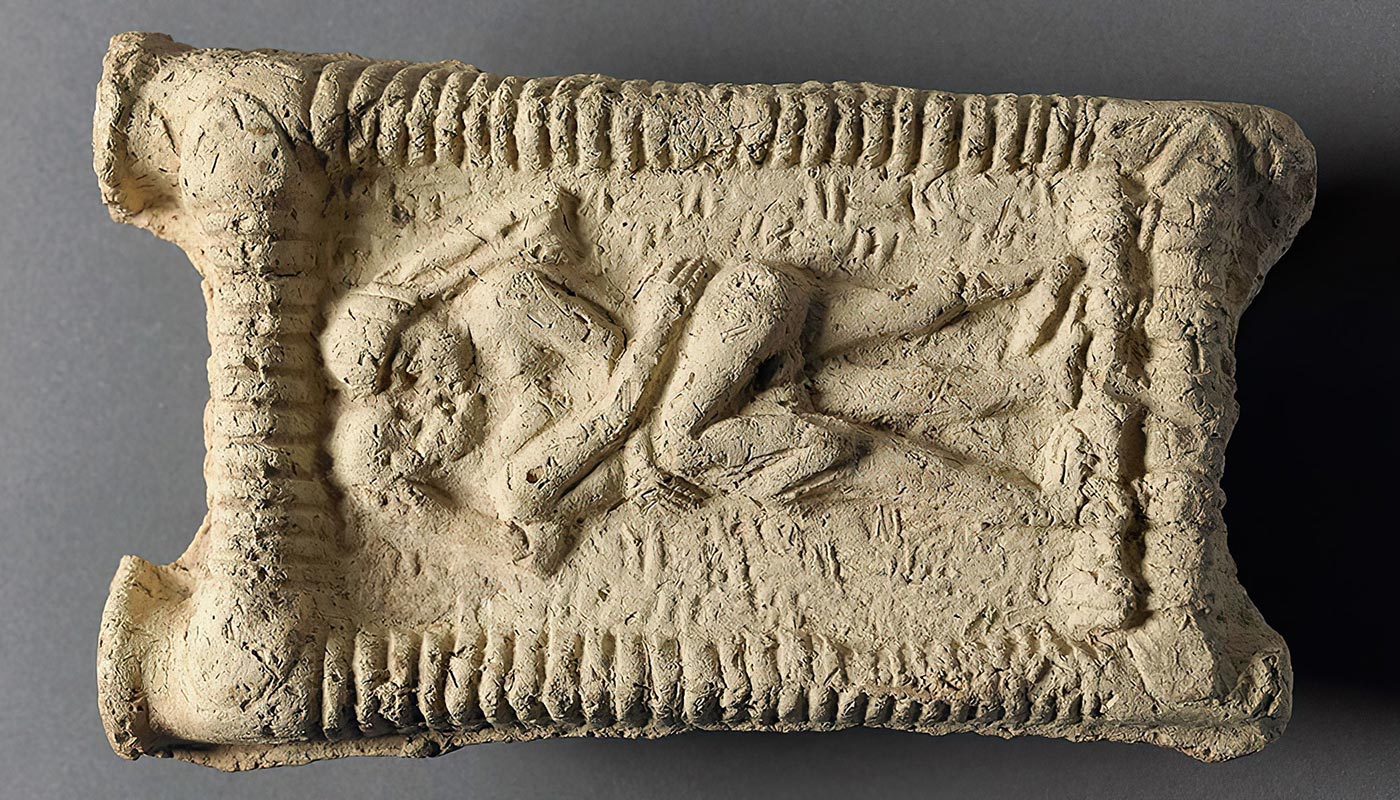
“In ancient Mesopotamia, which is the name for the early human cultures that existed between the Euphrates and Tigris rivers in present-day Iraq and Syria, people wrote in cuneiform script on clay tablets. Many thousands of these clay tablets have survived to this day, and they contain clear examples that kissing was considered a part of romantic intimacy in ancient times, just as kissing could be part of friendships and family members’ relations,” says Dr. Troels Pank Arbøll, an expert on the history of medicine in Mesopotamia.
He continues:
“Therefore, kissing should not be regarded as a custom that originated exclusively in any single region and spread from there but rather appears to have been practiced in multiple ancient cultures over several millennia.”
Dr. Sophie Lund Rasmussen adds:
“In fact, research into bonobos and chimpanzees, the closest living relatives to humans, has shown that both species engage in kissing, which may suggest that the practice of kissing is a fundamental behavior in humans, explaining why it can be found across cultures.”
Kissing As Potential Transmitter of Disease
In addition to its importance for social and sexual behavior, the practice of kissing may have played an unintentional role in the transmission of microorganisms, potentially causing viruses to spread among humans.
However, the suggestion that the kiss may be regarded as a sudden biological trigger behind the spread of particular pathogens is more doubtful. The spread of the herpes simplex virus 1, which researchers have suggested could have been accelerated by the introduction of the kiss, is a case in point:
“There is a substantial corpus of medical texts from Mesopotamia, some of which mention a disease with symptoms reminiscent of the herpes simplex virus 1,” Dr. Arbøll remarks.
He adds that the ancient medical texts were influenced by a variety of cultural and religious concepts, and it therefore must be emphasized that they cannot be read at face value.
“It is nevertheless interesting to note some similarities between the disease known as bu’shanu in ancient medical texts from Mesopotamia and the symptoms caused by herpes simplex infections. The bu’shanu disease was located primarily in or around the mouth and throat, and symptoms included vesicles in or around the mouth, which is one of the dominant signs of herpes infection.”
“If the practice of kissing was widespread and well-established in a range of ancient societies, the effects of kissing in terms of pathogen transmission most likely have been more or less constant”, says Dr. Rasmussen.
Dr. Arbøll and Dr. Rasmussen conclude that future results emerging from research into ancient DNA, inevitably leading to discussions about complex historical developments and social interactions – such as kissing as a driver of early disease transmission – will benefit from an interdisciplinary approach.
For more on this research, see Ancient History of Kissing and Its Role in Disease Transmission.
Reference: “The ancient history of kissing” by Troels Pank Arbøll and Sophie Lund Rasmussen, 18 May 2023, Science.
DOI: 10.1126/science.adf0512
Never miss a breakthrough: Join the SciTechDaily newsletter.
Follow us on Google and Google News.