
New research reveals that there was contact with Indigenous Americans before European arrival.
Rapa Nui, also known as Te Pito o Te Henua (the navel of the world) or Easter Island, stands as one of the most remote inhabited locales on the globe. Situated in the Pacific Ocean, it is over 1,900 km east of the nearest inhabited Polynesian island and 3,700 km west of South America. Despite thorough investigations by archaeologists, anthropologists, and geneticists into the island, its inhabitants, two key elements of Rapanui history remain very controversial to this day.
One of these is the theory of population collapse through “ecocide” or “ecological suicide” in the 1600s, thought to be the result of overpopulation and resource mismanagement. The other major contention is whether the Polynesian ancestors of the Rapanui interacted with Indigenous Americans before contact with Europeans in 1722.
A genetic study recently published in Nature sheds light on these two debates related to Rapanui history by examining the genomes of 15 Rapanui individuals who lived between 1670 and 1950. The remains of these 15 individuals are currently hosted at the Musée de l’Homme, in Paris.
The new study was carried out by an international team of scientists and was spearheaded by Assistant Professor Víctor Moreno-Mayar from the Globe Institute at the University of Copenhagen (Denmark), and PhD student Bárbara Sousa da Mota and Associate Prof. Anna-Sapfo Malaspinas from the Faculty of Biology and Medicine at the University of Lausanne (Switzerland), in close collaboration with colleagues in Rapa Nui as well as in Austria, France, Chile, Australia and U.S.A.
The collapse that never happened
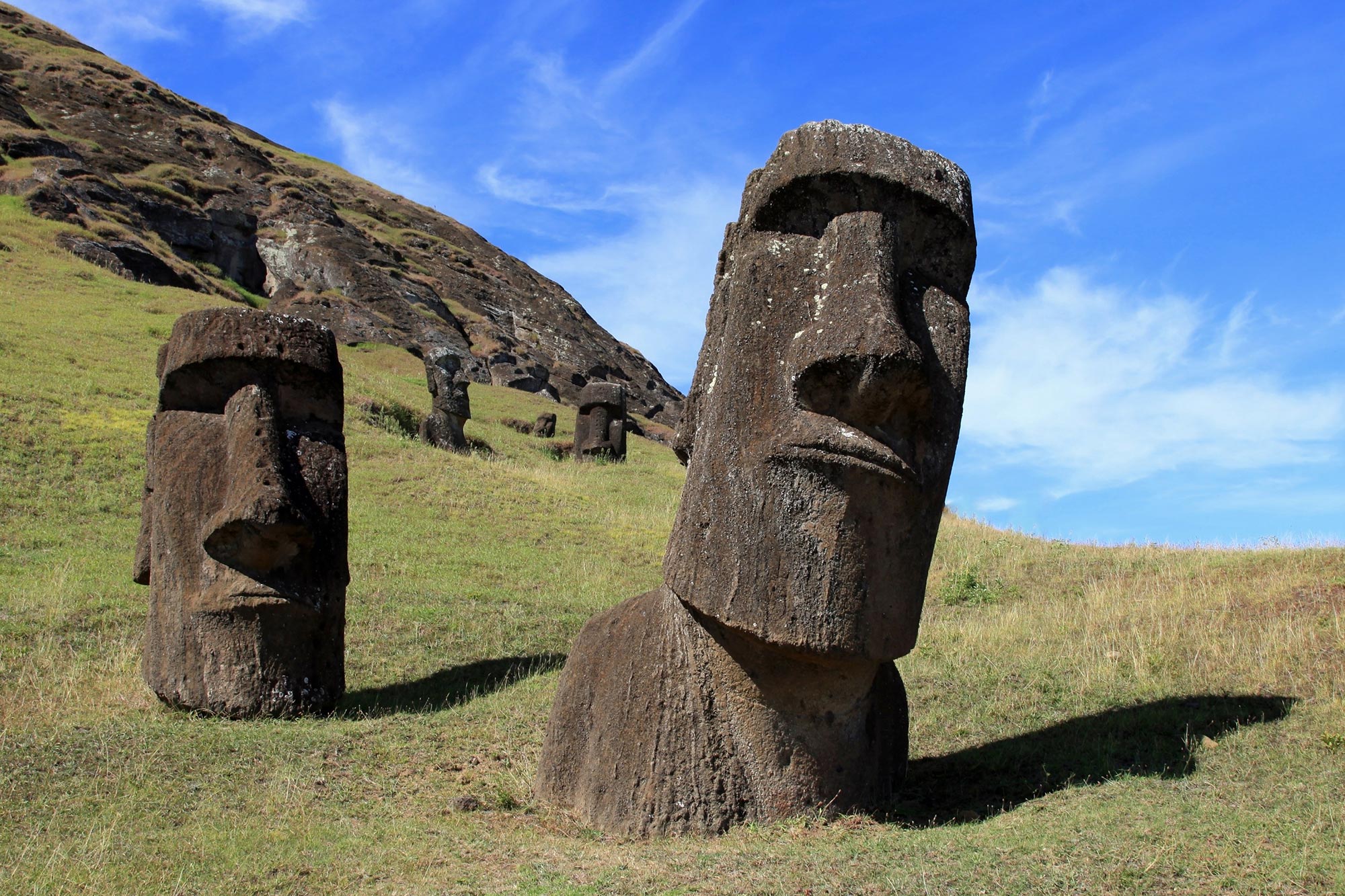
The story of the Rapanui has often been presented as a warning tale against humanity’s over-exploitation of resources. After Polynesians from the west peopled the island by 1250, the landscape on Rapa Nui changed drastically. Towering stone statues—the moai—were carved and placed in all corners of the island, while its original forest of millions of palm trees dwindled and, by the 1600s, was all but gone. According to the “ecocide” theory, a population of over 15,000 Rapanui individuals triggered these changes that led to a period of resource scarcity, famine, warfare, and even cannibalism culminating in a catastrophic population collapse.
“While it is well established that the environment of Rapa Nui was affected by anthropogenic activity, such as deforestation, we did not know if or how these changes led to a population collapse,” comments Anna-Sapfo Malaspinas, Assoc. Professor at the University of Lausanne and group leader at the SIB Swiss Institute of Bioinformatics, Switzerland, last author of the study.

The researchers looked into the genomes of the Ancient Rapanui individuals expecting to find a genetic signature of a population collapse such as a sudden drop in genetic diversity. But surprisingly, the data did not contain any evidence of a population collapse in the 1600s.
“Our genetic analysis shows a stably growing population from the 13th century through to European contact in the 18th century. This stability is critical because it directly contradicts the idea of a dramatic pre-contact population collapse,” says Bárbara Sousa da Mota, a researcher at the Faculty of Biology and Medicine at the University of Lausanne and first author of the study.
Through their genetic analysis, Moreno-Mayar, Sousa da Mota, Malaspinas, and their colleagues have not only provided evidence against the collapse theory, but also stressed the resilience of the Rapanui population facing environmental challenges over several centuries until the colonial disruptions that European contact brought after 1722.
Did Polynesians reach the Americas?
Another debate that has tantalized researchers for decades is whether Polynesians ever reached the Americas. Although long-distance maritime navigation using wooden watercraft likely halted after the Rapa Nui forest disappeared, archaeological and genetic evidence from contemporary individuals hints that voyages to the Americas did occur. However, previous studies looking at small amounts of DNA from ancient Polynesians had rejected the hypothesis that transpacific voyages took place. Thus, these findings have put into question whether Polynesians reached the Americas and have suggested that the inferred contact based on present-day genetic data was mediated by European colonial activity after 1722.
By generating high-quality ancient genomes from the 15 Rapanui individuals, the team substantially increased the amount of genomic data from the island and found that about ten percent of the Rapanui gene pool has an Indigenous American origin. But more importantly, they were able to infer both populations met before Europeans arrived on the island and in the Americas.
“We looked into how the Indigenous American DNA was distributed across the Polynesian genetic background of the Rapanui. This distribution is consistent with a contact occurring between the 13th and the 15th centuries, ” says first author Víctor Moreno-Mayar, Asst. Professor at the Globe Institute’s Section for Geogenetics, University of Copenhagen.
“While our study cannot tell us where this contact occurred, this might mean that the Rapanui ancestors reached the Americas before Christopher Columbus,” says Malaspinas.
Altogether, the results from the new study help settle longstanding debates that have led to years of speculation surrounding Rapanui history.
“Personally, I believe the idea of the ecocide is put together as part of a colonial narrative. That is this idea that these supposedly primitive people could not manage their culture or resources, and that almost destroyed them. But the genetic evidence shows the opposite. Although we have to acknowledge that the arrival of humans dramatically changed the ecosystem, there is no evidence of a population collapse before the Europeans arrived on the island. So we can put those ideas to rest now,” says Moreno-Mayar.
“Many thought that present-day Rapanui carry Indigenous American genetic ancestry due to European colonial activity. But instead, the data strongly suggests that Rapanui and Indigenous Americans met and admixed centuries before Europeans made it to Rapa Nui or the Americas. We believe this means that Rapanui were capable of even more formidable voyages across the Pacific than previously established, ” adds Sousa da Mota.
Future repatriation efforts
Importantly, the scientists held face-to-face discussions with members of the Rapanui community and the “Comisión Asesora de Monumentos Nacionales” in Rapa Nui (CAMN). These discussions allowed to steer the research and to define a set of research questions that were equally of high interest to the scientists and the community. For instance, the team was able to show that the populations closest to the ancient Rapanui are indeed those currently living on the island.
“We have seen that museum archives contain mistakes and mislabels. Now that we have established that these 15 individuals were in fact Rapanui we know that they belong back in the island,” says Moana Gorman Edmunds, an archaeologist in Rapa Nui and co-author of the study.
Furthermore, when ongoing results were presented to representatives of the Rapanui community, the need to repatriate their ancestors was discussed as a central goal for immediate future efforts.
“We now have a strong fact-based argument to start an important discussion about how and when these remains should be returned to the island. Furthermore, through the CAMN, the Rapanui community will stay in control of who gets the genetic data of our ancestors and what they use it for,” adds Gorman Edmunds.
Reference: “Ancient Rapanui genomes reveal resilience and pre-European contact with the Americas” by J. Víctor Moreno-Mayar, Bárbara Sousa da Mota, Tom Higham, Signe Klemm, Moana Gorman Edmunds, Jesper Stenderup, Miren Iraeta-Orbegozo, Véronique Laborde, Evelyne Heyer, Francisco Torres Hochstetter, Martin Friess, Morten E. Allentoft, Hannes Schroeder, Olivier Delaneau and Anna-Sapfo Malaspinas, 11 September 2024, Nature.
DOI: 10.1038/s41586-024-07881-4
Never miss a breakthrough: Join the SciTechDaily newsletter.
Follow us on Google and Google News.
5 Comments
Ok. So Rapa Nui was stable up to the 18th century. This is a bald-faced attempt to divert attention away from the collapse of Rapa Nui civilization after the rotten Brits and Peruvians arrived. Here are two points:
Introduction of European Diseases: After European contact in the 18th century, diseases like smallpox were introduced, devastating the population.
Slave Raids: In the 19th century, Peruvian slave traders captured a significant portion of the island’s population, including its leaders, further destabilizing the society.
Just a bit of good old fashioned “European colonial activity”, as the article puts it.
Same old story of European decimation of a native culture.
So perhaps Thor Heydahl’s now discredited notions of South Americans putting to sea on balsa-wood rafts have an element of truth; some such indigenous South American travellers did bump into Easter Island and leave their genes behind after helping design those magnificent statues with their red top-knots.
More speculation. How does an Unsubstantiated theory generate a hypothesis, get replaced by nothing more substantial other than popularity formerly for a new hypothesis on tiny data? Genetics
are indicators, not fact establishers.