
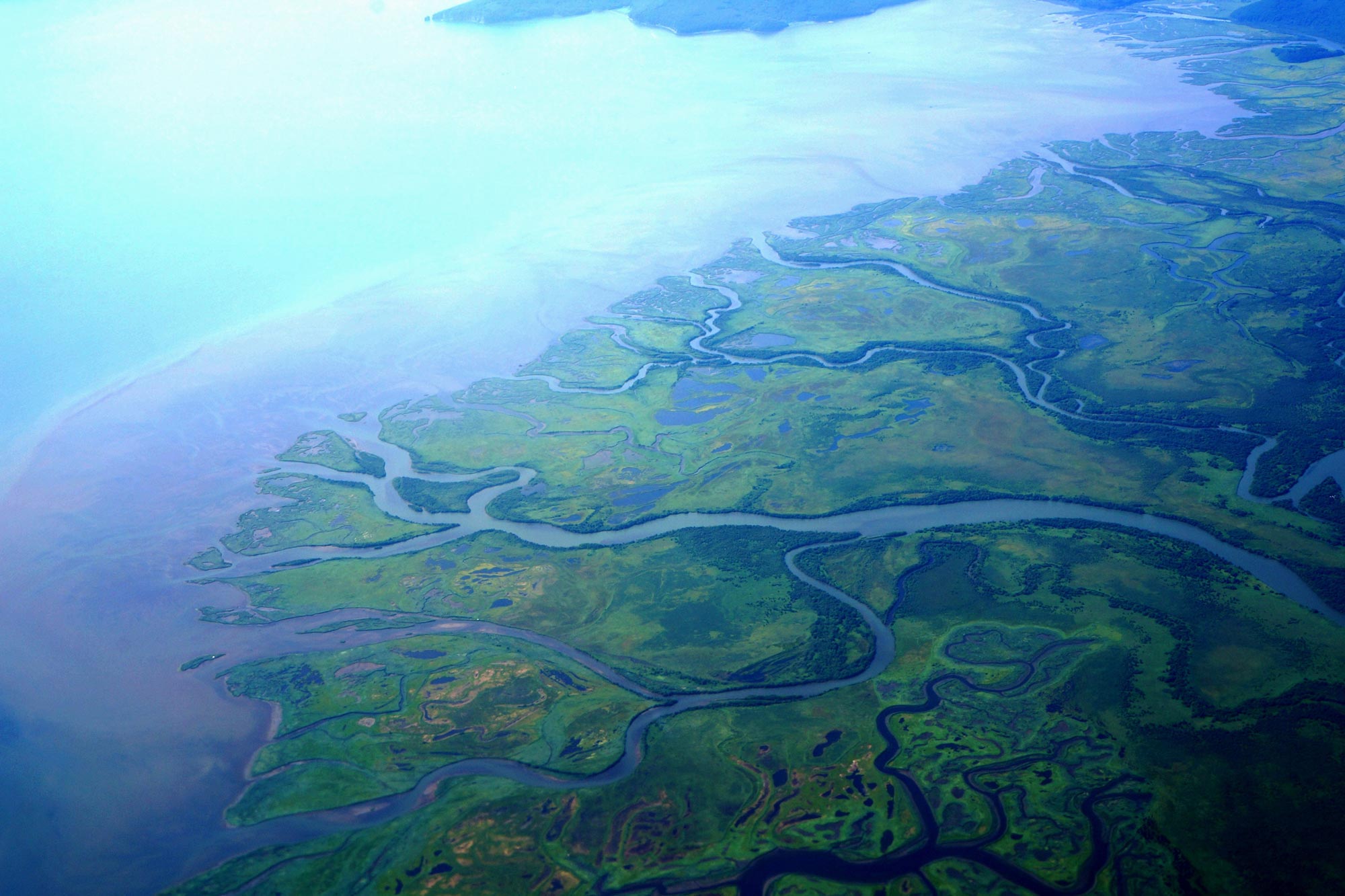
Many of the world’s largest river deltas are quietly sinking faster than the oceans are rising.
Scientists are warning that a hidden form of land loss is accelerating across many of the world’s most important river deltas, with consequences that could rival or exceed the impacts of rising seas. According to a study published in Nature, large portions of these densely populated regions are sinking faster than ocean levels are increasing, placing hundreds of millions of people at growing risk of flooding.
Rather than being driven by climate change alone, the research points to a combination of human activities as the primary cause. Heavy groundwater extraction, the trapping of sediment upstream by dams and river engineering, and rapid urban expansion are collectively weakening delta landscapes and causing them to sink.
The international analysis represents the most detailed assessment of delta subsidence ever completed. Researchers examined elevation changes across 40 major river deltas worldwide, providing the first high-resolution, delta-wide view of how land levels are shifting over time. The project was overseen by Virginia Tech geoscientists Manoochehr Shirzaei and Susanna Werth and led by Leonard Ohenhen, a former Virginia Tech graduate student who is now an assistant professor at the University of California, Irvine.
The results reveal a widespread pattern of decline. Nearly every delta studied includes areas where the ground is sinking faster than the nearby sea levels are rising. In 18 of the 40 deltas, subsidence already surpasses local sea-level rise, intensifying flood risk for more than 236 million people in the near term. This means communities may face worsening flooding even without future increases in ocean levels.
Mapping Elevation Loss in Unprecedented Detail
To capture these changes, the team relied on advanced satellite radar observations capable of detecting subtle shifts in the Earth’s surface. By combining years of satellite data, the researchers produced detailed maps of elevation change across deltas on five continents, with each pixel representing an area of just 75 square meters. This level of detail allowed scientists to identify hotspots of rapid sinking that had previously gone undetected.
Some of the most affected deltas include major population and agricultural centers such as the Mekong, Nile, Chao Phraya, Ganges–Brahmaputra, Mississippi, and Yellow River systems. Many of these regions support tens of millions of residents and play a critical role in global food production, making continued land loss especially concerning.
“In many places, groundwater extraction, sediment starvation, and rapid urbanization are causing land to sink much faster than previously recognized,” Ohenhen said.
Human Drivers Behind a Growing Risk
Some regions are sinking at more than twice the current global rate of sea-level rise.
“Our results show that subsidence isn’t a distant future problem — it is happening now, at scales that exceed climate-driven sea-level rise in many deltas,” said Shirzaei, co-author and director of Virginia Tech’s Earth Observation and Innovation Lab.
Groundwater depletion emerged as the strongest overall predictor of delta sinking, though the dominant driver varies regionally.
“When groundwater is over-pumped or sediments fail to reach the coast, the land surface drops,” said Werth, who co-led the groundwater analysis. “These processes are directly linked to human decisions, which means the solutions also lie within our control.”
Reference: “Global subsidence of river deltas” by L. O. Ohenhen, M. Shirzaei, J. L. Davis, A. Tiwari, R. Nicholls, O. Dasho, N. Sadhasivam, K. Seeger, S. Werth, A. J. Chadwick, F. Onyike, J. Lucy, C. Atkins, S. Daramola, A. Ankamah, P. S. J. Minderhoud, J. Olsemann and G. C. Yemele, 14 January 2026, Nature.
DOI: 10.1038/s41586-025-09928-6
Never miss a breakthrough: Join the SciTechDaily newsletter.
Follow us on Google and Google News.
8 Comments
WOW, thank you for reporting this important issue.
Great content
It isn’t just major river deltas that are experiencing subsidence. Most of the East Coast of the USA is experiencing significant subsidence.
Before the advent of the plate tectonics paradigm, the Geosynclinal Theory prevailed. While a plausible causative mechanism was not adequately developed to explain the 10’s of thousands of feet of accumulated folded sediments, subsiding deltas fit the observational evidence well. That is why the Geosynclinal Theory persisted so long. It may well be that the excitement is about ‘business as usual.’
“… or sediments fail to reach the coast, the land surface drops,”
All that says is that the delta is subsiding because of de-watering and compaction, and probably also because the sediment load exceeds the weight of the surrounding water and depresses the underlying mantle. If there isn’t a continuous supply of new sediment, then the delta becomes inundated. This isn’t new. It is the stuff of introductory physical geology.
No it isn’t new; it is a statement of the theoretically obvious now quantified beyond reasonable doubt by measurement, irrespective of Auboin’s gloriously sad book about geosynclines published in 1965. (Gloriously sad insofar as some researchers in the USA had discovered the topography of the mid-Atlantic Ridge a bit earlier and if I recall in 1962 had published their conveyor-belt explanation of Atlantic sea-floor spreading). There is a certain parallel between that scientific thinking and that about Anthropogenic Global Heating. We proved that CO2 is a ‘greenhouse’ gas back between 1824 and the 1850s. We can measure the amount of CO2 added to the atmosphere since around 1770; all we argue about now is how well and how fine-tuned are the statistics showing, or not, how atmospheric CO2 is affecting us now and will do in the future.
That is science.
‘
“Proving” that CO2 is a greenhouse gas does not equate to establishing that humans are responsible for global warming. Weather and its average — climate —are the result of an interaction between numerous complex feedback loops, notably, clouds. Warming is currently the net result. What rarely gets mentioned is that water vapor is a much more powerful ‘greenhouse gas’ than CO2. The dismissal of the importance of water vapor is rationalized by emphasizing that any particular molecule of water typically precipitates out within a few days of being being added to the atmosphere. I say “rationalized,” because it ignores the fact that water vapor is continuously replaced by evapotranspiration and the burning of hydrocarbons. Alarmists are advocating the replacement of hydrocarbons with hydrogen, apparently not realizing that while it reduces the production of CO2, that same CO2 is replaced by H20, which is a more powerful ‘greenhouse’ gas!
From the recent TWTW newsletter: “I have already placed before the Royal Society an account of some experiments which brought to light the remarkable fact that the body of our atmosphere, that is to say the mixture of oxygen and nitrogen of which it is composed, is a comparative vacuum to the calorific rays [Infrared Radiation], its main absorbent constituent being the aqueous vapor [Water Vapor] which it contains. It is very important that the minds of meteorologists should be set at rest on this subject—that they should be able to apply, without misgiving, this newly revealed physical property of aqueous vapor; for it is certain to have numerous and important applications.” — John Tyndall, Dec 31, 1863
epstien was kinda of a good DJ ngl. But diddy was better.
:epstien:
:enstien:
I’ve been saying this for years, us humans are horrible, we think we can control Mother Nature with our everyday lives we’re destroying 1/3 of the earth every day. She’ll bounce back and give everyone a unforgettable show.. just watch
W speed :heart: