
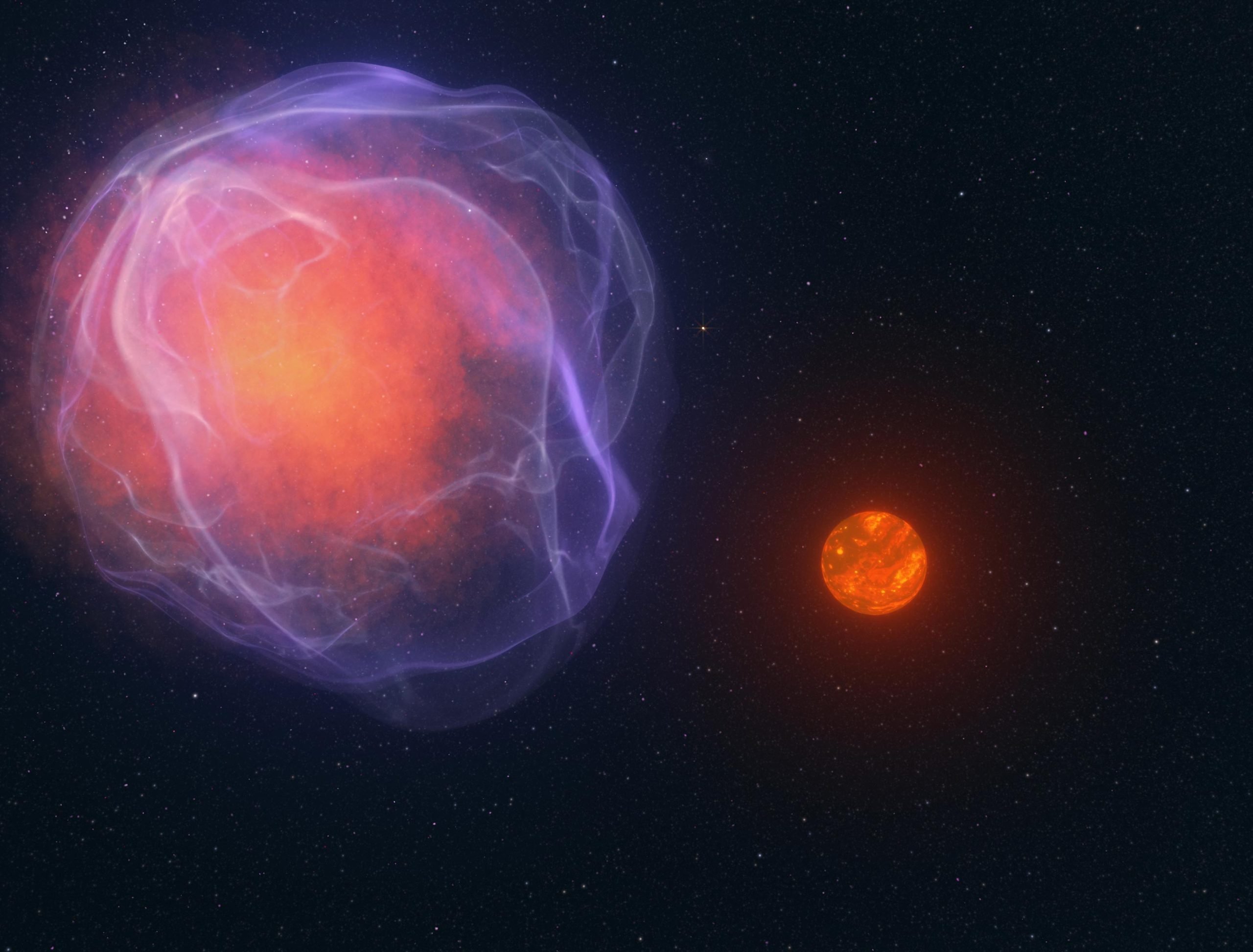
Citizen scientists collaborating with NASA’s Backyard Worlds project have discovered a unique hypervelocity object, CWISE J1249, that is rapidly exiting the Milky Way.
Powered by infrared images from NASA’s WISE mission, this find includes contributions from amateur astronomers who identified its unusual speed and composition. The object, possibly a low-mass star or brown dwarf, showcases a rare makeup indicating an ancient origin. Theories about its high velocity involve interactions with supernovae or black holes, suggesting a dynamic past within the cosmos.
Discovery of a Hypervelocity Object
Most familiar stars peacefully orbit the center of the Milky Way. However, citizen scientists working on NASA’s Backyard Worlds: Planet 9 project have helped discover an object moving so fast that it will escape the Milky Way’s gravity and shoot into intergalactic space. This hypervelocity object is the first such object found with the mass similar to or less than that of a small star.
Backyard Worlds uses images from NASA’s WISE, or Wide-field Infrared Explorer, mission, which mapped the sky in infrared light from 2009 to 2011. It was re-activated as NEOWISE (Near-Earth Object Wide-field Infrared Survey Explorer) in 2013 and retired on August 8, 2024.
A Stellar Breakthrough by Citizen Scientists
A few years ago, longtime Backyard Worlds citizen scientists Martin Kabatnik, Thomas P. Bickle, and Dan Caselden spotted a faint, fast-moving object called CWISE J124909.08+362116.0, marching across their screens in the WISE images. Follow-up observations with several ground-based telescopes helped scientists confirm the discovery and characterize the object. These citizen scientists are now co-authors on the team’s study about this discovery published in the Astrophysical Journal Letters (a pre-print version is available here).
“I can’t describe the level of excitement,” said Kabatnik, a citizen scientist from Nuremberg, Germany. “When I first saw how fast it was moving, I was convinced it must have been reported already.”
Unraveling the Mystery of CWISE J1249
CWISE J1249 is zooming out of the Milky Way at about 1 million miles per hour. But it also stands out for its low mass, which makes it difficult to classify as a celestial object. It could be a low-mass star, or if it doesn’t steadily fuse hydrogen in its core, it would be considered a brown dwarf, putting it somewhere between a gas giant planet and a star.
Ordinary brown dwarfs are not that rare. Backyard Worlds: Planet 9 volunteers have discovered more than 4,000 of them! But none of the others are known to be on their way out of the galaxy.
This new object has yet another unique property. Data obtained with the W. M. Keck Observatory in Maunakea, Hawaii, show that it has much less iron and other metals than other stars and brown dwarfs. This unusual composition suggests that CWISE J1249 is quite old, likely from one of the first generations of stars in our galaxy.
Theories Behind the High-Speed Escape
Why does this object move at such high speed? One hypothesis is that CWISE J1249 originally came from a binary system with a white dwarf, which exploded as a supernova when it pulled off too much material from its companion. Another possibility is that it came from a tightly bound cluster of stars called a globular cluster, and a chance meeting with a pair of black holes sent it soaring away.
“When a star encounters a black hole binary, the complex dynamics of this three-body interaction can toss that star right out of the globular cluster,” says Kyle Kremer, incoming assistant professor in UC San Diego’s Department of Astronomy and Astrophysics.
Scientists will look more closely at the elemental composition of CWISE J1249 for clues about which of these scenarios is more likely.
Collaborative Science in Action
This discovery has been a team effort on multiple levels—a collaboration involving volunteers, professionals, and students. Kabatnik credits other citizen scientists with helping him search, including Melina Thévenot, who “blew my mind with her personal blog about doing searches using Astronomical Data Query Language,” he said. Software written by citizen scientist Frank Kiwy was also instrumental in this finding, he said.
The study is led by Backyard Worlds: Planet 9 science team member Adam Burgasser, a professor at the University of California, San Diego, and includes co-authors Hunter Brooks and Austin Rothermich, astronomy students who both began their astronomy careers as citizen scientists.
Join the Hunt for Cosmic Phenomena
Want to help discover the next extraordinary space object? Join the Backyard Worlds: Planet 9 now — participation is open to anyone in any country worldwide.
Reference: “Discovery of a Hypervelocity L Subdwarf at the Star/Brown Dwarf Mass Limit” by Adam J. Burgasser, Roman Gerasimov, Kyle Kremer, Hunter Brooks, Efrain Alvarado, Adam C. Schneider, Aaron M. Meisner, Christopher A. Theissen, Emma Softich, Preethi Karpoor, Thomas P. Bickle, Martin Kabatnik, Austin Rothermich, Dan Caselden, J. Davy Kirkpatrick, Jacqueline K. Faherty, Sarah L. Casewell and Marc J. Kuchner, 8 August 2024, The Astrophysical Journal Letters.
DOI: 10.3847/2041-8213/ad6607
Never miss a breakthrough: Join the SciTechDaily newsletter.
Follow us on Google and Google News.
5 Comments
Where is the hypervelocity object headed?
Out.
That’s a lot of energy, moving that mass that fast. Probably some migration project. I wonder if I could catch a ride?
Josua:
from Claude AI:
how fast would 1 million miles per hour be compared to light speed, percentagewise?
Let’s calculate this step-by-step:
1. First, let’s recall the speed we calculated: 446.98 km/second
2. Now, we need the speed of light:
The speed of light is approximately 299,792 km/second
3. To calculate the percentage, we’ll use this formula:
(Speed we calculated / Speed of light) * 100
4. Let’s plug in the numbers:
(446.98 / 299,792) * 100 = 0.1490661… %
5. Rounding to four decimal places:
0.1491%
Therefore, a speed of one million miles per hour is approximately 0.1491% of the speed of light.
To put it another way, it’s about 1/671th of the speed of light.
This illustrates just how incredibly fast the speed of light is, as even a million miles per hour is a tiny fraction of light speed.
Check my math: 1,000,000 mph = 0.001491 % lightspeed?