
Close Menu
    Facebook X (Twitter) Instagram
    SciTechDaily
    • Biology
    • Chemistry
    • Earth
    • Health
    • Physics
    • Science
    • Space
    • Technology
    Facebook X (Twitter) Pinterest YouTube RSS
    SciTechDaily
    Home»Space»Astronomers Reveal the Rotation of the Hot Gas Around the Milky Way
    Space

    Astronomers Reveal the Rotation of the Hot Gas Around the Milky Way

    By Felicia Chou, NASA HeadquartersJuly 27, 20161 Comment3 Mins Read
    Facebook Twitter Pinterest Telegram LinkedIn WhatsApp Email Reddit
    Share
    Facebook Twitter LinkedIn Pinterest Telegram Email Reddit
    Astronomers Discover Dizzying Spin of the Milky Way’s Halo
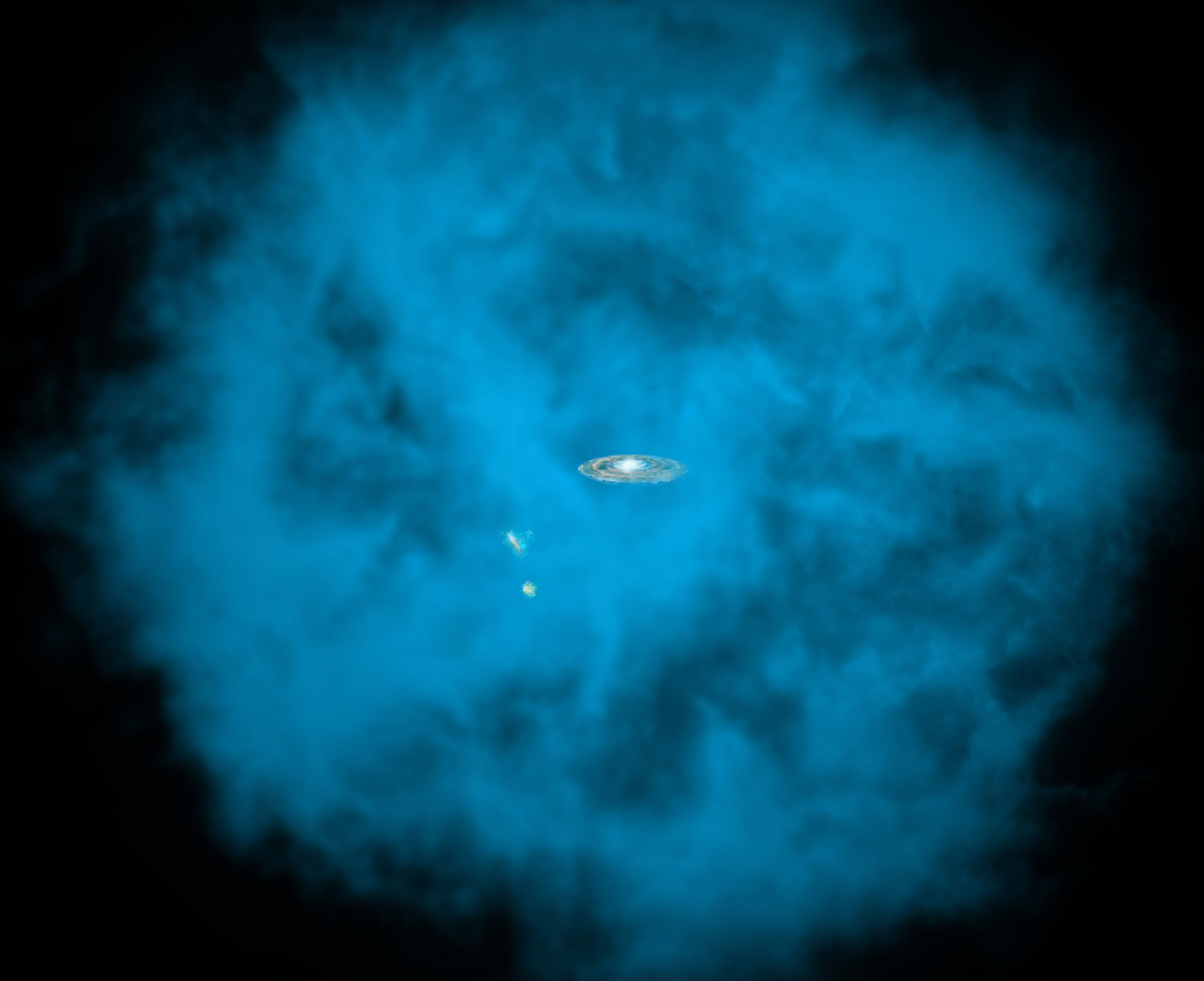
    Our Milky Way galaxy and its small companions are surrounded by a giant halo of million-degree gas (seen in blue in this artist’s rendition) that is only visible to X-ray telescopes in space. University of Michigan astronomers discovered that this massive hot halo spins in the same direction as the Milky Way disk and at a comparable speed.

    A team of astronomers has discovered that the hot gas in the halo of the Milky Way galaxy is spinning in the same direction and at comparable speed as the galaxy’s disk, which contains our stars, planets, gas, and dust. This new knowledge sheds light on how individual atoms have assembled into stars, planets, and galaxies like our own, and what the future holds for these galaxies.

    “This flies in the face of expectations,” says Edmund Hodges-Kluck, assistant research scientist. “People just assumed that the disk of the Milky Way spins while this enormous reservoir of hot gas is stationary – but that is wrong. This hot gas reservoir is rotating as well, just not quite as fast as the disk.”

    The new NASA-funded research using the archival data obtained by XMM-Newton, a European Space Agency telescope, was recently published in the Astrophysical Journal. The study focuses on our galaxy’s hot gaseous halo, which is several times larger than the Milky Way disk and composed of ionized plasma.

    Because motion produces a shift in the wavelength of light, the U-M researchers measured such shifts around the sky using lines of very hot oxygen. What they found was groundbreaking: The line shifts measured by the researchers show that the galaxy’s halo spins in the same direction as the disk of the Milky Way and at a similar speed—about 400,000 mph for the halo versus 540,000 mph for the disk.

    “The rotation of the hot halo is an incredible clue to how the Milky Way formed,” said Hodges Kluck. “It tells us that this hot atmosphere is the original source of a lot of the matter in the disk.”

    Scientists have long puzzled over why almost all galaxies, including the Milky Way, seem to lack most of the matter that they otherwise would expect to find. Astronomers believe that about 80% of the matter in the universe is the mysterious “dark matter” that, so far, can only be detected by its gravitational pull. But even most of the remaining 20% of “normal” matter is missing from galaxy disks. More recently, some of the “missing” matter has been discovered in the halo. The U-M researchers say that learning about the direction and speed of the spinning halo can help us learn both how the material got there in the first place, and the rate at which we expect the matter to settle into the galaxy.

    “Now that we know about the rotation, theorists will begin to use this to learn how our Milky Way galaxy formed – and its eventual destiny,” says Joel Bregman, a U-M LSA professor of astronomy.

    “We can use this discovery to learn so much more – the rotation of this hot halo will be a big topic of future X-ray spectrographs,” Bregman says.

    Reference: “The Rotation of the Hot Gas Around the Milky Way” by Edmund J. Hodges-Kluck, Matthew J. Miller and Joel N. Bregman, 27 April 2016, The Astrophysical Journal.
    DOI: 10.3847/0004-637X/822/1/21
    arXiv:1603.07734

    Never miss a breakthrough: Join the SciTechDaily newsletter.
    Follow us on Google and Google News.

    Astronomy Astrophysics Cosmology Milky Way NASA Popular
    Share. Facebook Twitter Pinterest LinkedIn Email Reddit

    Related Articles

    Astronomers Reveal the Hidden Magnetic Skeleton of the Milky Way

    Hypervelocity Escape: NASA Spots Mysterious Object Moving at 1 Million Miles per Hour

    Galactic Collision Captured in Stunning Detail: NASA’s Webb & Hubble Unite To Create Most Colorful View of Universe

    Evidence of Galaxy Star Birth Regulated by Black Holes

    Planck Space Telescope Reveals the Magnetic Field Lines of the Milky Way

    Hubble Reveals the First Visual Evidence of Changes in the Milky Way

    NASA Data Suggests Black Holes Abundant Among the Earliest Stars

    Fermi’s Motion Captured by Vela Pulsar Video

    The Bolshoi Simulation: Boxing the Universe

    1 Comment

    1. Madanagopal.V.C. on July 31, 2016 4:06 am

      Rotation of Hot gases are found not only around our Milky Way but also around Large and Small Magellanic clouds which are our neighbors and this phenomena is seen to be precursor of accretion of gases first and then the stars slowly from the neighboring galaxies in the process of galactic cannibalization. Thank You.

      Reply
    Leave A Reply Cancel Reply

    • Facebook
    • Twitter
    • Pinterest
    • YouTube

    Don't Miss a Discovery

    Subscribe for the Latest in Science & Tech!

    Trending News

    Breakthrough Bowel Cancer Trial Leaves Patients Cancer-Free for Nearly 3 Years

    Natural Compound Shows Powerful Potential Against Rheumatoid Arthritis

    100,000-Year-Old Neanderthal Fossils in Poland Reveal Unexpected Genetic Connections

    Simple “Gut Reset” May Prevent Weight Gain After Ozempic or Wegovy

    2.8 Days to Disaster: Scientists Warn Low Earth Orbit Could Suddenly Collapse

    Common Food Compound Shows Surprising Power Against Superbugs

    5 Simple Ways To Remember More and Forget Less

    The Atomic Gap That Could Cost the Semiconductor Industry Billions

    Follow SciTechDaily
    • Facebook
    • Twitter
    • YouTube
    • Pinterest
    • Newsletter
    • RSS
    SciTech News
    • Biology News
    • Chemistry News
    • Earth News
    • Health News
    • Physics News
    • Science News
    • Space News
    • Technology News
    Recent Posts
    • Total Solar Eclipse Made Cities Go Eerily Quiet Beneath the Surface
    • This Common Plant Could Be an Unexpected New Source of Protein
    • Birds in Cities Fear Women More Than Men and Scientists Don’t Know Why
    • Scientists Warn That This Common Pet Fish Can Wreck Entire Ecosystems
    • Scientists Just Made Carbon Capture Much Cheaper and Easier
    Copyright © 1998 - 2026 SciTechDaily. All Rights Reserved.
    • Science News
    • About
    • Contact
    • Editorial Board
    • Privacy Policy
    • Terms of Use

    Type above and press Enter to search. Press Esc to cancel.