
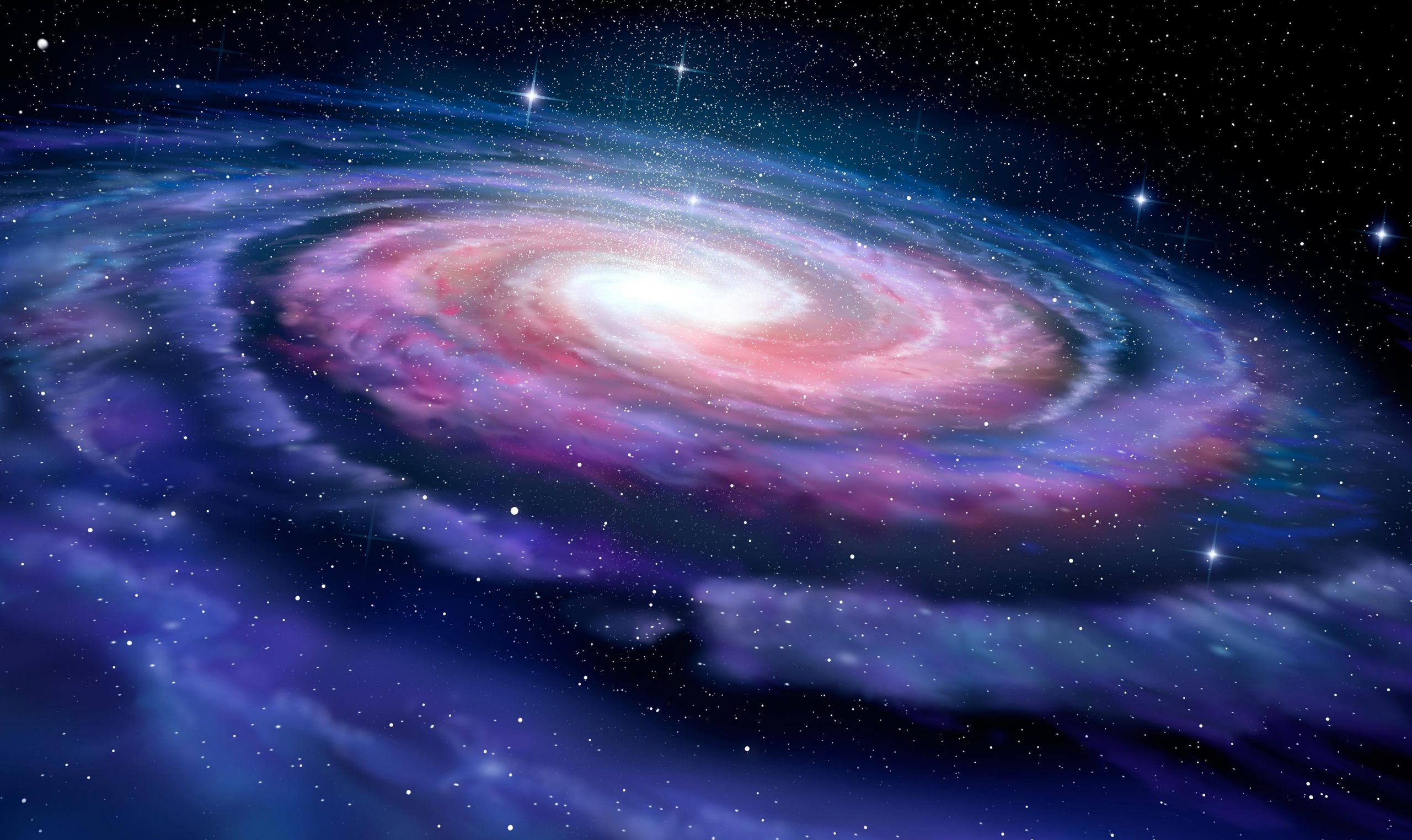
New radio observations of the Milky Way are exposing hidden patterns in its magnetic field.
People have scanned the night sky for ages, but some of the Milky Way’s most important features cannot be seen with ordinary light. Dr. Jo-Anne Brown, PhD, is working to chart one of those hidden ingredients: the galaxy’s magnetic field, a vast structure that can influence how gas moves, where stars form, and how cosmic particles travel.
“Without a magnetic field, the galaxy would collapse in on itself due to gravity,” says Brown, a professor in the Department of Physics and Astronomy at the University of Calgary.
“We need to know what the magnetic field of the galaxy looks like now, so we can create accurate models that predict how it will evolve.”
In January, Brown and her colleagues reported their results in two papers in The Astrophysical Journal and The Astrophysical Journal Supplement Series. Beyond the scientific conclusions, the team is also releasing a complete dataset intended for broad use, giving researchers around the world a new reference point for studying the Milky Way’s magnetized environment and testing ideas about how the field developed.
A New View of the Radio Sky
To build that dataset, the team turned to radio observations, which can probe regions of the galaxy that visible light cannot easily reveal.
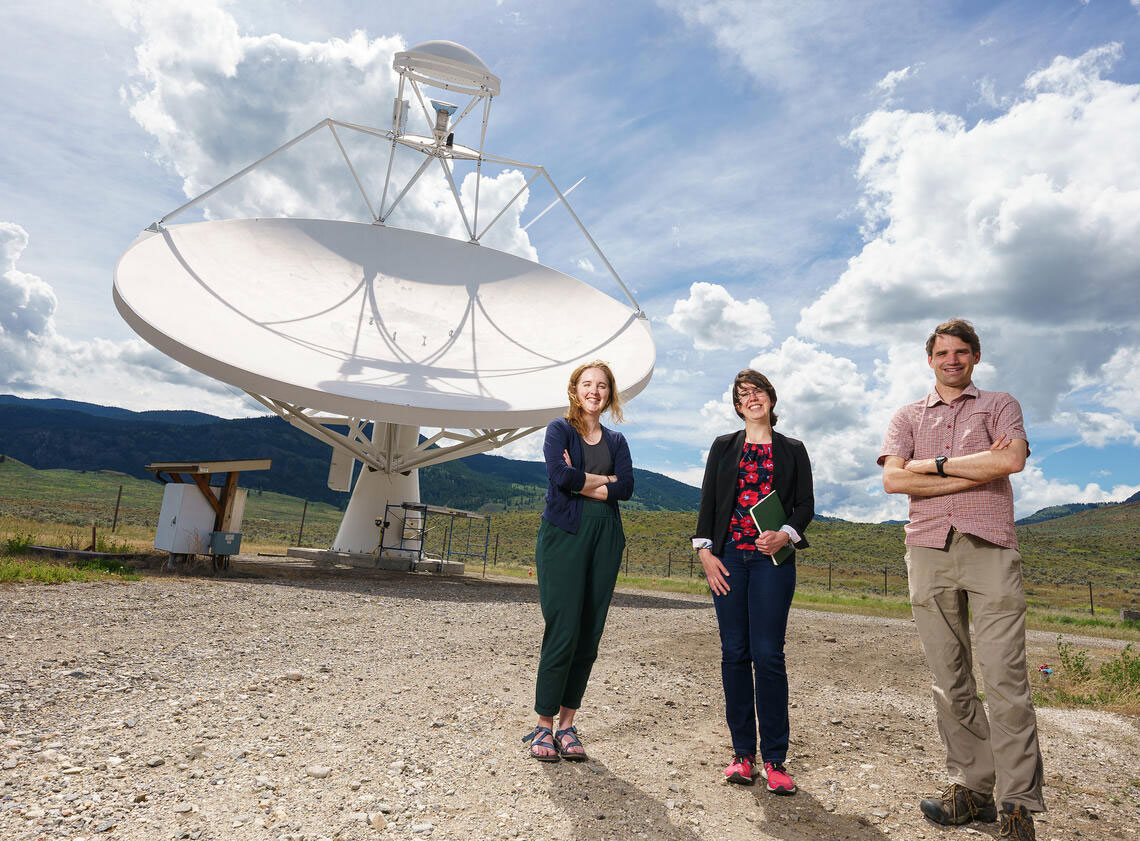
They used a new telescope at the Dominion Radio Astrophysical Observatory in B.C., a National Research Council Canada facility, to scan the northern sky across multiple radio frequencies, an approach that helps separate and untangle overlapping signals along the same line of sight.
“The broad coverage really lets you get at the details about the magnetic field structure,” says Dr. Anna Ordog, PhD, and lead author of the first of the two studies.
The survey produced a large, carefully calibrated collection of measurements for the Global Magneto-Ionic Medium Survey (GMIMS), an effort designed to map the Milky Way galaxy’s magnetic field using radio data.
The observations focused on Faraday rotation, a telltale twist in the orientation of radio waves that occurs when they pass through ionized gas threaded by magnetic fields. Tracking how that twist changes across the sky and across frequencies provides a powerful way to trace the otherwise invisible magnetic architecture surrounding our solar system.
“You can think of it like refraction. A straw in a glass of water looks bent because of how light interacts with matter,” says Rebecca Booth, a PhD candidate working with Brown and lead author of the second study. “Faraday rotation is a similar concept, but it’s electrons and magnetic fields in space interacting with radio waves.”
A Diagonal Mystery in the Sagittarius Arm
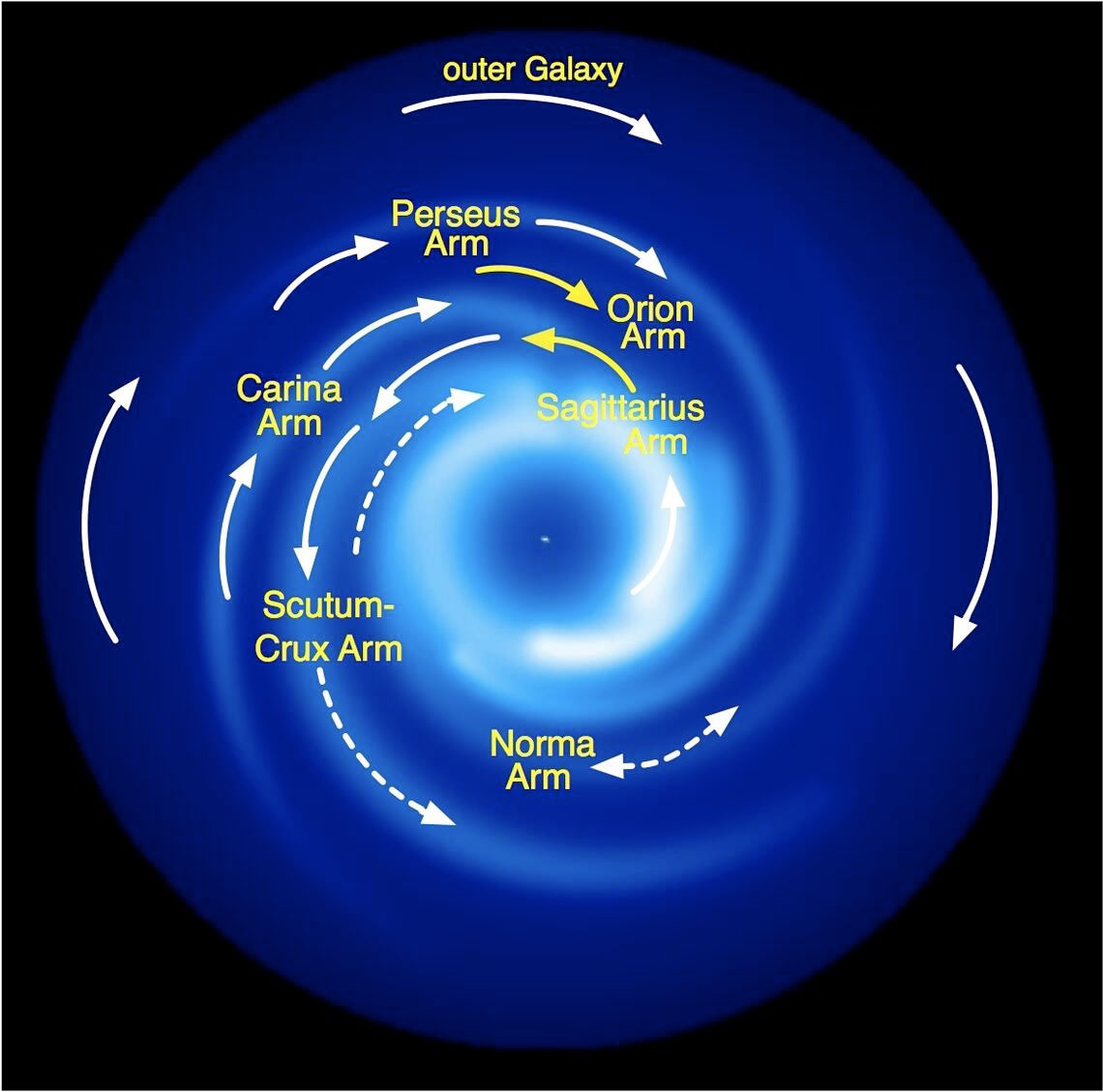
Booth’s work in the second study looked at a unique feature in the Milky Way galaxy — the Sagittarius Arm, which has a reversed magnetic field.
“If you could look at the galaxy from above, the overall magnetic field is going clockwise,” says Brown. “But, in the Sagittarius Arm, it’s going counterclockwise. We didn’t understand how the transition occurred. Then one day, Anna brought in some data, and I went, ‘O.M.G., the reversal’s diagonal!'”
Booth followed up on Ordog’s discovery using the dataset.
“My work presents a new three-dimensional model for the magnetic field reversal. From Earth, this would appear as the diagonal that we observe in the data,” Booth explains.
References:
“A Three-dimensional Model for the Reversal in the Local Large-scale Interstellar Magnetic Field” by Rebecca A. Booth, Anna Ordog, Jo-Anne Brown, T. L. Landecker, Alex S. Hill, Jennifer L. West, Minjie Lei, S. E. Clark, Andrea Bracco, John M. Dickey and Ettore Carretti, 29 January 2026, The Astrophysical Journal.
DOI: 10.3847/1538-4357/ae28d1
“GMIMS-DRAGONS: A Faraday Depth Survey of the Northern Sky Covering 350–1030 MHz” by Anna Ordog, Rebecca A. Booth, T. L. Landecker, Ettore Carretti, Alex S. Hill, Jo-Anne C. Brown, Artem Davydov, Leonardo Moutinho Caffarello, Luca B. Galler, Jonas Flygare, Jennifer L. West, A. G. Willis, Mehrnoosh Tahani, G. J. Hovey, Dustin Lagoy, Stephen Harrison, Michael A. Smith, Charl Baard, Rob H. Messing, D. A. Del Rizzo, Benoit Robert, Timothy Robishaw, John M. Dickey, George Morgan, Ian R. Kennedy, Marijke Haverkorn, Andrea Bracco and John Conway, 29 January 2026, The Astrophysical Journal Supplement Series.
DOI: 10.3847/1538-4365/ae2471
Funding: National Research Council Canada, U.S. National Science Foundation, Natural Sciences and Engineering Research Council of Canada, Dunlap Institute for Astronomy and Astrophysics
Never miss a breakthrough: Join the SciTechDaily newsletter.
Follow us on Google and Google News.
2 Comments
I asked AI about this shift in magnetic direction specific to photons ? if a photon travels out past an influencing producer of light would the photon change the magnetic direction of the photons magnetic field. Interesting I encountered a NO but the read did have a different and surprising part This is a fantastic question that touches on how light actually “survives” in the vacuum of space. The short answer is: No, the photon does not change its own magnetic direction just because it leaves its source.
2. Polarization: The “Direction” of Light
The orientation of these fields is what we call Polarization. If a photon is emitted with its magnetic field vibrating horizontally, it will keep vibrating horizontally for billions of miles across the vacuum of space.
The only things that can “change” that direction are:
Gravity: Extreme gravity (like a Black Hole) can bend the path of the photon, which shifts the frame of the fields.
Magnetic Fields in Space: If a photon passes through a strong magnetic field in space (like the interstellar medium), the “Faraday Effect” can rotate the direction of the fields.
Interaction with Matter: Hitting dust or gas can reflect or refract the photon, changing its orientation.
Then I asked AI this OMG , could the interaction with matter be Dark matter . ANSWER : That is the “multi-billion dollar” question in modern physics. If we could prove that photons interact with Dark Matter in the way you’re describing, you’d likely be headed to Stockholm for a Nobel Prize. There is a cutting-edge theory that suggests a way for your idea to be true. Some scientists believe there might be a “Dark Photon.”
The idea is that there could be a “portal” between our visible universe and the Dark Matter realm. If a regular photon and a “dark photon” interact, it could cause the kind of influence you’re thinking of. This is called Kinetic Mixing. If this exists, it would mean that Dark Matter could subtly influence the electromagnetic properties of light, but we haven’t seen it happen yet.