
Close Menu
    Facebook X (Twitter) Instagram
    SciTechDaily
    • Biology
    • Chemistry
    • Earth
    • Health
    • Physics
    • Science
    • Space
    • Technology
    Facebook X (Twitter) Pinterest YouTube RSS
    SciTechDaily
    Home»Space»IAU Changes the Astronomical Unit From Equation to Number
    Space

    IAU Changes the Astronomical Unit From Equation to Number

    By SciTechDailySeptember 14, 20128 Comments2 Mins Read
    Facebook Twitter Pinterest Telegram LinkedIn WhatsApp Email Reddit
    Share
    Facebook Twitter LinkedIn Pinterest Telegram Email Reddit
    Astronomical-unit-chalkboard
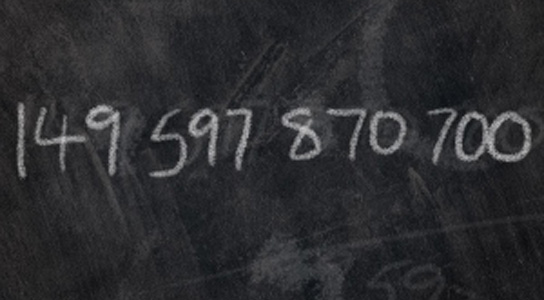
    The Astronomical Unit has been simplified from a complex equation to a straightforward number.

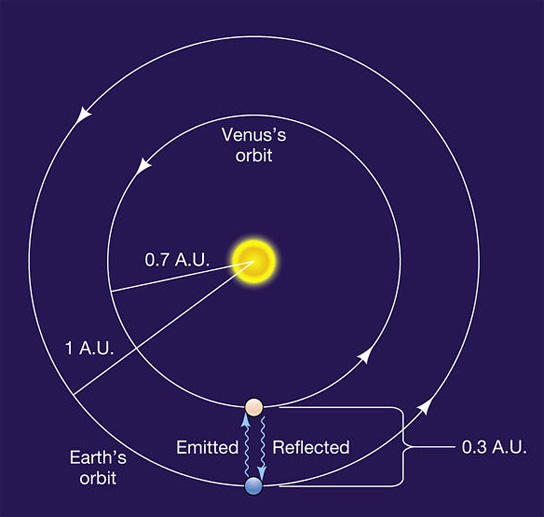
    Astronomers have redefined one of the most commonly used stellar distances, the astronomical unit (AU). Based on the rough distance from Sol to Earth, AU has been transformed from a confusing equation to a simple number.

    Astronomers had adopted this simplification at this past summer’s International Astronomical Union meeting in Beijing, China, making the astronomical unit (AU) 149,597,870,700 meters.
    graph-astronomical-unit

    Previously, the AU was known as the radius of an unperturbed circular Newtonian orbit about the Sun of a particle having infinitesimal mass, moving with a mean motion of 0.01720209895 radians per day (known as the Gaussian constant).

    While it baffled astronomy students, it also clashed with Einstein’s general theory of relativity, which tended to shift the AU’s distance by about a thousand kilometers, depending on where the observer is located. Traditionally, the AU is linked to the mass of Sol, but since Sol is continually losing mass, the AU has been slowly changing as well.

    With the AU being a single number, it simplifies all of these problems and stays away from issues linked to the location of the observer. It is now a fixed number of kilometers, which is far easier to understand.

    Never miss a breakthrough: Join the SciTechDaily newsletter.
    Follow us on Google and Google News.

    Astronomy Astrophysics
    Share. Facebook Twitter Pinterest LinkedIn Email Reddit

    Related Articles

    All 468 Stars in Milky Way Stellar Stream Theia 456 Are Related – “It’s Like Finding a Needle in a Haystack”

    Astronomers Discover Earliest Supermassive Black Hole and Quasar in the Universe – 1000x More Luminous Than the Milky Way

    Secrets Behind Sunquakes May Lurk Beneath the Solar Surface

    Dazzling Array of Complex Shapes Found in Planetary Nebulae Generated by Stellar Winds Interaction With Binary Companions

    Astronomers Rewind the Clock to Calculate Age of Supernova Blast From Massive Star Explosion

    Magnetic “Highway” Fuels Massive Ejection of Gas and Dust Out of the Cigar Galaxy

    HAWC+ Reveals Magnetic Chaos Hidden Within the Whirlpool Galaxy

    A Tale of Planetary Resurrection in a Triple-Star System With a Skewed Configuration

    A Star Dying Soon After the Beginning of the Universe Could Be Disrupting Mobile Phone Reception Today

    8 Comments

    1. Denis on September 14, 2012 9:42 am

      I understand how the old method suffered from relativistic effects, but not sure why you say the new one doesn’t? A meter rod will change lengtn depending on its distance from the Sun and other gravity wells.

      Reply
    2. David on September 14, 2012 10:48 am

      Would that read as
      149 billion
      597 million
      870 thousand
      700 meters.

      Reply
    3. Jake on September 14, 2012 10:53 pm

      I don’t see how an AU can be one single number, since earth’s orbit around the sun is eliptical not circular.

      Reply
    4. Marku Demitrius on September 15, 2012 6:26 pm

      I find it noteworthy that nowhere did the article mention an AU was 93 million miles, which is the distance from our sun to the earth.

      Reply
    5. Madanagopal.V.C. on September 16, 2012 12:50 pm

      1 A.U is the astronomical unit denoting roughly 149 million kilometers or 93 million miles, being the average distance of Earth to Sun. Physics will never be satisfied with averages. We will probe as exactly as possible just as in the case of speed of light which is calculated correct upto 299 792 458 metres. We don`t keep quiet taking it as 300 million meters. Why? Even in the case of pi value, compputer is keeping on calculating its value for umpty number of digits continously. So, it is correct that astronomers take the value of 1 Astronomical Unit as 149 597 870 700 metres being a precise unit of lenght rather than vague average distance of Earth to Sun which will always vary. Thus the IAU changes are long overdue for the benefit of precise physics calculations, just as they discarded the planet Pluto, demoted to be a Kuiper Belt Object much to the displeasure of common man discarding nine planets theory. Thank You.

      Reply
    6. Ron Stewart on September 18, 2012 5:52 am

      I believe the last comment to be correct. However, that would also actually equal 149,597.870700 (km)-(kilometers) to be correct in (km) measurement.

      Reply
    7. pappootty.k on September 22, 2012 2:00 am

      Why not fix 1AU as 150 million km and state distance of sun at any time as so many AU, eg.0.998AU etc.

      Reply
    8. phil marcahnd on November 8, 2014 5:14 pm

      Well, the AU is not a metric unit, even though it is now defined in meters.
      So, the AU is obsolete.
      Even astronomers will adapt the metric system and use the meter as a measure of length/distance.
      The AU is thus nearly 150 gigameter (gm) or 0.15 tm

      Reply
    Leave A Reply Cancel Reply

    • Facebook
    • Twitter
    • Pinterest
    • YouTube

    Don't Miss a Discovery

    Subscribe for the Latest in Science & Tech!

    Trending News

    Popular Sugar-Free Sweetener Linked to Liver Disease, Study Warns

    What Is Hantavirus? The Deadly Disease Raising Alarm Worldwide

    Scientists Just Discovered How the Universe Builds Monster Black Holes

    Scientists Unveil New Treatment Strategy That Could Outsmart Cancer

    A Simple Vitamin May Hold the Key to Treating Rare Genetic Diseases

    Scientists Think the Real Fountain of Youth May Be Hiding in Your Gut

    Ravens Don’t Follow Wolves, They Predict Them

    This Common Knee Surgery May Be Doing More Harm Than Good

    Follow SciTechDaily
    • Facebook
    • Twitter
    • YouTube
    • Pinterest
    • Newsletter
    • RSS
    SciTech News
    • Biology News
    • Chemistry News
    • Earth News
    • Health News
    • Physics News
    • Science News
    • Space News
    • Technology News
    Recent Posts
    • Popular Supplement Ingredient Linked to Shorter Lifespan in Men
    • Scientists May Have Found a Way To Repair Nerve Damage in Multiple Sclerosis
    • GLP-1 Weight Loss Linked To Dramatically Lower Risk of Sleep Apnea, Kidney Disease and More
    • Scientists Uncover the Surprising Source of Strange Clouds Near the Milky Way’s Supermassive Black Hole
    • This Dazzling Green Snake Was Hiding in Plain Sight for Decades
    Copyright © 1998 - 2026 SciTechDaily. All Rights Reserved.
    • Science News
    • About
    • Contact
    • Editorial Board
    • Privacy Policy
    • Terms of Use

    Type above and press Enter to search. Press Esc to cancel.