
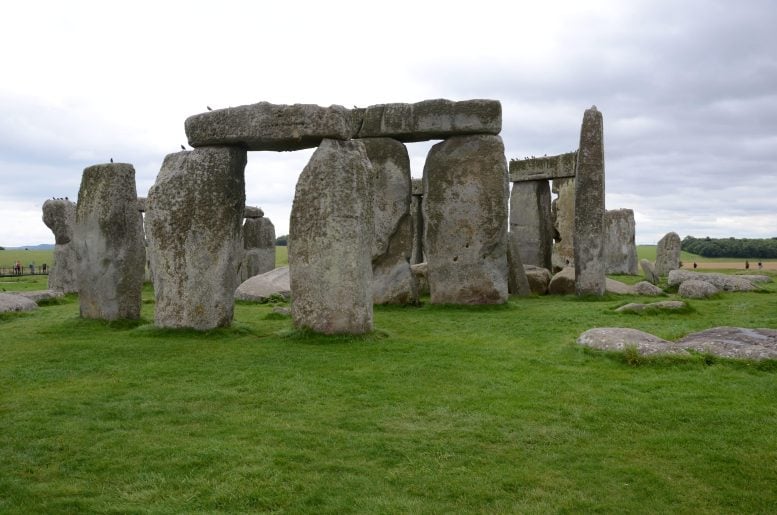
Critics debunk the theory of Stonehenge as a solar calendar, emphasizing its sacred role over speculative modern constructs.
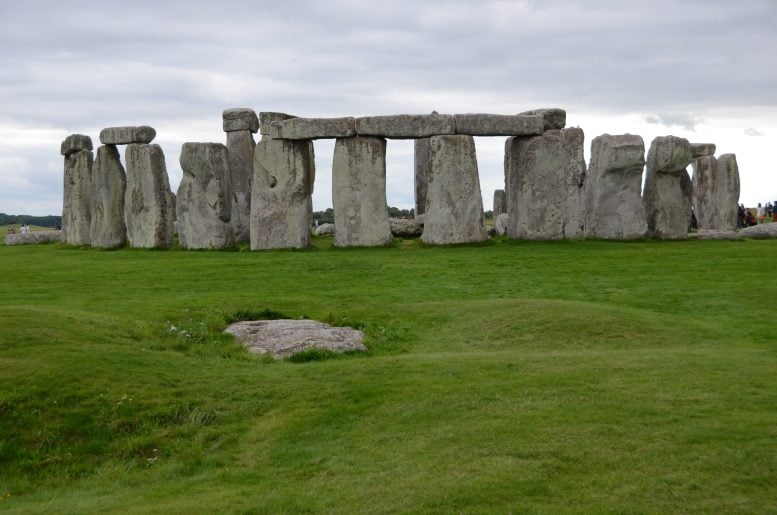
Stonehenge is a monument of remarkable complexity that captivates onlookers with its magnificent megalithic circle and “horseshoe” design, constructed around 2600 BC.
Throughout history, various hypotheses have been proposed regarding the significance and purpose of Stonehenge. Currently, however, archaeologists have a better understanding of this monument as a “place for the ancestors,” situated within a complex ancient landscape that included several other elements.
Archaeoastronomy has a key role in this interpretation since Stonehenge exhibits an astronomical alignment to the sun which, due to the flatness of the horizon, refers both to the summer solstice sunrise and to the winter solstice sunset. This accounts for a symbolic interest of the builders in the solar cycle, most probably related to the connections between the afterlife and winter solstice in Neolithic societies.
he “Calendar in Stone” Hypothesis
This is, of course, very far from saying that the monument was used as a giant calendrical device, as instead has been proposed in a new theory published in the renewed Archaeology Journal Antiquity. According to this theory, the monument represents a calendar based on 365 days per year divided into 12 months of 30 days plus five epagomenal days, with the addition of a leap year every four. This calendar is identical to the Alexandrian one, introduced more than two millennia later, at the end of the first century BC as a combination of the Julian calendar and the Egyptian civil calendar.
To justify this “calendar in stone”, the number of the days is obtained by multiplying the 30 sarsen lintels (probably) present in the original project by 12 and adding to 360 the number of the standing trilithons of the Horseshoe, which is five. The addition of a leap year every four is related to the number of the “station stones”, which is, indeed, four. This machinery was allegedly kept in operation using the solstice alignment of the axis and was supposedly taken from Egypt, much refining, however, the Egyptian calendar, which was of 365 days (the leap year correction was not present until Roman times).
Critique of the Solar Calendar Hypothesis
This is the admittedly fascinating theory that has been subjected to a severe stress test by two renewed experts of Archaeoastronomy, Juan Antonio Belmonte (Instituto de Astrofísica de Canarias and Universidad de La Laguna, Tenerife, Spain) and Giulio Magli (Polytechnic University of Milan). In their paper, which was published in the journal Antiquity as well, the authors show that the theory is based on a series of forced interpretations of the astronomical connections of the monument, as well as on debatable numerology and unsupported analogies.
First of all, astronomy. Although the solstice alignment is quite accurate, Magli and Belmonte show that the slow movement of the sun at the horizon in the days close to solstices makes it impossible to control the correct working of the alleged calendar, as the device (remember: composed by huge stones) should be able to distinguish positions as accurate as a few arc minutes, that is, less than 1/10 of one degree. So, while the existence of the axis does show interest in the solar cycle in a broad sense, it provides no proof whatsoever for inferring the number of days of the year conceived by the builders.
Second, is numerology. Attributing meanings to “numbers” in a monument is always a risky procedure. In this case, a “key number” of the alleged calendar, 12, is not recognizable anywhere, as well as any means of taking into account the additional epagomenal day every four years, while other “numbers” are simply ignored (for instance, the Stonehenge portal was made of two stones). Thus, the theory suffers also from the so-called “selection effect”, a procedure in which only the elements favorable to a desired interpretation are extracted from the material records.
Finally, cultural paragons. The first elaboration of the 365 plus 1-day calendar is documented in Egypt only two millennia later than Stonehenge (and entered into use further centuries later). Thus, even if the builders took the calendar from Egypt, they refined it on their own. In addition, they invented on their own also a building to control time, since nothing of this kind ever existed in ancient Egypt – probably the Egyptians reflected the drift of their 365-day calendar through the seasons in their architecture but this is far different. Besides, a transfer and elaboration of notions with Egypt occurred around 2600 BC and has no archaeological basis.
Stonehenge’s Role as a Sacred Witness
All in all, the alleged “Neolithic” solar-precise Stonehenge calendar is shown to be a purely modern construct whose archaeoastronomical and calendrical bases are flawed.
As occurred many times in the past – for instance, for the claims (shown untenable by modern research) that Stonehenge was used to predict eclipses – the monument returns to its role of the silent witness of the sacred landscape of its builders, a role which – as Magli and Belmonte stress – does not take anything away from his extraordinary fascination and importance.
Reference: “Archaeoastronomy and the alleged ‘Stonehenge calendar’” by Giulio Magli and Juan Antonio Belmonte, 23 March 2023, Antiquity.
DOI: 10.15184/aqy.2023.33
Never miss a breakthrough: Join the SciTechDaily newsletter.
Follow us on Google and Google News.
6 Comments
Stonehenge is a monument that represents a society of that epoch. The stones on its periphery represent its people united by a common thinking (the stones on top of them). The stones at the center represent its leaders — probably a king, queen, and its druid.
Wow that’s re****ed
They’re a bunch of rocks bro, they used it to have camp fires
Historical accident that the stones wound up vaguely corresponding to the calendar? Yes, there might have been simpler ways of doing that; I’m sure Neolithic Man wasn’t thinking of 20th century tourist traps! Neolithic WPA Project? 18th century places often were built to provide paid employment during tough times. Keep busy to justify your job!
Stonehenge is a monument that represents a society of that epoch. The stones on its periphery represent its people united by a common thinking (the stones on top of them). The stones at the center represent its leaders — probably a king, queen, and its Court.
The Stonehenge is just an elaborate community camp fire or meeting place where they would do administrative stuff around the fire
Stonehenge is already solved several years ago, in fact its technology was patented.