
Evidence from key archaeological sites suggests a major cosmic explosion may have reshaped the climate and ecosystems of the late Pleistocene.
Scientists are expanding the evidence supporting the idea that a fragmented comet exploded over Earth nearly 13,000 years ago. This cosmic event may have played a part in the extinction of mammoths, mastodons, and many other large Ice Age animals, as well as the sudden disappearance of the Clovis culture from North America’s archaeological record.
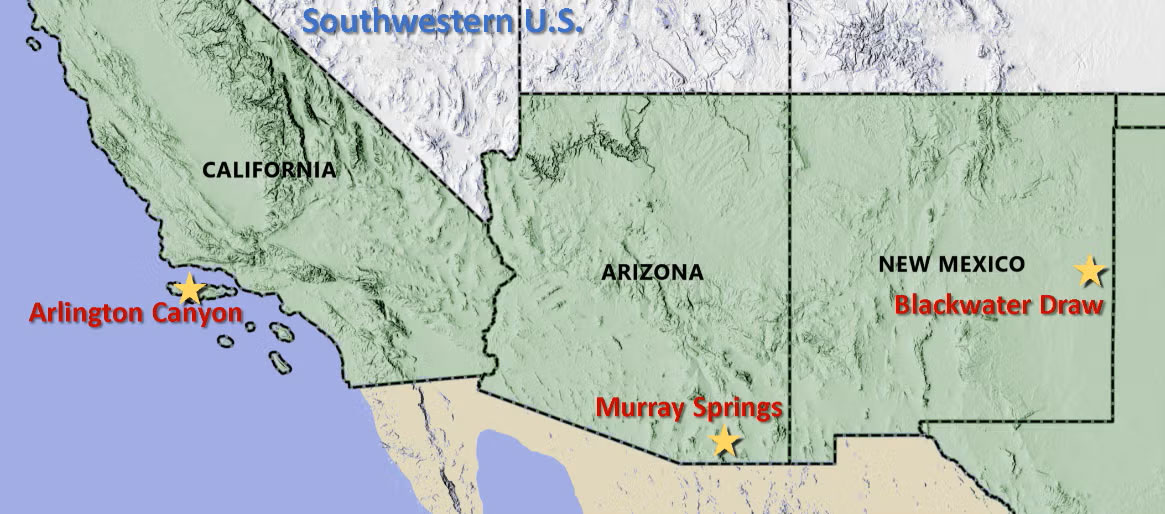
In a study published in PLOS One, UC Santa Barbara Emeritus Professor of Earth Science James Kennett and his team report the discovery of shocked quartz (sand grains altered by intense heat and pressure) at three key Clovis sites in the United States: Murray Springs in Arizona, Blackwater Draw in New Mexico, and Arlington Canyon in California’s Channel Islands.
“These three sites were classic sites in the discovery and the documentation of the megafaunal extinctions in North America and the disappearance of the Clovis culture,” said Kennett.
Evidence for the Younger Dryas Impact hypothesis
The extinction of large Ice Age animals and the loss of the Clovis technocomplex occurred at the same time as the onset of the Younger Dryas, a sudden cooling period that interrupted the planet’s gradual warming after the Last Glacial Period. This unusual return to near–ice age conditions lasted for roughly a thousand years.
Scientists have suggested several possible causes for this dramatic climate shift. Kennett and his colleagues propose that a fragmented comet exploded in the atmosphere, releasing intense heat and shockwaves across the planet.
“In other words, all hell broke loose,” Kennett said. According to the Younger Dryas impact hypothesis, the explosions were responsible for widespread burning and the resulting smoke and soot, in addition to dust that blocked the sun, leading to an “impact winter.” Rapid melting of the ice sheets could have helped to further cool the impact zones. The shock of impact itself, followed by harsh conditions thereafter, may have contributed to the demise of the megafauna in both North and South America and the disappearance of the Clovis culture, according to the hypothesis.
Accumulating Evidence for an Impact Event
For the past couple of decades, Kennett and fellow proponents of this hypothesis have been gathering evidence that increasingly supports it, including a “black mat” layer in the sediment at many sites across North America and Europe — indicative of widespread burning. Additionally, they have uncovered a growing list of impact proxies, which include unusually high concentrations of rare minerals that are common in comets, such as platinum and iridium, and mineral formations indicative of extremely high temperatures and pressures, such as nanodiamonds and metals and minerals that have melted, cooled, and hardened again, including metallic spherules and meltglass.
Thanks to advances in technology, the team is homing in on another proxy that is considered the crème de la crème of cosmic impact evidence: shocked quartz — grains of sand that exhibit deformations due to extreme heat and temperature. In samples from the three North American archaeological sites — Murray Springs, Blackwater Draw and Arlington Canyon — the researchers identified quartz grains with telltale cracks, some filled with melted silica. They used a variety of techniques, including electron microscopy and cathodoluminescence, to confirm that the quartz grains had been shocked at extremely high temperatures and pressures, far beyond what could have been accomplished by volcanism or ancient human activity.
Airbursts and the Challenge of Craterless Impacts
The presence of shocked quartz is particularly important in the absence of craters — the smoking gun of cosmic impact evidence. Unlike the asteroid that killed off the dinosaurs 65 million years ago and left a crater beneath the Yucatan Peninsula, “touchdown airbursts” — cosmic collisions that occur above the Earth’s surface, such as from this proposed fragmented comet — leave little, if any, evidence on the landscape. Using hydrocode modeling, the team modeled these low-altitude, above-ground explosions and the variety of impacts that could lead to the shock patterns in the quartz grains.
nbs said. While the accepted evidence for cosmic impact leans heavily on the parallel cracks in quartz found at craters, the variety of directions, pressures, and temperatures that emerge around airbursts would lead to variations in the shock patterns in the quartz, he explained. “There are going to be some very highly shocked grains and some that will be low-shocked. That’s what you would expect.”
Added to the other impact proxies found in the same layer of sediment — carbon-rich black mat, nanodiamonds, impact spherules — and found at three key archaeological sites, the discovery of these shocked quartz grains “supports a cosmic impact as a major contributing factor in the megafaunal extinctions and the collapse of the Clovis technocomplex at the Younger Dryas onset,” according to the paper.
Reference: “Shocked quartz at the Younger Dryas onset (12.8 ka) supports cosmic airbursts/impacts contributing to North American megafaunal extinctions and collapse of the Clovis technocomplex” by James P. Kennett, Malcolm A. LeCompte, Christopher R. Moore, Gunther Kletetschka, John R. Johnson, Wendy S. Wolbach, Siddhartha Mitra, Abigail Maiorana-Boutilier, Victor Adedeji, Marc D. Young, Timothy Witwer, Kurt Langworthy, Joshua J. Razink, Valerie Brogden, Brian van Devener, Jesus Paulo Perez, Randy Polson and Allen West, 10 September 2025, PLOS ONE.
DOI: 10.1371/journal.pone.0319840
Never miss a breakthrough: Join the SciTechDaily newsletter.
Follow us on Google and Google News.
5 Comments
You guys need to go test non Clovis sites – where it might be known that people were not pounding rocks. See if the deformated Quartz sample-numbers vary.
Every mission to comets has proven the “Dirty Snowball Theory” wrong! However, this article uses that theory to explain what happened almost 13,000 years ago. There was a huge problem for Earth at that time. This was caused by an interplanetary ice storm that even affected the planet Mars. If you ask questions, I will provide evidence.
Certainly, an air burst such, as the analog at Tunguska, will produce much less pressure than an impact. The question, which isn’t even posed let alone answered, is, “Will the pressure from an air burst be sufficient to create ‘shocked quartz?”
The Clovis culture myth is a fantasy of idiotic cultural anthropologists. They found stone spear points at large numbers of digs across the country. The arrowhead like spear points were very large, some six inches with a notched base for tying to a spear or lance. The spearheads were named Clovis points and were used to stab into large prey animals and broken off inside. Then a new Clovis point was tied on and the hunt would continue until points would bleed the animals to death. No need to carry around a bunch of heavy spears.. it was a very effective stone age hunting tool. Hunters everywhere just copied success same as always. Only academic pinheads would call this a culture. .
Hahaha. What scares me is people will believe this load of horse poop because they assume the author is smarter than them therefore probably know what they’re talking about. But the sad thing is these scientists only know what their books tell em. And geology is the most fraudulent science of them all next to space science. Most of the times when a geologist is referring to layers of sediment 9 times out of 10 they’re not layers of sediment. They’re growth rings. Because what they don’t teach us is that most geology is petrified biology. There were giant trees all over the world. Those trees had giant roots systems that petrified after the flood which is what killed everything off. Examples: Devils tower is a petrified tree stump. Mount Rushmore is carved out of an ancient giant petrified cedar tree stump. You can still see some of the bark that didn’t fall off before it petrified towards the bottom of it. You can also see the growth rings through out it. Geology teaches us that it’s layers of sediment. But anyone with eyes can see what they really are. Quartz is petrified tree sap from those giant trees. If you walk around the Mount Rushmore park on the trails you’ll see that entire area is one giant petrified cedar tree root system from trees so big it’s hard to wrap your mind around. The earth is 6.000 yrs old give or take. Stop claiming ridiculous numbers based on some goofy aging system. The flood killed everything that wasn’t in the arc. .