
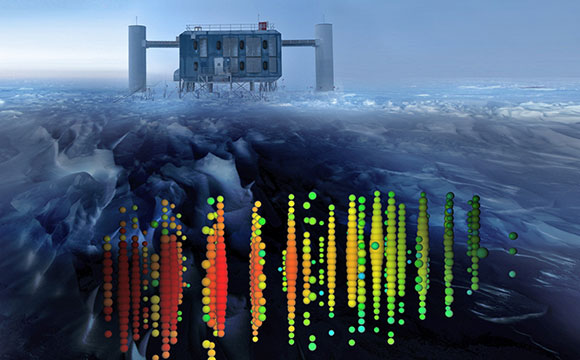
The IceCube Collaboration and DM-Ice have announced new observations on cosmic neutrinos and the nature of dark matter.
Yale University physicists are part of two international research efforts at the South Pole — the IceCube Collaboration and DM-Ice — that have announced new observations on cosmic neutrinos and the nature of dark matter.
Scientists from the IceCube Collaboration have announced new results on the detection of cosmic neutrinos. Buried 2,450 meters below the surface in the Antarctic ice shield, the IceCube experiment has detected muon neutrinos — subatomic particles that travel through the universe nearly undisturbed by other matter — that originated outside the Earth’s galaxy. The observation includes some of the highest-energy neutrinos ever observed from the direction of Earth’s Northern Hemisphere.
The results have been published in the journal Physical Review Letters.
Neutrinos are never directly observed. IceCube, a gigaton particle detector located near the Amundsen-Scott South Pole Station, observes the by-products of neutrinos that interact with the Antarctic ice. The detector records about 100,000 neutrinos every year, most of them produced by the interaction of cosmic rays with the Earth’s atmosphere. Those interactions also create billions of atmospheric neutrinos. In this study, the researchers identified about 10 high-energy neutrinos of cosmic origin, possibly produced by massive, exploding stars or black holes elsewhere in the universe.
“The Antarctic Ice at the South Pole is a fantastic place to do experiments,” said Reina Maruyama, an assistant professor of physics at Yale and longstanding IceCube collaborator, who was involved in the construction and commissioning of the IceCube detector. “At that depth the ice is clean and transparent for detection of light from particles resulting from neutrino interactions. The ice also provides an effective shield from backgrounds for a dark matter search.”
Maruyama is the spokesperson for the direct detection dark matter experiment DM-Ice. Located with IceCube in the Antarctic ice shield, DM-Ice aims to detect the annual modulation of a weakly interacting massive particle (WIMP) dark matter signal. In a paper presented this week at the international TAUP conference, DM-Ice addresses one of the longest-standing claims about the observation of a dark matter signal in an earlier experiment, called DAMA.
DM-Ice shows that the annual modulation signal is unlikely to be explained by muons created in the atmosphere and related instrumental backgrounds. That finding brings scientists one step closer to understanding the data produced by DAMA.
Other DM-Ice collaborators from Yale who contributed to this work include graduate students Walter Pettus, Antonia Hubbard, Zack Pierpoint, postdoctoral researchers Matt Kauer and Kyungeun Lim, and Yale undergraduate students Nikita Dutta and Field Rogers.
IceCube is headquartered at the Wisconsin IceCube Particle Astrophysics Center at the University of Wisconsin-Madison. The international collaboration includes 300 physicists and engineers from the United States, Germany, Sweden, Belgium, Switzerland, Japan, Canada, New Zealand, Australia, the United Kingdom, Korea, and Denmark. The development and analysis of DM-Ice is led by the Yale Wright Laboratory. DM-Ice has 25 collaborators.
The IceCube Neutrino Observatory and DM-Ice were built with grants from the National Science Foundation and operated with continued support from the NSF, the Alfred P. Sloan Research Foundation, and participating institutions.
Never miss a breakthrough: Join the SciTechDaily newsletter.
Follow us on Google and Google News.