
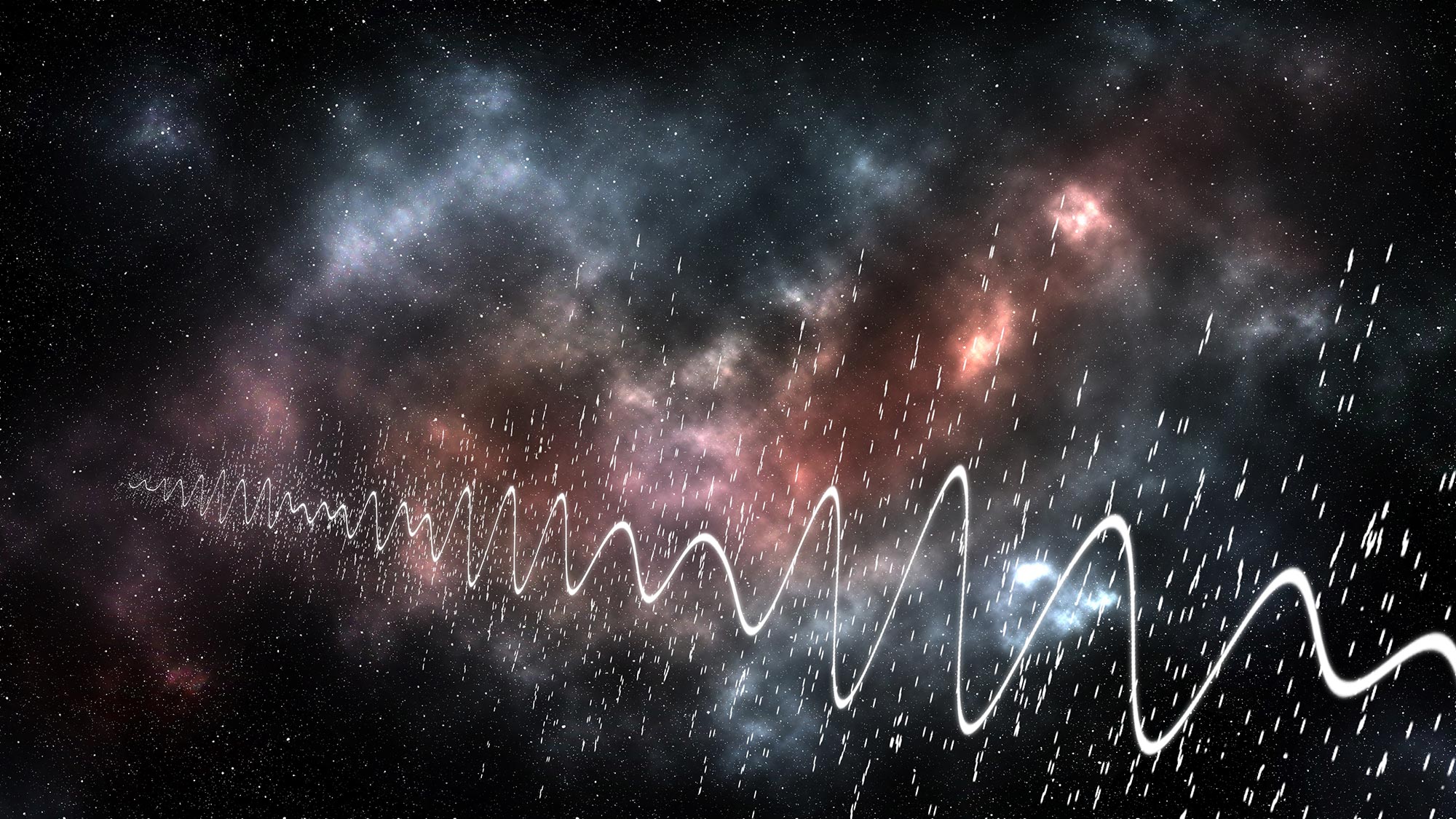
A new study of human deep space communications identifies the regions of space where signals from extraterrestrial intelligence are most likely to be detected.
If an extraterrestrial civilization were trying to detect human signals, where and when would they be most likely to find them? A recent study by researchers at Penn State and NASA’s Jet Propulsion Laboratory in Southern California examined the timing and directions of deep space transmissions from Earth. They found patterns that could not only reveal how outsiders might detect us but also help refine our own strategies in the search for extraterrestrial intelligence (SETI).
“Humans are predominantly communicating with the spacecraft and probes we have sent to study other planets like Mars,” said Pinchen Fan, graduate student in astronomy and astrophysics in the Penn State Eberly College of Science, science principal investigator of the NASA grant supporting this research and first author of the paper. “But a planet like Mars does not block the entire transmission, so a distant spacecraft or planet positioned along the path of these interplanetary communications could potentially detect the spillover; that would occur when Earth and another solar system planet align from their perspective. This suggests that we should look for alignment of planets outside of our solar system when searching for extraterrestrial communications.”
SETI context and technosignatures
The team’s paper was published on Aug 21, 2025, in Astrophysical Journal Letters, with findings also presented that same day at the Penn State SETI Symposium, hosted by the Penn State Extraterrestrial Intelligence Center.
“SETI researchers often search the universe for signs of past or present technology, called technosignatures, as evidence of intelligent life,” Fan said. “Considering the direction and frequency of our most common signals gives insights into where we should be looking to improve our chances of detecting alien technosignatures.”
To investigate this, the researchers analyzed logs from NASA’s Deep Space Network (DSN), a system of ground-based antennas that enables two-way radio communication with spacecraft in space. By cross-referencing DSN records with the locations of spacecraft, the team determined both the timing and direction of transmissions sent from Earth. While other nations operate their own deep-space networks, the researchers noted that NASA’s DSN is the most representative, since it supports the majority of deep-space missions launched to date.
Deep Space Network transmission patterns
“NASA’s Deep Space Network provides the crucial link between Earth and its interplanetary missions like the New Horizons spacecraft, which is now outbound from the Solar System, and the James Webb Space Telescope,” said Joseph Lazio, project scientist at JPL and an author of the paper. “It sends some of humanity’s strongest and most persistent radio signals into space, and the public logs of its transmissions allowed our team to establish the temporal and spatial patterns of those transmissions for the past 20 years.”
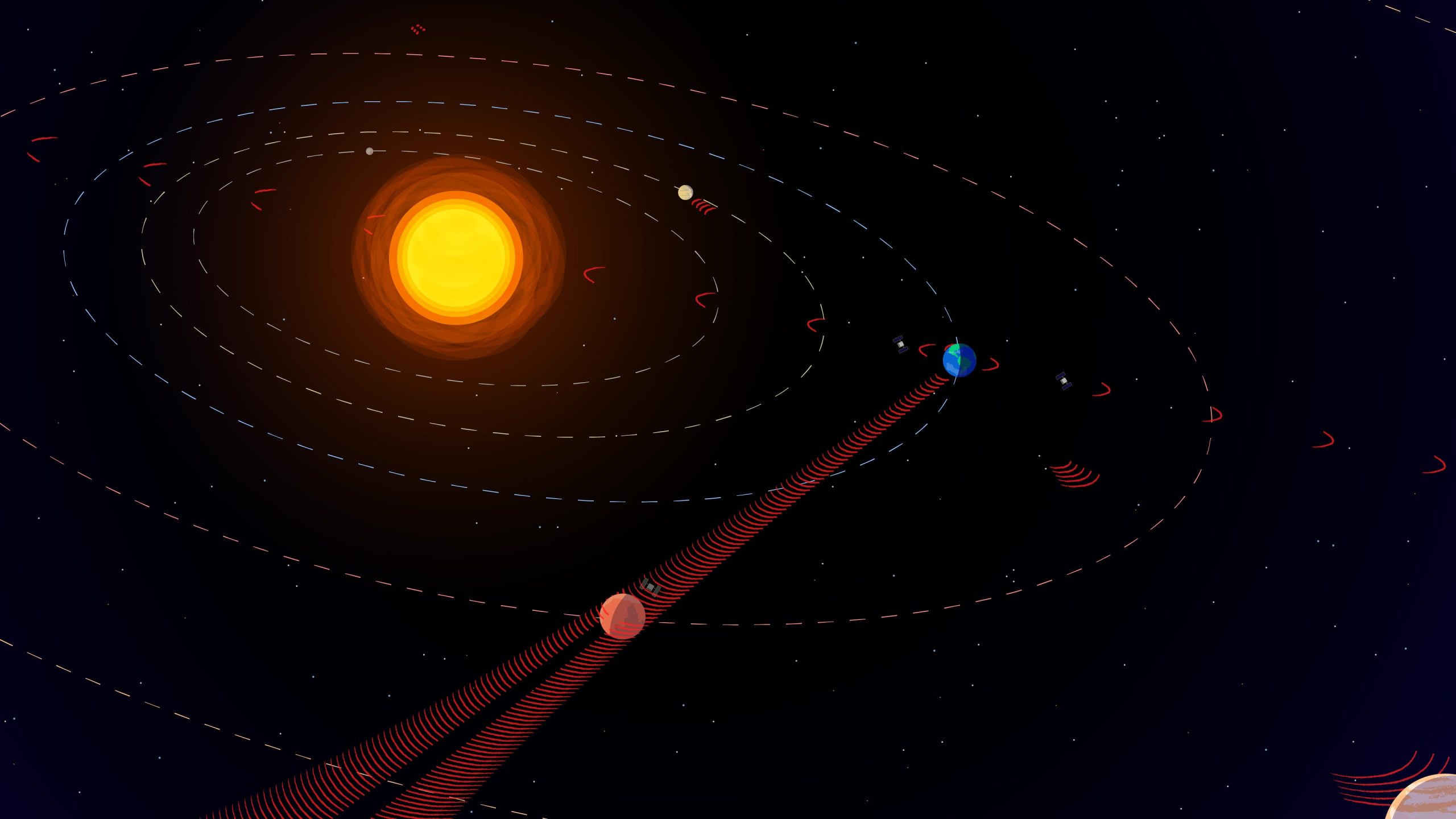
For this study, the researchers focused specifically on deep-space transmissions, which included signals directed to interplanetary spacecraft and space-based telescopes. They did not include signals intended for satellites in low-Earth orbit, since those are much weaker and unlikely to be detected from far away.
The results showed that most deep space signals were aimed at spacecraft near Mars. Other frequent targets included spacecraft around other planets and telescopes located at Sun-Earth Lagrange points — stable regions of space where the combined gravitational pull of the Sun and Earth holds satellites in a fixed position relative to Earth.
Likelihood of alien detection
“Based on data from the last 20 years, we found that if an extraterrestrial intelligence were in a location that could observe the alignment of Earth and Mars, there’s a 77% chance that they would be in the path of one of our transmissions — orders of magnitude more likely than being in a random position at a random time, Fan said. “If they could view an alignment with another solar-system planet, there is a 12% chance they would be in the path of our transmissions. When not observing a planet alignment, however, these chances are minuscule.”
To improve our own search for technosignatures, the researchers said, humans should look for alignment of exoplanets — planets outside our solar system — or at least when exoplanets align with their host star.
Astronomers frequently study exoplanets during alignment with their host star. In fact, most of the currently known exoplanets were detected by looking for the darkening of a star when a planet crosses in front of, or transits, its host star from Earth’s line of sight.
Expanding the search with future telescopes
“However, because we are only starting to detect a lot of exoplanets in the last decade or two, we do not know many systems with two or more transiting exoplanets,” Fan said. “With the upcoming launch of NASA’s Nancy Grace Roman Space Telescope, we expect to detect a hundred thousand previously undetected exoplanets, so our potential search area should increase greatly.”
Because our solar system is fairly flat with most planets orbiting on the same plane, the majority of DSN transmissions occurred within 5 degrees of Earth’s orbital plane, the researchers explained. If the solar system were a dinner plate with all the planets and objects sitting on that plate, human transmissions tended to follow along the plate’s surface, rather than shooting out into space at a stark angle.
The research team also calculated that an average DSN transmission could be detected about 23 light-years away using telescopes like ours. Focusing efforts, they said, on solar systems that are within 23 light-years and especially whose plane is oriented with its edge toward Earth could improve our search for extraterrestrial intelligence. The team now plans to identify these systems and quantify how frequently they could have received signals coming from Earth.
Broader implications for future SETI efforts
The DSN transmission patterns found also could be applied to searches for laser transmissions from exoplanets, the researchers said, though they noted that lasers would have much less spillover than radio transmission. NASA is testing its interplanetary laser communication system, and extraterrestrial civilizations may opt to use lasers instead of radio waves.
“Humans are pretty early in our spacefaring journey, and as we reach further into our solar system, our transmissions to other planets will only increase,” said Jason Wright, professor of astronomy and astrophysics in the Penn State Eberly College of Science, director of the Penn State Extraterrestrial Intelligence Center, and an author of the paper. “Using our own deep space communications as a baseline, we quantified how future searchers for extraterrestrial intelligence could be improved by focusing on systems with particular orientations and planet alignments.”
Reference: “Detecting Extraterrestrial Civilizations that Employ an Earth-level Deep Space Network” by Pinchen Fan, Jason T. Wright and T. Joseph W. Lazio, 21 August 2025, The Astrophysical Journal Letters.
DOI: 10.3847/2041-8213/adf6b0
Funding from the NASA Exoplanets Research Grant Program and the Penn State Extraterrestrial Intelligence Center supported this work. Computations for this research were performed on the Penn State Institute for Computational and Data Sciences Roar supercomputer.
Never miss a breakthrough: Join the SciTechDaily newsletter.
Follow us on Google and Google News.
4 Comments
Why would aliens want to bother with us? By the time they got here. they would find a wrecked planet. There have been enough vindictive radio messages emanating from us since 1914 to keep any sane alien as far as they can get from Earth.
The cough of one Spanish Conquistador killed 90,000,000 Native Americans. What do imagine one, odd ball, DNA eating alien molecule might accomplish? (remember, every blade of grass, every snotty drip of slime mold, every tree and plant, all the bugs, all the animals and of course all the half-wit humans, all depend on your capacity to figure it out – to say nothing of how cleaver ‘the Aliens’ might be)
90 million? That many, when there were between 450 million to 550 million of us on the Earth at the time of the Conqistadors?
so, how about Voyager 1, dont we sent signals to it… and it is out past the planets, right…