
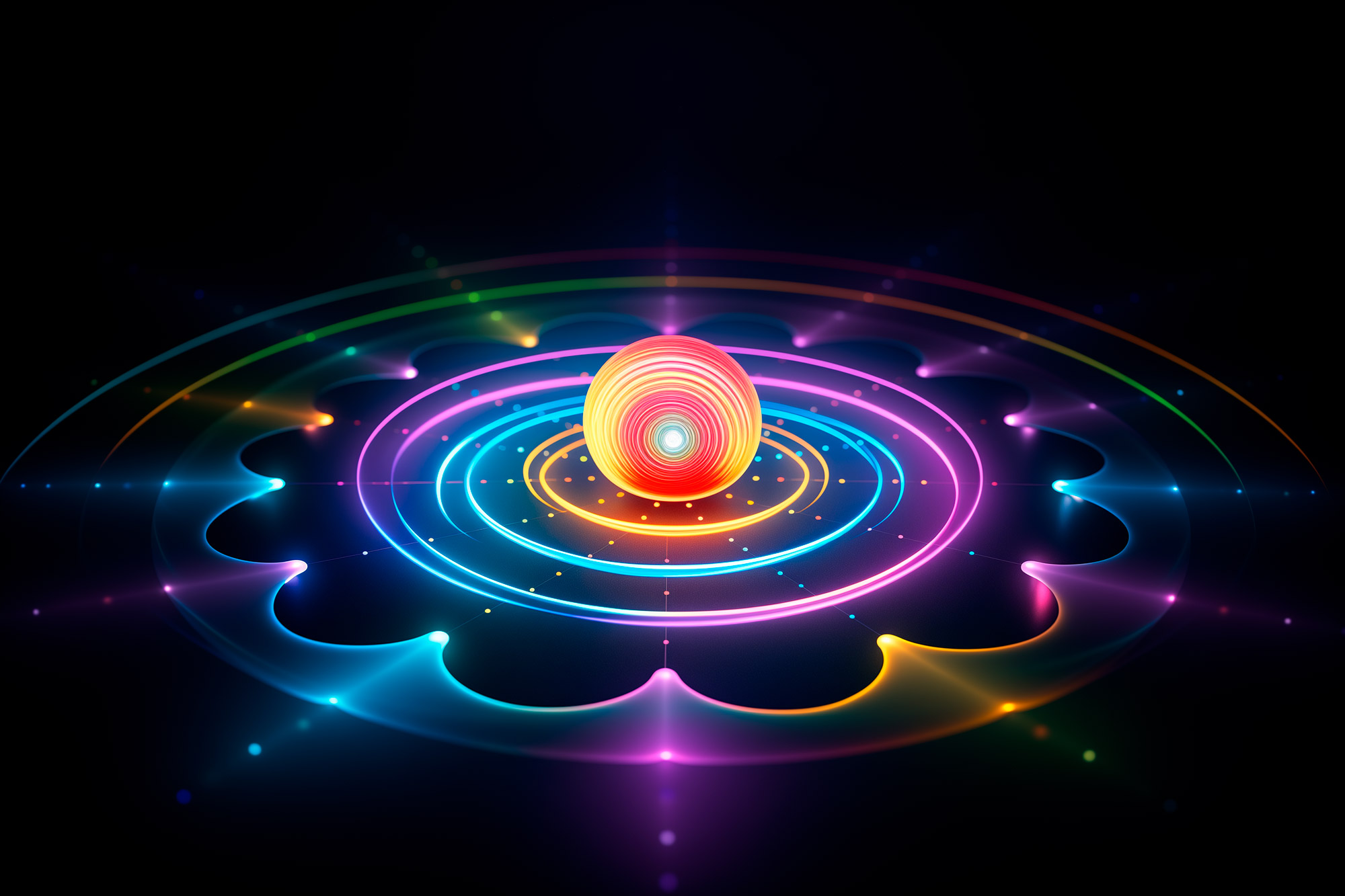
An international collaboration between astronomers using the CHEOPS and TESS space satellites, including NCCR PlanetS members from the University of Bern and the University of Geneva, have found a key new system of six transiting planets orbiting a bright star in a harmonic rhythm. This rare property enabled the team to determine the planetary orbits which initially appeared as an unsolvable riddle.
Collaboration and Methodology
CHEOPS is a joint mission by ESA and Switzerland, under the leadership of the University of Bern in collaboration with the University of Geneva. Thanks to a collaboration with scientists working with data from NASA’s satellite TESS, the international team could uncover the planetary system orbiting the nearby star HD110067. A very distinctive feature of this system is its chain of resonances: the planets orbit their host star in perfect harmony. Part of the research team are researchers from the University of Bern and the University of Geneva who are also members of the National Center of Competence in Research (NCCR) PlanetS. The findings have recently been published in the journal Nature.
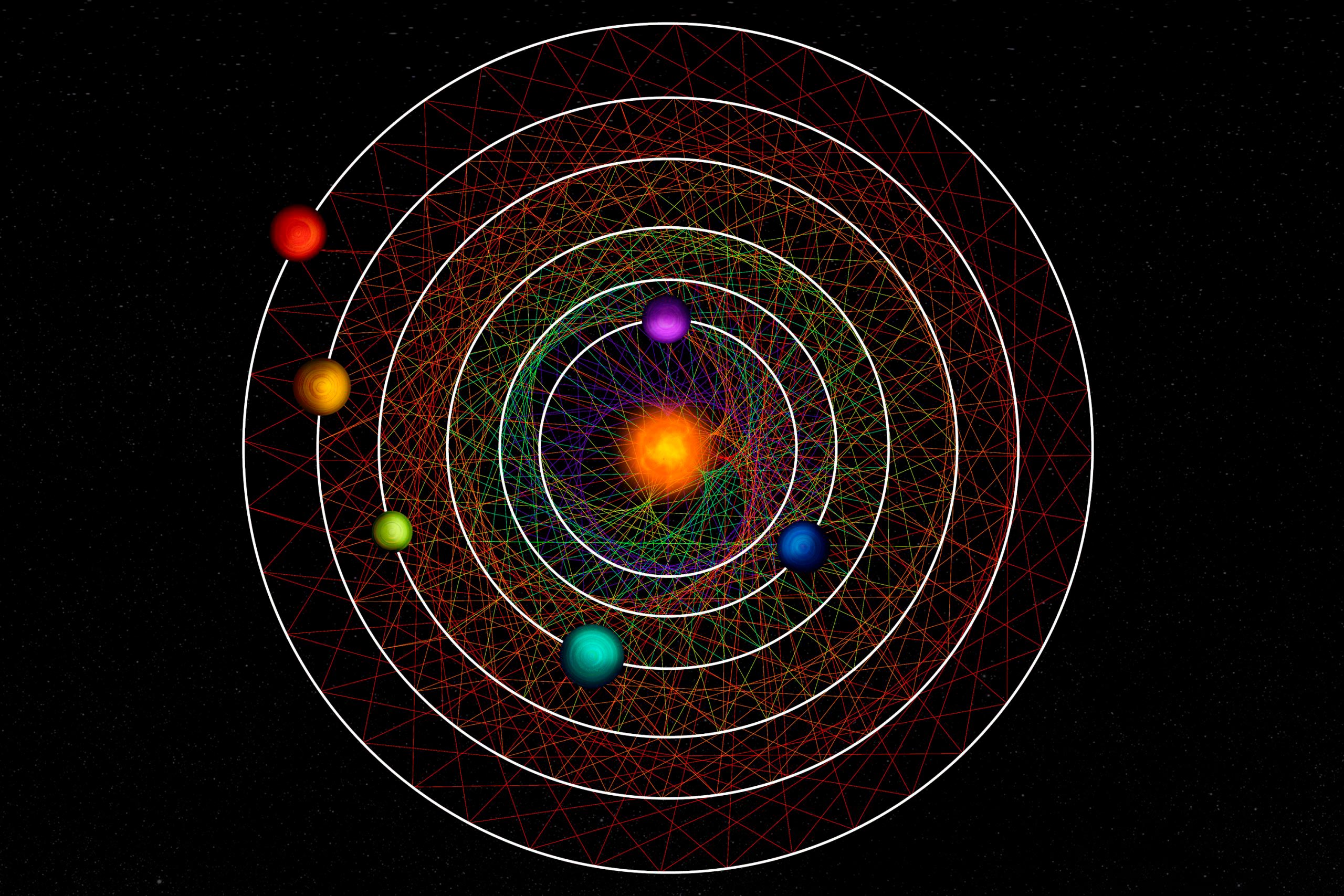
The planets in the HD110067 system revolve around the star in a very precise waltz. When the closest planet to the star makes three full revolutions around it, the second one makes exactly two during the same time. This is called a 3:2 resonance.
“Amongst the over 5,000 exoplanets discovered orbiting other stars than our Sun, resonances are not rare, nor are systems with several planets. What is extremely rare though, is to find systems where the resonances span such a long chain of six planets” points out Dr. Hugh Osborn, CHEOPS fellow at the University of Bern, leader of CHEOPS observation program involved in the study, and co-author of the publication.
This is precisely the case of HD110067 whose planets form a so-called “resonant chain” in successive pairs of 3:2, 3:2, 3:2, 4:3, and 4:3 resonances, resulting in the closest planet completing six orbits while the outer-most planet does one.
A Seemingly Unsolvable Puzzle
Although multiple planets were initially detected thanks to their transits, the exact arrangement of the planets was unclear at first. However, the precise gravitational dance enabled the scientists’ team to solve the puzzle of HD110067. Prof. Adrien Leleu from the University of Geneva, in charge of analyzing the orbital resonances, and co-author of the study, explains: “A transit occurs when a planet, from our point of view, passes in front of its host star, blocking a minute fraction of the starlight, creating an apparent dip of its brightness.”
From the first observations carried out by NASA’s TESS satellite, it was possible to determine that the two inner planets called ‘b’ and ‘c’ have orbital periods of 9 and 14 days respectively. However, no conclusions could be drawn for the other four detected planets as two were seen to transit once in 2020 and once in 2022 with a large 2-year gap in the data, and the other two transited only once in 2022.
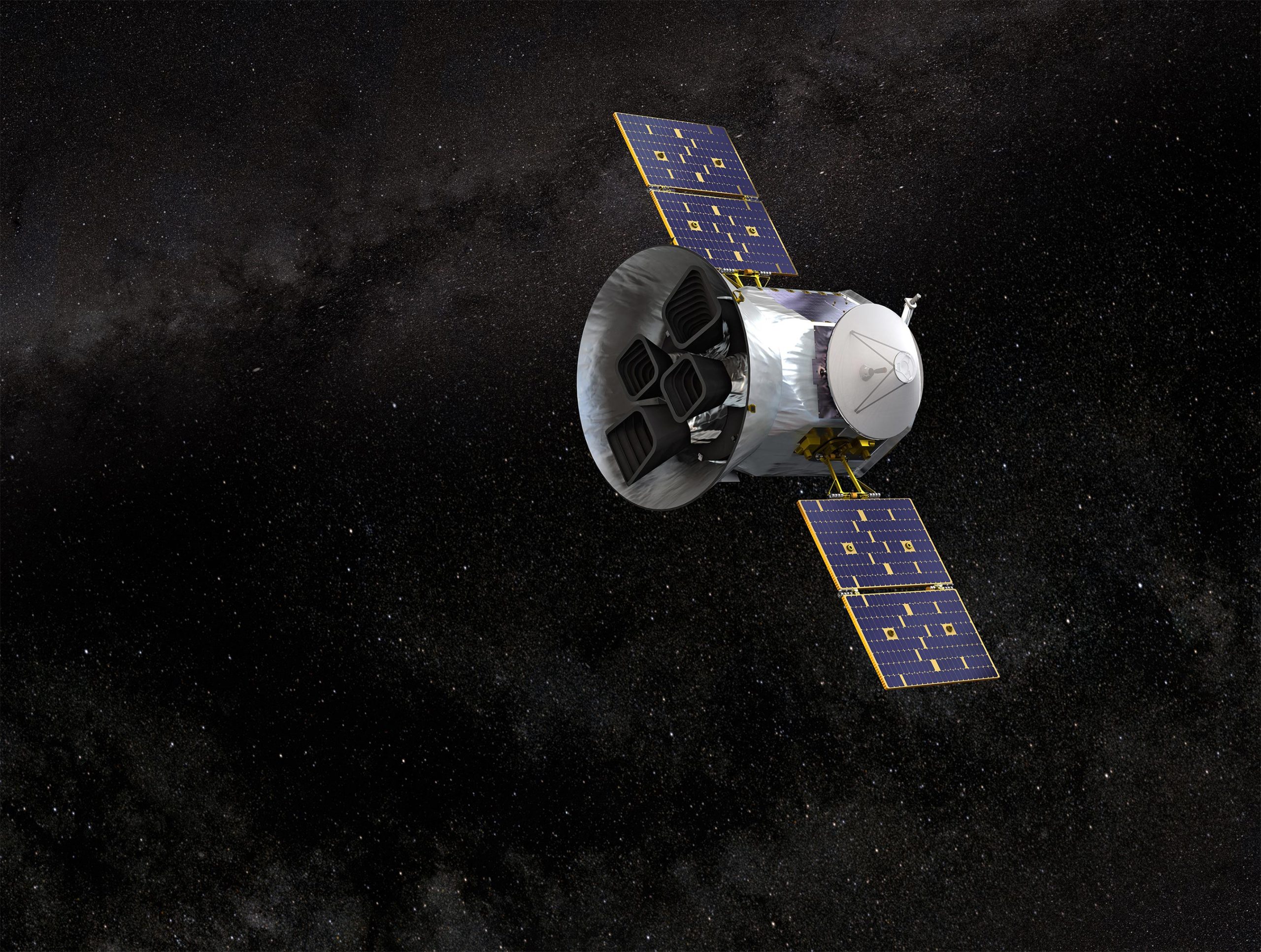
The solution to the puzzle for those four additional planets finally began to emerge thanks to observations with the CHEOPS space telescope. While TESS aims at scanning all of the sky bit by bit to find short-period exoplanets, CHEOPS is a targeted mission, focusing on a single star at a time with exquisite precision. “Our CHEOPS observations enabled us to find that the period of planet ‘d’ is 20.5 days. Also, it ruled out multiple possibilities for the remaining three outer planets, ‘e’, ‘f’ and ‘g’,” reveals Osborn.

Predicting the Precise Waltz of the Planets
That is when the team realized that the three inner planets of HD110067 are dancing in a precise 3:2, 3:2 chain of resonances: when the innermost planet revolves nine times around the star, the second revolves six times and the third planet four times.
The team then considered the possibility that the three other planets could also be part of the chain of resonances. “This led to dozens of possibilities for their orbital period,” explains Leleu, “but combining existing observational data from TESS and CHEOPS, with our model of the gravitational interactions between the planets, we could exclude all solutions but one: the 3:2, 3:2, 3:2, 4:3, 4:3 chain.” The scientists could therefore predict that the outer three planets (‘e’, ‘f’ and ‘g’) have orbital periods of 31, 41 days, and 55 days.
This prediction allowed to schedule observations with a variety of ground-based telescopes. Further transits of planet ‘f’ were observed, revealing it was precisely where theory predicted it based on the resonant-chain. Finally, reanalysis of the data from TESS revealed two hidden transits, one from each of planets ‘f’ and ‘g’, exactly at the times expected by the predictions, confirming the periods of the six planets. Additional CHEOPS observations of each planet, and in particular planet ‘e’ are scheduled in the near future.
A Key System for the Future
From the handful of resonant-chain systems found so far, CHEOPS has highly contributed to the understanding of not only HD110067, but also of TOI-178. Another well-known example of a resonant-chain system is the TRAPPIST-1 system which hosts seven rocky planets. However, TRAPPIST-1 is a small and incredibly faint star which makes any additional observations very difficult. HD110067, on the other hand, is more than 50 times brighter than TRAPPIST-1.
“The fact that the planets in the HD110067 system have been detected by the transit method is key. While they pass in front of the star, light also filters through the planetary atmospheres” points out Jo Ann Egger, PhD student at the University of Bern, who computed the composition of the planets using CHEOPS data, and co-author of the study. This property allows astronomers to determine the chemical composition and other properties of the atmospheres. Since a lot of light is required, the bright star HD110067 and its orbiting planets are an ideal target for further studies to characterize the planetary atmospheres.
“The sub-Neptune planets of the HD110067 system appear to have low masses, suggesting they may be gas- or water-rich. Future observations, for example with the James Webb Space Telescope (JWST), of these planetary atmospheres could determine whether the planets have rocky or water-rich interior structures,” concludes Egger.
For more on this discovery:
- Unraveling the 6-Planet Resonance Mystery
- Strange Discovery of a Six-Planet System in Perfect Harmony
Reference: “A resonant sextuplet of sub-Neptunes transiting the bright star HD 110067” by R. Luque, H. P. Osborn, A. Leleu, E. Pallé, A. Bonfanti, O. Barragán, T. G. Wilson, C. Broeg, A. Collier Cameron, M. Lendl, P. F. L. Maxted, Y. Alibert, D. Gandolfi, J.-B. Delisle, M. J. Hooton, J. A. Egger, G. Nowak, M. Lafarga, D. Rapetti, J. D. Twicken, J. C. Morales, I. Carleo, J. Orell-Miquel, V. Adibekyan, R. Alonso, A. Alqasim, P. J. Amado, D. R. Anderson, G. Anglada-Escudé, T. Bandy, T. Bárczy, D. Barrado Navascues, S. C. C. Barros, W. Baumjohann, D. Bayliss, J. L. Bean, M. Beck, T. Beck, W. Benz, N. Billot, X. Bonfils, L. Borsato, A. W. Boyle, A. Brandeker, E. M. Bryant, J. Cabrera, S. Carrazco-Gaxiola, D. Charbonneau, S. Charnoz, D. R. Ciardi, W. D. Cochran, K. A. Collins, I. J. M. Crossfield, Sz. Csizmadia, P. E. Cubillos, F. Dai, M. B. Davies, H. J. Deeg, M. Deleuil, A. Deline, L. Delrez, O. D. S. Demangeon, B.-O. Demory, D. Ehrenreich, A. Erikson, E. Esparza-Borges, B. Falk, A. Fortier, L. Fossati, M. Fridlund, A. Fukui, J. Garcia-Mejia, S. Gill, M. Gillon, E. Goffo, Y. Gómez Maqueo Chew, M. Güdel, E. W. Guenther, M. N. Günther, A. P. Hatzes, Ch. Helling, K. M. Hesse, S. B. Howell, S. Hoyer, K. Ikuta, K. G. Isaak, J. M. Jenkins, T. Kagetani, L. L. Kiss, T. Kodama, J. Korth, K. W. F. Lam, J. Laskar, D. W. Latham, A. Lecavelier des Etangs, J. P. D. Leon, J. H. Livingston, D. Magrin, R. A. Matson, E. C. Matthews, C. Mordasini, M. Mori, M. Moyano, M. Munari, F. Murgas, N. Narita, V. Nascimbeni, G. Olofsson, H. L. M. Osborne, R. Ottensamer, I. Pagano, H. Parviainen, G. Peter, G. Piotto, D. Pollacco, D. Queloz, S. N. Quinn, A. Quirrenbach, R. Ragazzoni, N. Rando, F. Ratti, H. Rauer, S. Redfield, I. Ribas, G. R. Ricker, A. Rudat, L. Sabin, S. Salmon, N. C. Santos, G. Scandariato, N. Schanche, J. E. Schlieder, S. Seager, D. Ségransan, A. Shporer, A. E. Simon, A. M. S. Smith, S. G. Sousa, M. Stalport, Gy. M. Szabó, N. Thomas, A. Tuson, S. Udry, A. M. Vanderburg, V. Van Eylen, V. Van Grootel, J. Venturini, I. Walter, N. A. Walton, N. Watanabe, J. N. Winn and T. Zingales, 29 November 2023, Nature.
DOI: 10.1038/s41586-023-06692-3
Never miss a breakthrough: Join the SciTechDaily newsletter.
Follow us on Google and Google News.
1 Comment
“Since a lot of light is required, the bright star HD110067 and its orbiting planets are an ideal target for further studies to characterize the planetary atmospheres.”
Fact, but it is also a fact that none of the planets lie in the habitable zone while 3 of TRAPPIST-1 planets do. So it is a good exercise but not all what we aim for.