
The higher the collision energy of particles, the more interesting the physics. Scientists from the Institute of Nuclear Physics of the Polish Academy of Sciences in Cracow have found further confirmation of this assumption, this time in the high-energy collision of protons with protons or lead nuclei.
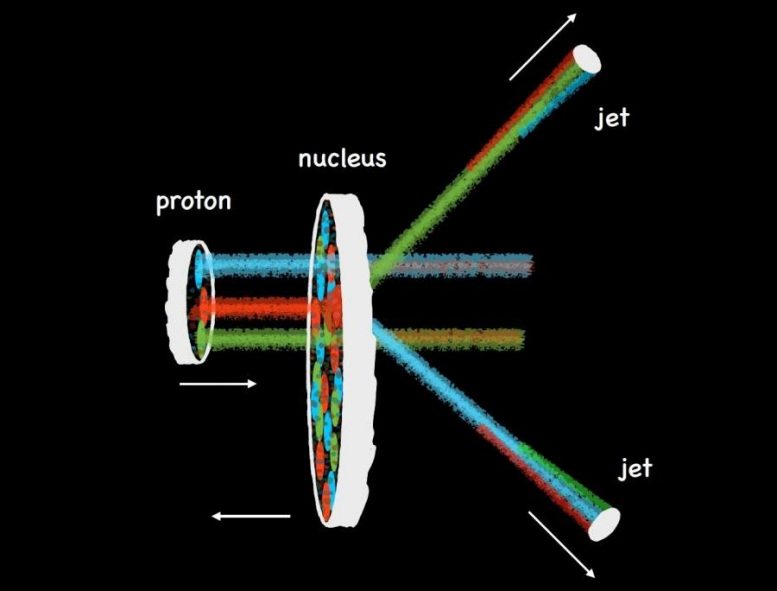
When a proton collides at high energy with another proton or atomic nucleus, the effect of the collision is a stream of secondary particles known as a jet in physicists’ jargon. Some of these jets extend sideways, but there are some that keep to a direction of motion close to the primary one. The details of the collision course are determined not only by the type of colliding particles, but also by many other factors, in particular the amount of energy. In research published in Physics Letters B, a group of four scientists from the Institute of Nuclear Physics of the Polish Academy of Sciences (IFJ PAN) in Cracow has shown that at the highest energies obtained in the LHC accelerator, for an accurate description of the course of the collision of protons with protons or lead nuclei, additional phenomena need to be taken into account.
The ATLAS experiment at the LHC accelerator (CERN, Geneva) has been recording the collisions of two proton beams or a proton beam with a beam of lead nuclei traveling in opposite directions for years. The Cracow-based researchers took a closer look at the latest data concerning high energy collisions reaching five teraelectron volts (i.e. thousands of billions of eV). Special attention was paid to those cases in which the jets running from the collision point moved in a forward direction, i.e. along the original direction of the beams.
“Neither protons nor the neutrons found in atomic nuclei are elementary particles. Usually, they are said to consist of three quarks, but this is a huge over-simplification. In fact, each proton or neutron is an extremely dynamic entity, filled with a constantly boiling sea of gluons, i.e. the particles that glue quarks together. There is an interesting fact connected with this dynamism: depending on the behavior of its component particles, i.e. partons, the proton can be sometimes more dense or sometimes less. And this explains why we find the cases of collisions with ‘forward-directed’ jets so interesting. They relate to situations where one proton is dilute, or behaves like a bullet, and the other one is dense, or behaves like a target,” explains Dr. Krzysztof Kutak (IFJ PAN).
In their model of high-energy proton collisions, physicists from the IFJ PAN took into consideration two previously known phenomena. The first is connected with the fact that as the collision energy increases, the number of gluons formed inside protons increases too. It turns out that this process does not continue indefinitely. At a certain point, when the collision energy is great enough, there are so many gluons that they start to recombine with each other. A dynamic equilibrium is then created between the process of gluon production and their recombination. This effect is called saturation.
The second factor taken into account by the Cracow physicists was the Sudakov effect. This relates to situations in which the momentum of the difference of the momenta of generated jets is greater than the momentum of the partons initiating jet production. This seemingly contradictory result is in reality the result of quantum effects associated with the transfer of momentum between the partons involved in the collision. As a result, the probability of producing back-to-back jets is reduced and the probability of the production of jets at a moderate azimuthal angle is enhanced.
“Both saturation and the Sudakov effect have been known for some time. However, their interplay was not addressed. The extreme conditions, that are created in forward-forward di-jets production motivated us to account for both effects,” says Dr. Andreas van Hameren (IFJ PAN). “Sudakov effect was usually taken into account in simulations. However, once energy is high enough, the nonlinear effects turn on and one needs to account for saturation,” says Dr. Piotr Kotko (IFJ PAN, AGH).
This statement is supplemented by Dr. Sebastian Sapeta (IFJ PAN): “We ourselves took the Sudakov effect into consideration in one of our earlier papers, but only in the cases when some jets ran in a ‘forward’ direction and some remained in the central area of the detector, i.e. scattered at a large angle in relation to the direction of the beam. When describing such events, we could omit saturation.”
In their latest publication, the Cracow-based group proves that for the theoretical description to agree with experimental data, collisions at high energies require both of these phenomena to be taken into consideration simultaneously. This article is the first such complete description of the production of ‘forward’ jets in high-energy proton-proton and proton-nucleus (lead) high-energy collisions. Currently, the authors are working on an extension of the proposed formalism to collisions with the production of a greater number of jets and particles.
Reference: “Broadening and saturation effects in dijet azimuthal correlations in p-p and p-Pb collisions at √sNN=5.02TeV” by Andreas van Hameren, Piotr Kotko, Krzysztof Kutak and Sebastian Sapeta, 10 August 2019, Physics Letters B.
DOI: 10.1016/j.physletb.2019.06.055
This research was financed by a DEC-2017/27/B/ST2/01985 grant from the National Science Center in Poland.
The Henryk Niewodniczanski Institute of Nuclear Physics (IFJ PAN) is currently the largest research institute of the Polish Academy of Sciences. The broad range of studies and activities of IFJ PAN includes basic and applied research, ranging from particle physics and astrophysics, through hadron physics, high-, medium-, and low-energy nuclear physics, condensed matter physics (including materials engineering), to various applications of methods of nuclear physics in interdisciplinary research, covering medical physics, dosimetry, radiation and environmental biology, environmental protection, and other related disciplines. The average yearly yield of the IFJ PAN encompasses more than 600 scientific papers in the Journal Citation Reports published by the Thomson Reuters. The part of the Institute is the Cyclotron Center Bronowice (CCB) which is an infrastructure, unique in Central Europe, to serve as a clinical and research center in the area of medical and nuclear physics. IFJ PAN is a member of the Marian Smoluchowski Kraków Research Consortium: “Matter-Energy-Future” which possesses the status of a Leading National Research Center (KNOW) in physics for the years 2012-2017. The Institute is of A+ Category (leading level in Poland) in the field of sciences and engineering.
Never miss a breakthrough: Join the SciTechDaily newsletter.
Follow us on Google and Google News.
1 Comment
That is the proper blog for anybody who needs to seek out out about this topic. You notice so much its nearly hard to argue with you (not that I actually would need…HaHa). You definitely put a brand new spin on a topic thats been written about for years. Nice stuff, just nice!