
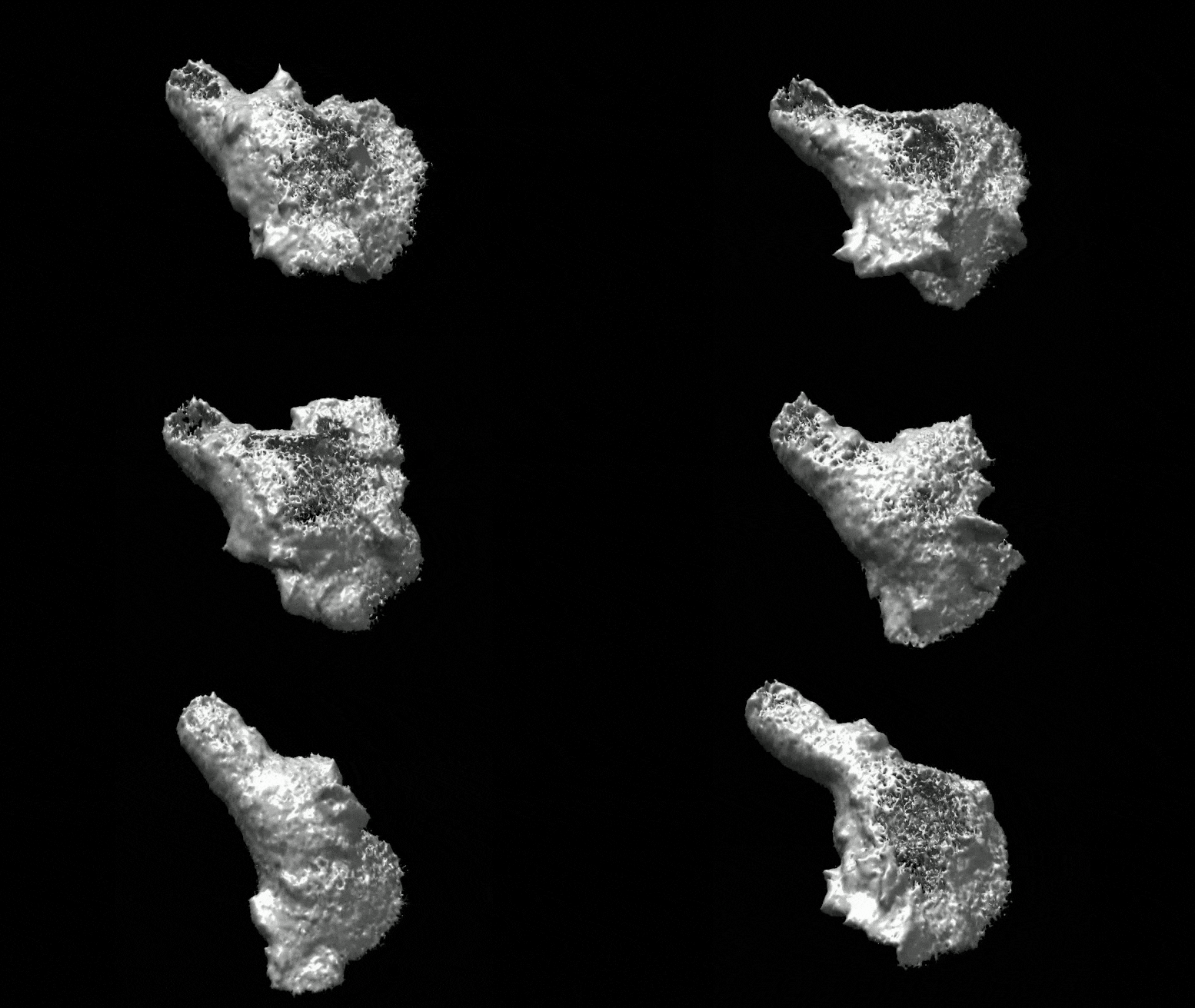
Researchers have discovered that human leukocytes can swim using a novel mechanism called molecular paddling.
Human white blood cells, known as leukocytes, swim using a newly described mechanism called molecular paddling, researchers report in the Biophysical Journal. This microswimming mechanism could explain how both immune cells and cancer cells migrate in various fluid-filled niches in the body, for good or for harm.
“The capacity of living cells to move autonomously is fascinating and crucial for many biological functions, but mechanisms of cell migration remain partially understood,” says co-senior study author Olivier Theodoly of Aix-Marseille University in France. “Our findings shed new light on the migration mechanisms of amoeboid cells, which is a crucial topic in immunology and cancer research.”
Cells have evolved different strategies to migrate and explore their environment. For example, sperm cells, microalgae, and bacteria can swim through shape deformations or by using a whip-like appendage called a flagellum. By contrast, somatic mammalian cells are known to migrate by attaching to surfaces and crawling. It is widely accepted that leukocytes cannot migrate on 2D surfaces without adhering to them.
A prior study reported that certain human white blood cells called neutrophils could swim, but no mechanism was demonstrated. Another study showed that mouse leukocytes could be artificially provoked to swim. It is widely thought that cell swimming without a flagellum requires changes in cell shape, but the precise mechanisms underlying leukocyte migration have been debated.
This is a 3D videomicroscopy of the cytoskeleton of a swimming lymphocyte showing protrusions traveling along cell body that mimic a breast-stroke motion. Credit: SoSPIM microscopy: L. Aoun, O. Theodoly, M. Biarnes, R. Galland
In contrast to previous studies, Theodoly, co-senior study author Chaouqi Misbah of Grenoble Alpes University, and their collaborators provide experimental and computational evidence in the new study that human leukocytes can migrate on 2D surfaces without sticking to them and can swim using a mechanism that does not rely on changes in cell shape. “Looking at cell motion gives the illusion that cells deform their body like a swimmer,” Misbah says. “Although leukocytes display highly dynamic shapes and seem to swim with a breast-stroke mode, our quantitative analysis suggests that these movements are inefficient to propel cells.”
Instead, the cells paddle using transmembrane proteins, which span the cell membrane and protrude outside the cell. The researchers show that membrane treadmilling — rearward movement of the cell surface — propels leukocyte migration in solid or liquid environments, with and without adhesion.
However, the cell membrane does not move like a homogenous treadmill. Some transmembrane proteins are linked to actin microfilaments, which form part of the cytoskeleton and contract to allow cells to move. The actin cytoskeleton is widely accepted as the molecular engine propelling cell crawling. The new findings demonstrate that actin-bound transmembrane proteins paddle and propel the cell forward, whereas freely diffusing transmembrane proteins hinder swimming.
This video shows imaging of the backward treadmilling of paddling molecules outside the cell. Credit: TIRF microscopy: N Garcia-Seyda
Protein Recycling Drives Continuous Cellular Movement
The researchers propose that continuous paddling is enabled by a combination of actin-driven external treadmilling and inner recycling of actin-bound transmembrane proteins through vesicular transport. Specifically, the paddling proteins at the rear of the cell are enclosed inside a vesicle that pinches off from the cell membrane and transported to the front of the cell. By contrast, the non-paddling transmembrane proteins are sorted out and do not undergo this process of internal recycling through vesicular transport.
“This recycling of the cell membrane is studied intensively by the community working on intracellular vesicular traffic, but its role in motility was hardly considered,” Theodoly says. “These functions of protein sorting and trafficking seemed highly sophisticated for swimming. Our investigations, to our own surprise, bridge such distant domains as the physics of microswimmers and the biology of vesicular traffic.”
The authors say that molecular paddling could allow immune cells to thoroughly explore all locations in the body as they migrate in liquid-filled niches such as swollen body parts, infected bladders, cerebrospinal fluid, or amniotic fluid. Moving forward, the researchers plan to investigate the functions of molecular paddling in various environments and assess whether other types of cells use this mode of migration.
Reference: “Amoeboid Swimming Is Propelled by Molecular Paddling in Lymphocytes” by Laurene Aoun, Alexander Farutin, Nicolas Garcia-Seyda, Paulin Nègre, Mohd Suhail Rizvi, Sham Tlili, Solene Song, Xuan Luo, Martine Biarnes-Pelicot, Rémi Galland, Jean-Baptiste Sibarita, Alphée Michelot, Claire Hivroz, Salima Rafai, Marie-Pierre Valignat, Chaouqi Misbah and Olivier Theodoly, 11 August 2020, Biophysical Journal.
DOI: 10.1016/j.bpj.2020.07.033
The work was supported by the French Agence Nationale de la Recherche, the LABEX INFORM, the Région Sud, the Turing Centre for Living systems, the Excellence Initiative of Aix-Marseille University-A*MIDEX, a French ”Investissements d’Avenir” program, and the company Alveole.
Never miss a breakthrough: Join the SciTechDaily newsletter.
Follow us on Google and Google News.
3 Comments
It is somewhat scarry to actually visualize what is happening in our bodies at that deep a level. As Alan Watts said: there is a giant battle going on constantly in our blood, which microbe do you side width? How can you take sides? Isn’t there more microbial DNA in our bodies, weight wise, compared to human genome weight? I’m just a skin sack holding together this whole ecosystem of symbiotic microbes.
Very interesting content in this report.
I’d be open to new friends discussing this or other similar information.
Feel free to message and friend me on Facebook or even better my number is 818-300-1136
Exciting times we live in !
And you think life just happened by accident. This is creation folks.