
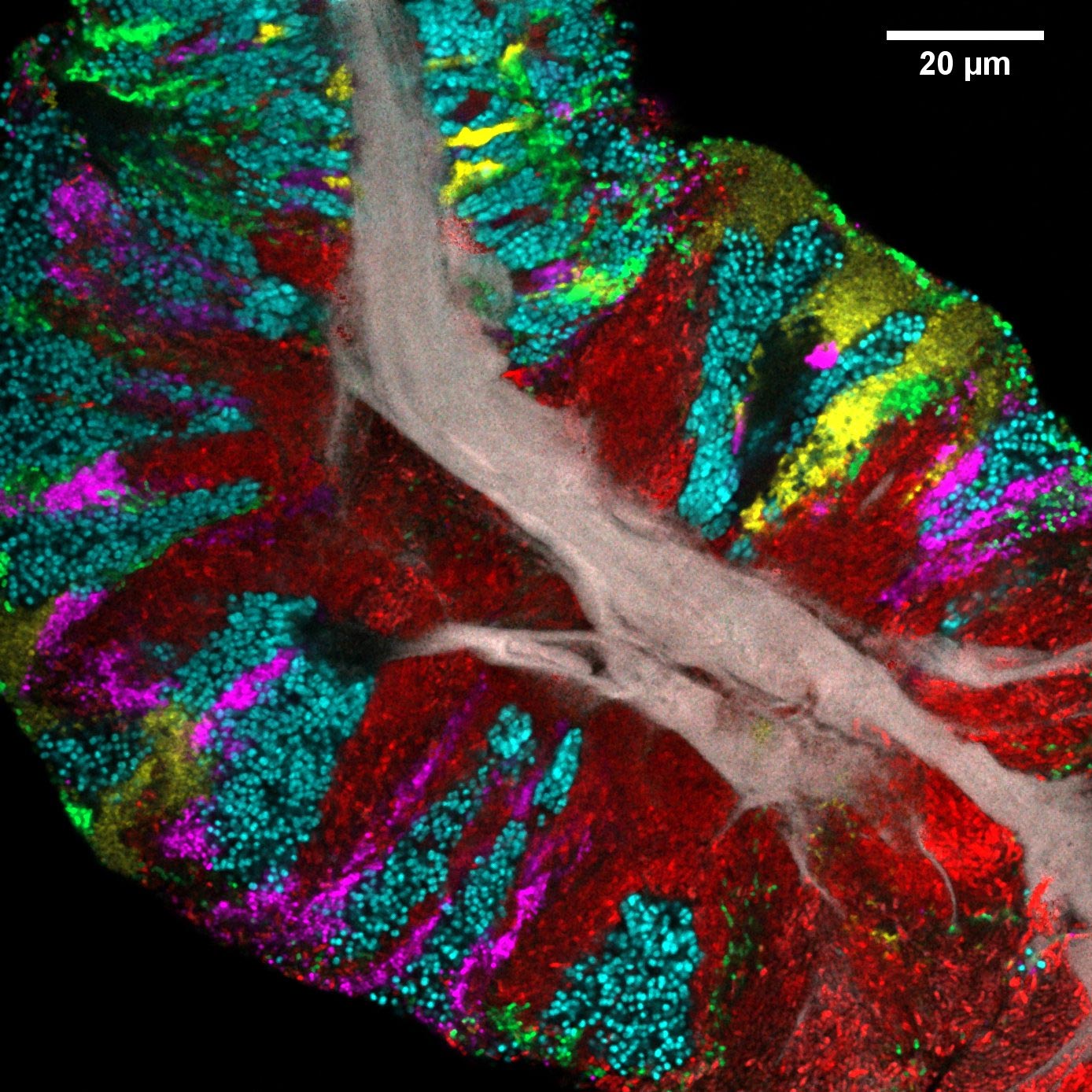
Using a recently developed fluorescent imaging technique, researchers in the United States have developed high-resolution maps of microbial communities on the human tongue. The images, presented March 24 in the journal Cell Reports, reveal that microbial biofilms on the surface of the tongue have a complex, highly structured spatial organization.
“From detailed analysis of the structure, we can make inferences about the principles of community growth and organization,” says senior author Gary Borisy, of the Forsyth Institute and the Harvard School of Dental Medicine. “Bacteria on the tongue are a lot more than just a random pile. They are more like an organ of our bodies.”
The human oral microbiome is a complex ecosystem. The spatial organization of microbial communities in the mouth is affected by a variety of factors, including temperature, moisture, salivary flow, pH, oxygen, and the frequency of disturbances such as abrasion or oral hygiene. In addition, microbes influence their neighbors by acting as sources and sinks of metabolites, nutrients, and inhibitory molecules such as hydrogen peroxide and antimicrobial peptides. By occupying space, microbes can physically exclude one another from desirable habitats, but their surfaces also present binding sites to which other microbes may adhere.
High-resolution maps of microbial communities on the human tongue reveal that microbial biofilms on the surface of the tongue have a complex, highly structured spatial organization.
Yet spatial patterning has received relatively little attention in the field of microbial ecology. “We think that learning who is next to who will help us understand how these communities work,” says co-author Jessica Mark Welch (@JMarkWelch), a microbial ecologist at the Marine Biological Laboratory in Woods Hole, Massachusetts. “The tongue is particularly important because it harbors a large reservoir of microbes and is a traditional reference point in medicine. ‘Stick out your tongue’ is one of the first things a doctor says.”
In the new study, the researchers used a technique called Combinatorial Labeling and Spectral Imaging – Fluorescence in situ Hybridization (CLASI-FISH), which was recently developed in the Borisy lab. This strategy involves labeling a given type of microorganism with multiple fluorophores, greatly expanding the number of different kinds of microbes that can be simultaneously identified and localized in a single field of view.
“Our study is novel because no one before has been able to look at the biofilm on the tongue in a way that distinguishes all the different bacteria, so that we can see how they arrange themselves,” Borisy says. “Most of the previous work on bacterial communities used DNA sequencing-based approaches, but to get the DNA sequence, you have to first grind up the sample and extract the DNA, which destroys all the beautiful spatial structure that was there. Imaging with our CLASI-FISH technique lets us preserve the spatial structure and identify the bacteria at the same time.”
First, the researchers used analyzed sequence data to identify major bacterial taxa contained within small samples scraped from the tongues of 21 healthy participants. Guided by sequence analysis, the imaging approach targeted major genera and selected species to obtain a comprehensive view of microbiome structure. The researchers identified 17 bacterial genera that were abundant on the tongue and present in more than 80% of individuals. The samples consisted of free bacteria, bacteria bound to host epithelial cells, and bacteria organized into consortia — structurally complex, multi-layer biofilms.
The consortia showed patchiness in community structure, consisting of spatially localized domains dominated by a single taxon. Although they varied in shape, they were typically tens to hundreds of microns long and had a core of epithelial cells and a well-defined perimeter. The tongues of all subjects had consortia consisting of three genera: Actinomyces, Rothia, and Streptococcus. Actinomyces frequently appeared near the core, while Rothia was often observed in large patches toward the exterior of the consortium. Streptococcus was observed forming a thin crust on the exterior of the consortia and also formed veins or patches in their interior.
“Collectively, our species-level imaging results confirm and deepen our understanding of habitat specificity of key players and show the value of investigating microbiomes at high imaging and identification resolution,” Mark Welch says.
Taken together, the results suggest a model for how the structured microbial communities harbored on our tongues are generated. First, bacterial cells attach to the epithelium of the tongue’s surface singly or in small clusters. During population growth, differing taxa push on one another and proliferate more rapidly in microenvironments that support their physiological needs. This differential growth results in the patch mosaic organization observed in larger, more mature structures.
The images also revealed that some taxa capable of nitrate reduction — Actinomyces, Neisseria, Rothia, and Veillonella — are prominent in tongue consortia. This raises the possibility that small bumps on the surface of the human tongue are structured to encourage the growth of bacteria that convert salivary nitrate to nitrite — a function not encoded by the human host genome.
Reference: “Spatial Ecology of the Human Tongue Dorsum Microbiome” by Steven A. Wilbert, Jessica L. Mark Welch and Gary G. Borisy, 24 March 2020, Cell Reports.
DOI: 10.1016/j.celrep.2020.02.097
This work was supported by the National Institutes of Health.
Never miss a breakthrough: Join the SciTechDaily newsletter.
Follow us on Google and Google News.