
Emerging field of synthetic condensates isolates or traps together biomolecules to control cellular processes.
Biomedical engineers at Duke University have demonstrated a new synthetic approach to controlling cellular biochemical processes. Rather than creating particles or structures that directly interact with cellular machinery through traditional “lock and key” mechanisms, cells are directed to build compartments that physically stop — or encourage — biomolecular functions.
The researchers demonstrate that their approach can affect two cellular processes, one responsible for spreading genetic instructions amongst bacteria and the other for modulating protein circuits in mammalian cells. The results could prove invaluable to developing new strategies to understand and fight disease or to stop the spread of antibiotic resistant pathogens.
The results appear online today (February 6, 2023) in the journal Nature Chemical Biology.
“A living cell is like a dense noodle soup, the density of the biomolecules in the cell is sometimes described as putting every human on the planet into the Great Salt Lake,” said Yifan Dai, a postdoctoral researcher working in the laboratory of Ashutosh Chilkoti, the Alan L. Kaganov Distinguished Professor of Biomedical Engineering and the laboratory of Lingchong You, the James L. Meriam Distinguished Professor of Biomedical Engineering at Duke.
“Amber formation sometimes locks and preserves animals for thousands of years because of its distinct material properties compared to the surrounding environment,” Dai said. “Scientists thought that maybe cells can do the same thing with information.”
Biological micromachinery generally relies on so-called “lock and key” mechanisms, where a protein, genetic strand or other biomolecule is just the right shape and size to interact with its target structure. Because these are the easiest and most obvious processes to study and recreate, nearly all biomedical research has been focused on its vast, complex web of machinery.
Harnessing Phase Separation and Condensates
But because cells are so densely packed with this biomolecular machinery, and they need to control activity to respond to different needs throughout their lifetime, scientists have long suspected they must have ways of dialing activities up and down. But it wasn’t until 2009 that researchers discovered the mechanism of one such method, called phase separation mediated biological condensates.
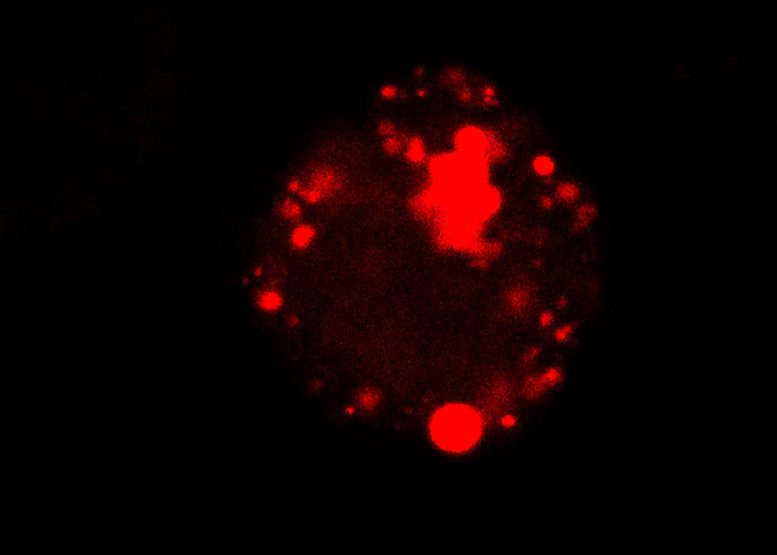
Biological condensates are small compartments that cells can build to either separate or trap together certain proteins and molecules, either hindering or promoting their activity. Researchers are just beginning to understand how condensates work and what they could be used for. Creating a platform that can tell cells to create synthetic versions of these biomolecular cages is a large step toward both goals.
“To me, what’s most remarkable is the effectiveness of the rules emerging from past studies in guiding the rational engineering of the physical properties of these condensates, which in turn work effectively in living cells despite the many confounding factors associated with the intracellular environment,” Lingchong You said.
Synthetic Genetic Instructions for Cellular Control
In the paper, Dai, Chilkoti, You, and their colleagues from the laboratory of Rohit V. Pappu, the Gene K. Beare Distinguished Professor of Biomedical Engineering and the director of the Center for Biomolecular Condensates at Washington University in St. Louis, demonstrate the creation of a synthetic set of genetic instructions that causes cells to create different types of condensates that trap various biomolecular processes. In one example, they build condensates that stop small packets of DNA called plasmids from traveling between bacteria in a process called horizontal gene transfer. This process is one of the primary methods pathogens use to spread resistance to antibiotics, and stopping it from happening could be a key step toward fighting the creation and proliferation of “superbugs.”
The researchers also show that they can use this approach to control the transcription of DNA into RNA in E. coli, effectively amplifying the expression of a specific gene by bringing different factors together. They further demonstrate this approach to modulate protein circuits in mammalian cells. Modulating the activity of specific genes and protein activities could be a useful way of combatting a wide variety of diseases, especially genetic diseases.
“This paper shows that we, as biomedical engineers, can design new molecular parts from the ground up, convince the cell to make them, and assemble these parts inside the cell to make a new machine,” said Chilkoti. “These synthetic condensates can then be turned on inside the cell to control how the cell functions. This paper is part of an emerging field that will allow us to reprogram life in new and exciting ways.”
Reference: “Programmable Synthetic Biomolecular Condensates for Cellular Control” by Yifan Dai, Mina Farag, Dongheon Lee, Xiangze Zeng, Kyeri Kim, Hye-in Son, Xiao Guo, Jonathon Su, Nikhil Peterson, Javid Mohammad, Max Ney, Daniel Mark Shapiro, Rohit V. Pappu, Ashutosh Chilkoti and Lingchong You, 6 February 6, 2023, Nature Chemical Biology.
DOI: 10.1038/s41589-022-01252-8
This research was supported by the Air Force Office of Scientific Research (FA9550-20-1-0241) and the National Institutes of Health (MIRA R35GM127042 and R01EB031869).
Never miss a breakthrough: Join the SciTechDaily newsletter.
Follow us on Google and Google News.