
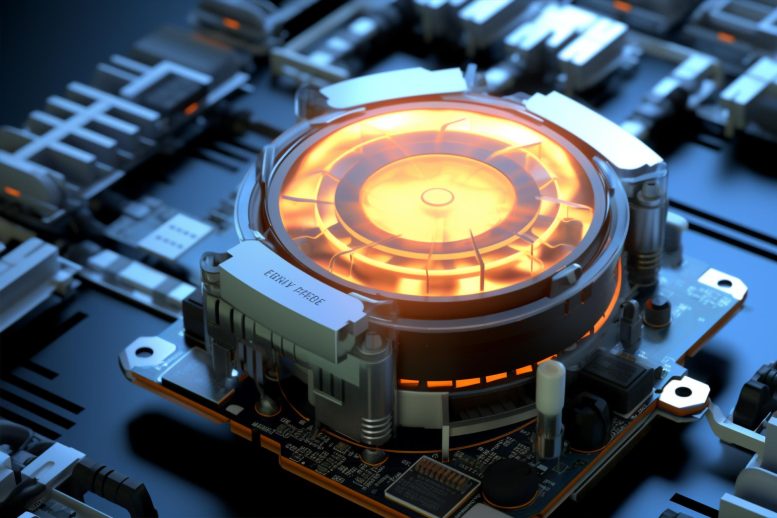
Penn State researchers have created a thermoelectric cooler that significantly improves cooling power and efficiency for future high-power electronics. The device uses half-Heusler alloys and a unique annealing process to yield higher cooling power density and carrier mobility.
Revolutionary Thermoelectric Cooler for Next-Generation Electronics
The development of next-generation electronics, set to feature smaller yet more powerful components, calls for innovative cooling solutions. A newly designed thermoelectric cooler, the brainchild of Penn State scientists, notably improves cooling power and efficiency compared to existing commercial thermoelectric units. This development, the researchers believe, could be instrumental in managing heat in upcoming high-power electronics.
Bed Poudel, research professor in the Department of Materials Science and Engineering at Penn State, expressed optimism about the device’s future applications. He said, “Our new material can provide thermoelectric devices with very high cooling power density. We were able to demonstrate that this new device can not only be competitive in terms of technoeconomic measures but outperform the current leading thermoelectric cooling modules. The new generation of electronics will benefit from this development.”
Thermoelectric Coolers: Mechanism and Challenge
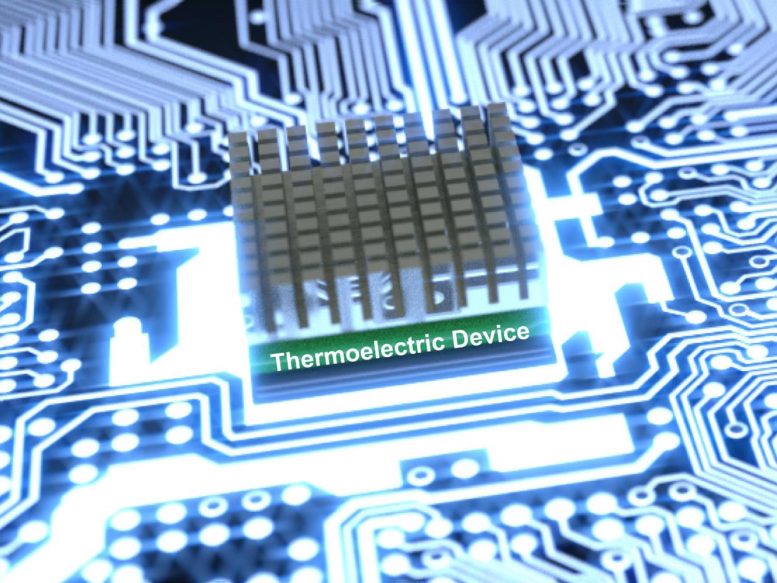
Thermoelectric coolers function by transferring heat from one side of the device to the other upon the application of electricity. This process results in a module with distinctly cold and hot sides. By placing the cold side on heat-generating electronic components such as laser diodes or microprocessors, the surplus heat can be pumped away, effectively controlling the temperature. However, as these components continue to grow more powerful, thermoelectric coolers will also need to expel more heat.
The newly developed thermoelectric device demonstrated a 210% increase in cooling power density compared to the leading commercial device, constructed from bismuth telluride. Additionally, it potentially maintains a similar coefficient of performance (COP), the ratio of useful cooling to the energy required, as reported in the journal Nature Communications.
Addressing Thermoelectric Cooling Challenges
Shashank Priya, vice president for research at the University of Minnesota and a co-author of the paper, shed light on the new device’s capabilities. He stated, “This solves two out of the three big challenges in making thermoelectric cooling devices. First, it can provide a high cooling power density with a high COP. This means a small amount of electricity can pump a lot of heat. Second, for a high-powered laser or applications that require a lot of localized heat to be removed from a small area, this can provide the optimum solution.”
Innovative Half-Heusler Material in the New Device
This novel device is constructed from a compound of half-Heusler alloys, a class of materials with distinctive properties promising for energy applications like thermoelectric devices. These materials offer considerable strength, thermal stability, and efficiency.
The researchers employed a special annealing process — which manipulates how materials are heated and cooled — enabling them to alter and regulate the material’s microstructure to remove defects. This method had not been previously used to fabricate half-Heusler thermoelectric materials.
The Annealing Process and Its Effects
The annealing process also substantially increased the material’s grain size, leading to fewer grain boundaries — regions in a material where crystallite structures meet and that reduce electrical or thermal conductivity.
Wenjie Li, assistant research professor in the Department of Materials Science and Engineering at Penn State, described this transformation: “In general, half-Heusler material has a very small grain size — nano-sized grain. Through this annealing process, we can control the grain growth from the nanoscale to the microscale — a difference of three orders of magnitude.”
Reducing the grain boundaries and other defects significantly enhanced the carrier mobility of the material, influencing how electrons can move through it, which resulted in a higher power factor. This power factor is especially crucial in electronics-cooling applications as it determines the maximum cooling power density.
High Thermal Management Applications and Future Implications
Li further explained the relevance of this advancement, stating, “For instance, in laser diode cooling, a significant amount of heat is generated in a very small area, and it must be maintained at a specific temperature for the optimal performance of the device. That’s where our technology can be applied. This has a bright future for local high thermal management.”
In addition to the high power factor, the materials produced the highest average figure of merit, or efficiency, of any half-Heusler material in the temperature range of 300 to 873 degrees Kelvin (80 to 1,111 degrees Fahrenheit.) This indicates a promising strategy for optimizing half-Heusler materials for near-room-temperature thermoelectric applications.
“As a country, we are investing a lot in the CHIPS and Science Act, and one problem might be how the microelectronics can handle high-power density as they get smaller and operate at higher power,” Poudel said. “This technology may be able to address some of these challenges.”
Reference: “Half-Heusler alloys as emerging high power density thermoelectric cooling materials” by Hangtian Zhu, Wenjie Li, Amin Nozariasbmarz, Na Liu, Yu Zhang, Shashank Priya and Bed Poudel, 6 June 2023, Nature Communications.
DOI: 10.1038/s41467-023-38446-0
Also contributing were Amin Nozariasbmarz, assistant research professor and Na Liu and Yu Zhang, postdoctoral scholars, Penn State; and Hangtian Zhu, associate professor, Institute of Physics, Chinese Academy of Sciences, Beijing.
Researchers on the project were supported by grants from the Office of Defense Advanced Research Projects Agency, Office of Naval Research, U.S. Department of Energy, National Science Foundation and the Army Small Business Research Program.
Never miss a breakthrough: Join the SciTechDaily newsletter.
Follow us on Google and Google News.
1 Comment
Any updates on the developemnt of this? I look dorward to efficient sub ambient cooling for overlcocking CPUs.