
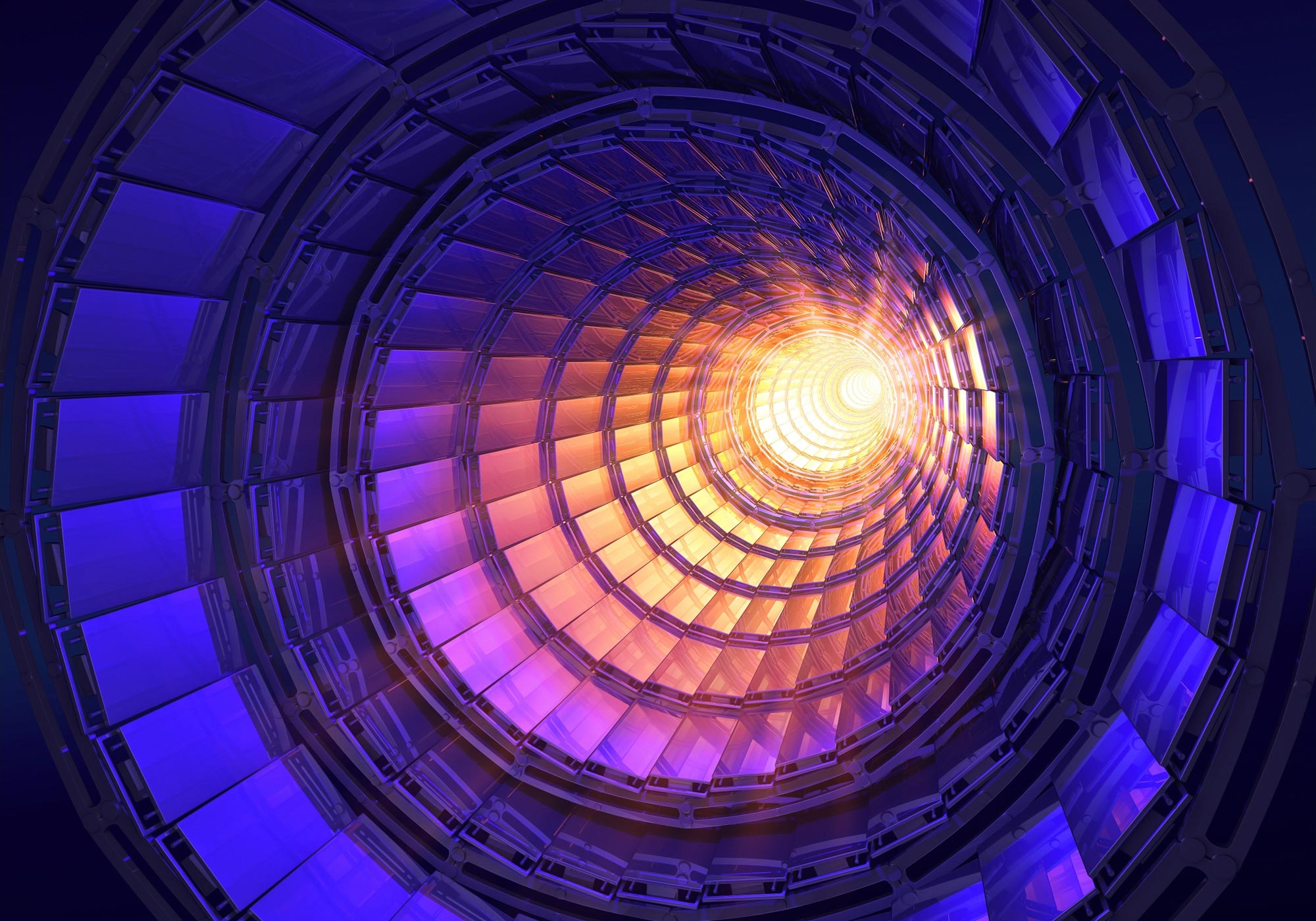
A landmark study revisiting the U.S. Department of Energy’s Thomas Jefferson National Accelerator Facility (CEBAF) benchmarks the upgraded performance and capabilities of this unique particle accelerator, four decades after its conception.
A groundbreaking study, decades in the making, has provided a comprehensive re-benchmarking of the U.S. Department of Energy’s Thomas Jefferson National Accelerator Facility’s primary particle accelerator. The study meticulously documents the accelerator’s original and upgraded operating parameters, offering detailed insights into its main systems, subsystems, capabilities, and limitations.
The research was spearheaded by Geoffrey Krafft, a prominent figure at Jefferson Lab’s Center for Advanced Studies of Accelerators and the director of its Accelerator Education Program. Krafft, also a professor at Old Dominion University’s Center for Accelerator Science, led the creation of this 63-page paper, which centers on Jefferson Lab’s renowned Continuous Electron Beam Accelerator Facility (CEBAF).
“No accelerator like CEBAF has ever been built before. So, telling how it was built and how it works, it’s not trivial,” he said.
A Unique Machine for Exploring the Atom’s Nucleus
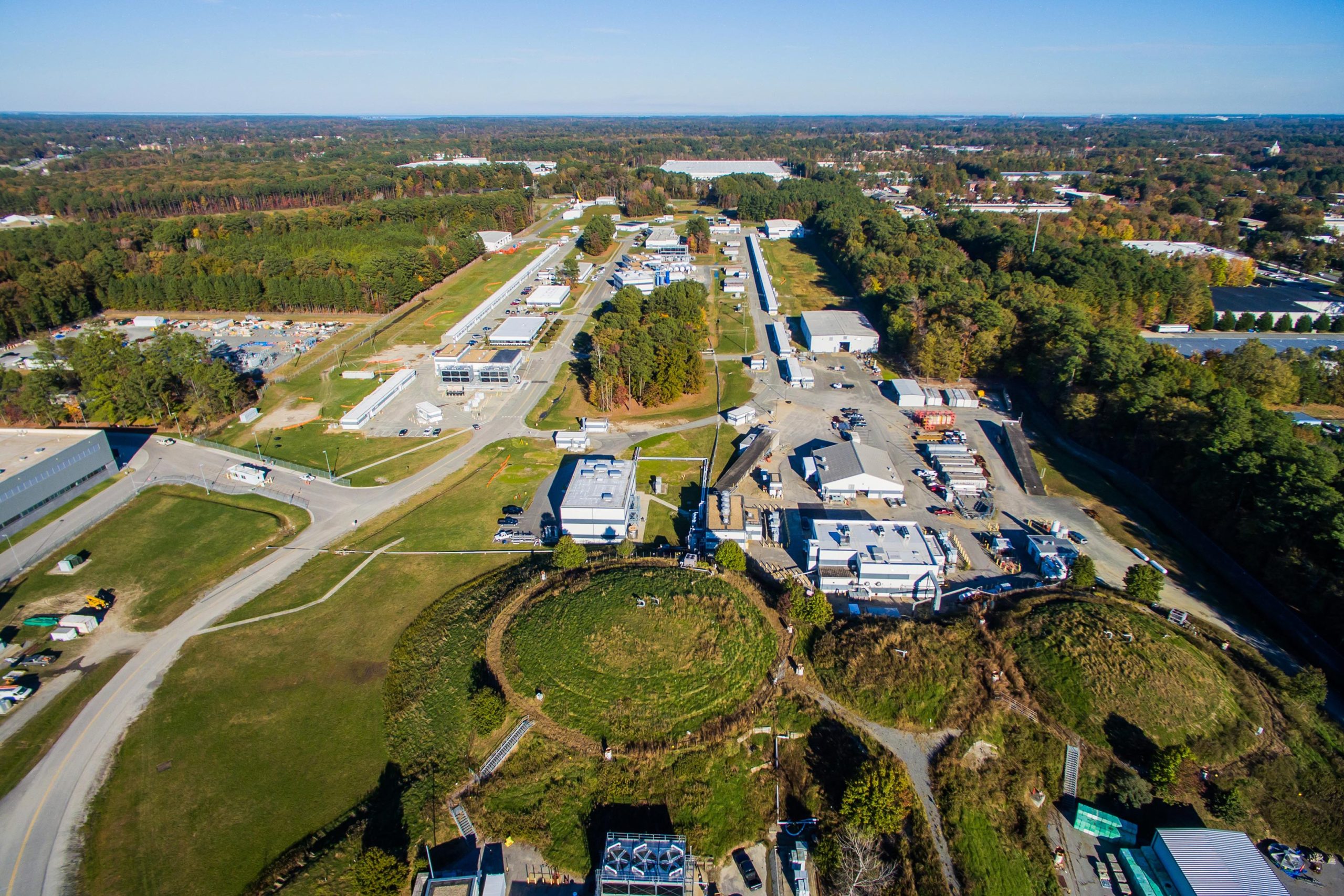
Forty years ago, in August 1983, Congress approved initial funding for research, development and design for what would soon become the Continuous Electron Beam Accelerator Facility. The particle accelerator’s purpose was to deliver beams of energetic electrons for nuclear physics experiments. Each of these electrons would be sent through the machine to be accelerated – ramped up to higher speeds and stuffed full of additional energies of up to 4 billion electron-Volts (4 GeV). These electrons would then be sent into a target, where they would interact with the target’s protons and neutrons to reveal the details of these particles’ structures and interactions inside ordinary matter.
As the 1980s wore on and the facility began taking shape, it was clear that it would be a new particle accelerator like no other.
Advancements in Accelerator Technology
For one, the design of the machine was radically altered in 1985. Originally, the design called for a room-temperature copper-based linear accelerator (and pulse stretcher ring) with an operating energy of 4 GeV. But by 1985, the facility’s first director, Hermann Grunder, decided to throw out that conservative design to try something new: an accelerator powered by superconducting radiofrequency technology. It was hoped that this material would enable the machine to reach even higher energies and also would make the accelerator upgradeable in the future.
SRF technology is built on a material called niobium, which becomes superconducting when it is cooled to near absolute zero. This allows SRF accelerators to use niobium SRF accelerator cavities to propel particle beams with much less energy lost to heat. Unlike the existing copper-based particle accelerators of the time, an SRF accelerator can deliver these beams nearly continuously, allowing researchers to conduct the same experiment many times over without the accelerator overheating.
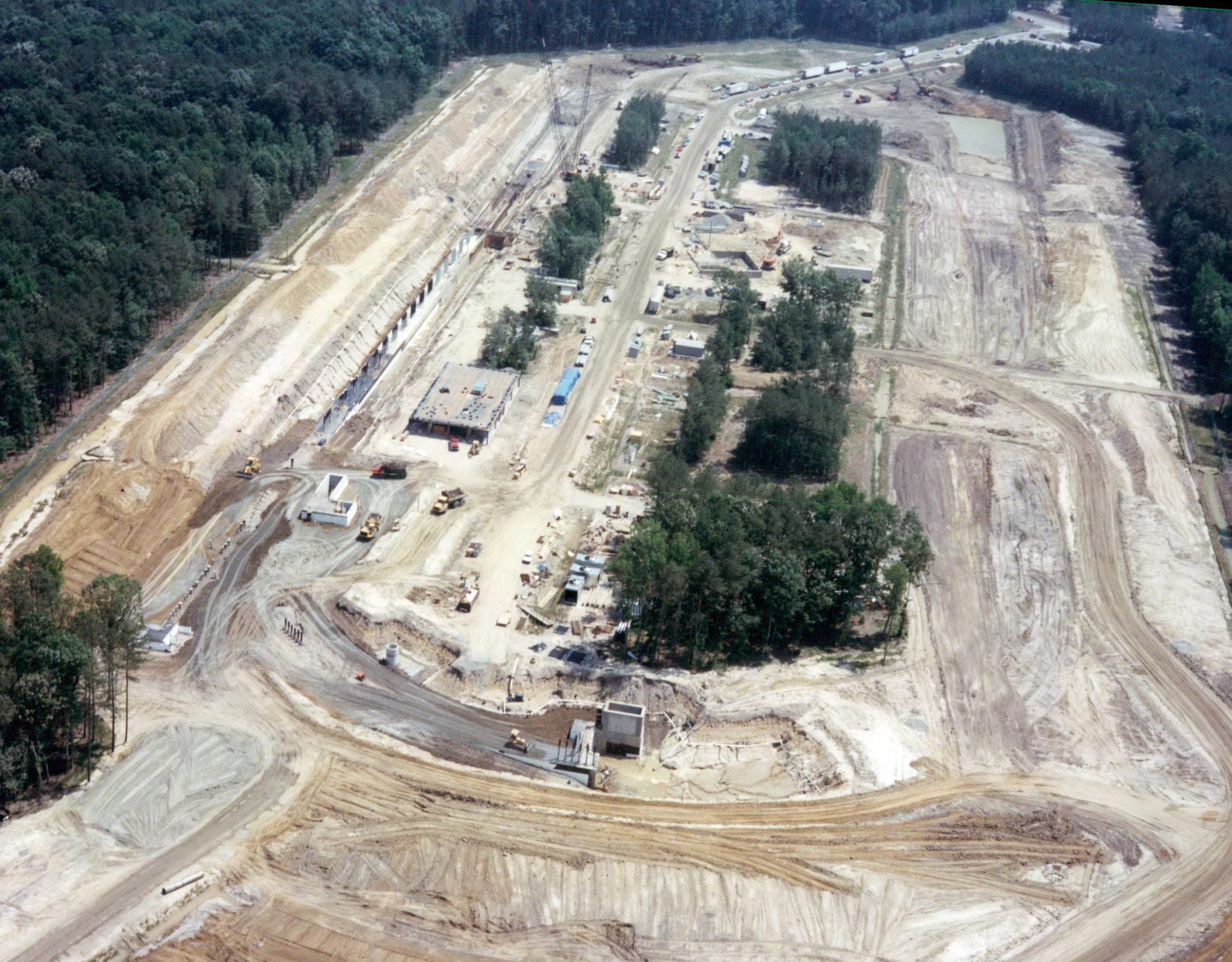
The technology had shown promise in multiple university research labs, but it had never been built into a large-scale machine. The facility moved ahead with the new design, and by 1988, construction had begun at the site.
CEBAF had begun to take shape.
Completion and Initial Operations
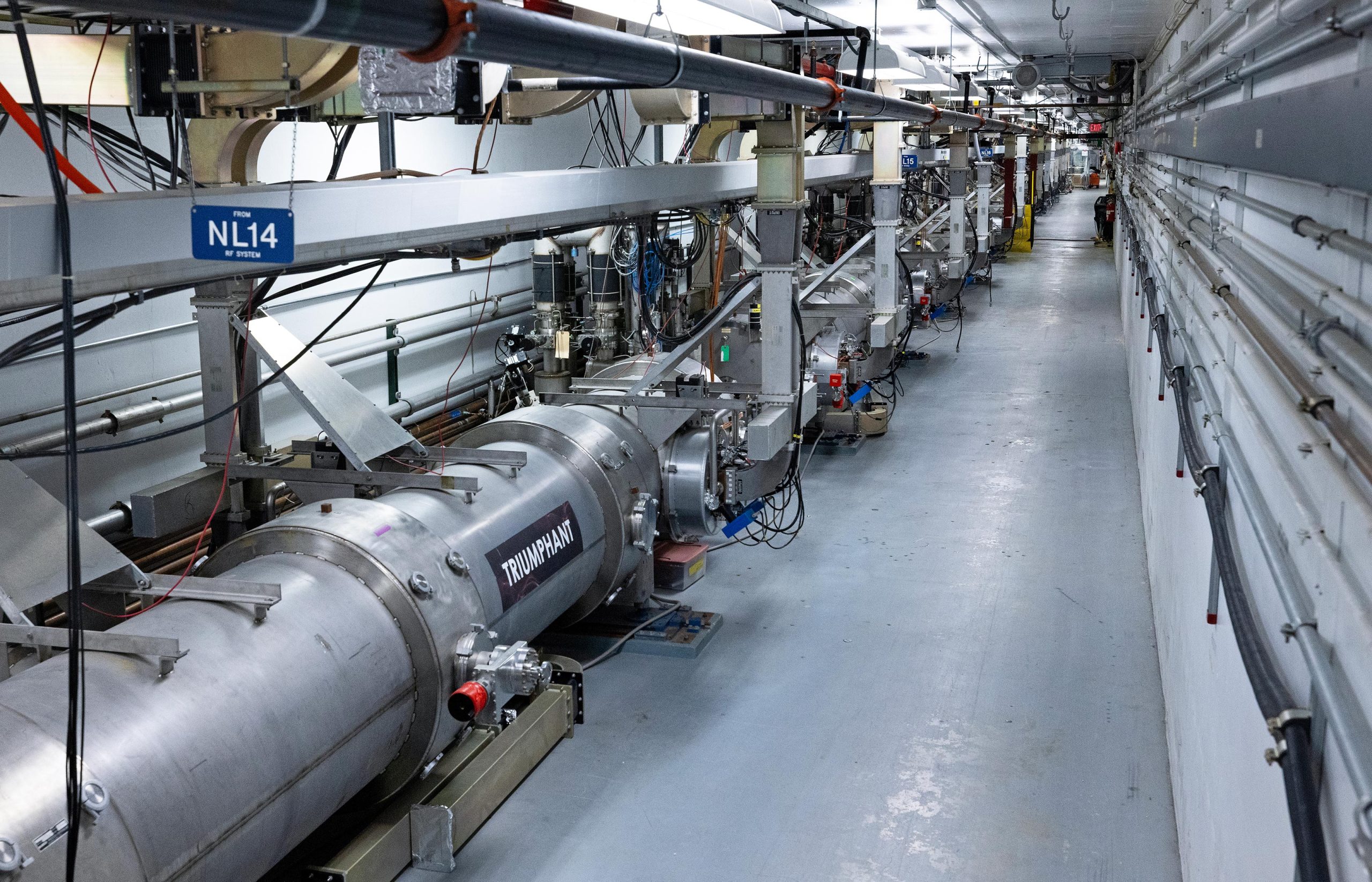
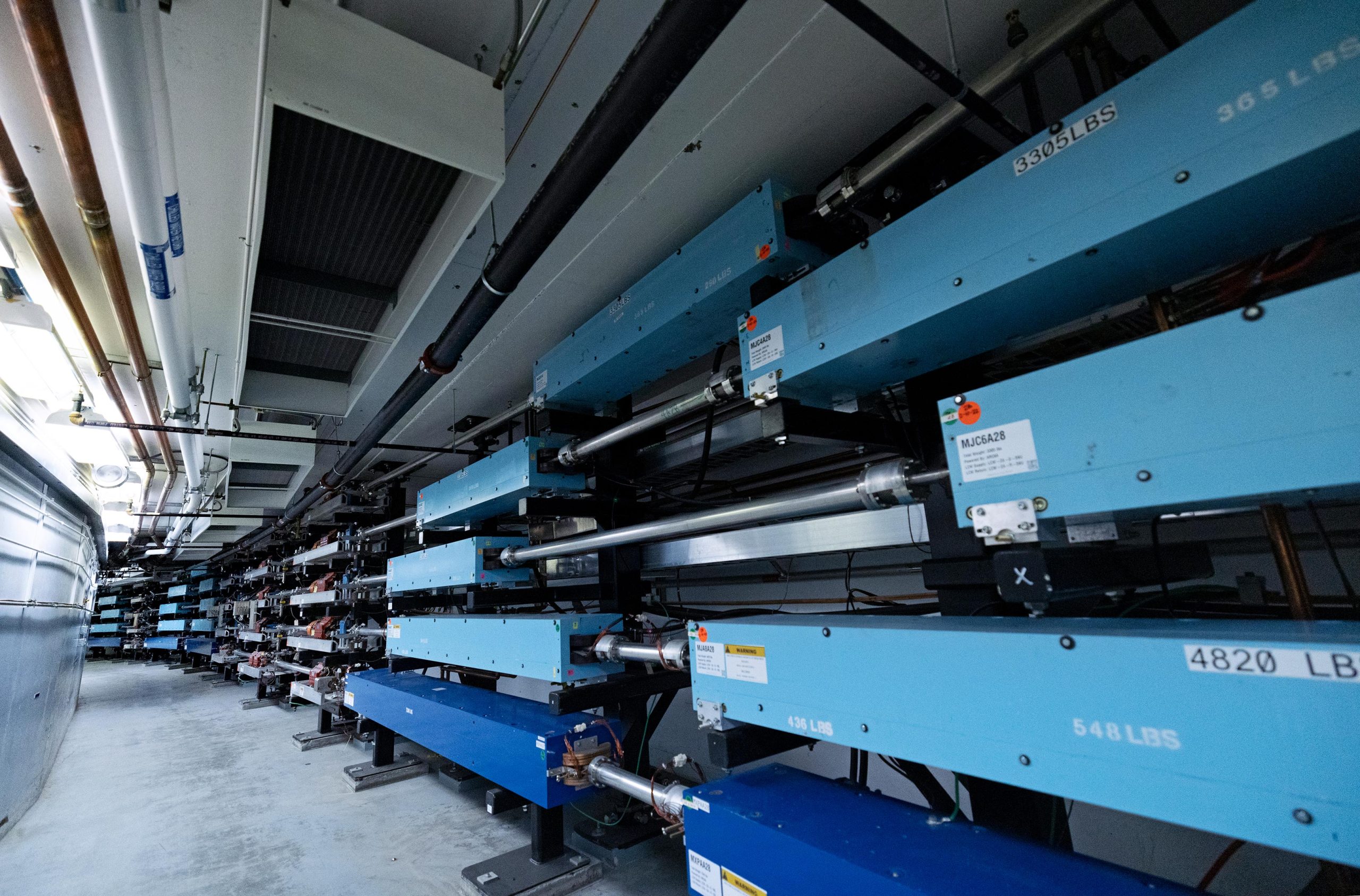
The machine was completed in December 1993 with the placing of its last section of accelerator, called a cryomodule. The complete machine would house two plus a one-quarter cryomodule in the machine’s injector, where the electron beams were formed. Another 40 of these cryomodules were lined up end to end in two linear accelerators (20 in each linac), which were connected by two arcs. This racetrack design was 7/8 of a mile around, and it would allow electrons to travel through the machine up to five times, gaining additional energy with each pass, before being directed into an experimental hall for research.
By 1995, CEBAF was already taking data in for nuclear physics experiments, some of which had been conceived nearly two decades prior. Less than two years later, all three of CEBAF’s experimental halls – Halls A, B and C – were up and running.
Benchmarking and Early Successes
By 2001, Krafft and his accelerator scientist colleagues Christoph Leemann (who would later become Jefferson Lab’s second director) and David Douglas had gathered enough information to publish a benchmark paper on CEBAF. “The Continuous Electron Beam Accelerator Facility: CEBAF at the Jefferson Laboratory” was published in the Annual Review of Nuclear and Particle Science and has served as the resource for all things CEBAF ever since. This technical journal article provided nuclear and accelerator physicists with everything they needed to know about CEBAF, including its key technologies, operating specifications, and demonstrated capabilities.
Then, just a few short years later, it was clear that big changes were on the horizon.

The Need for Upgrades
The original particle accelerator had performed spectacularly well, exceeding its design goal of 4 GeV by 50%, eventually reaching 6 GeV. Additional capabilities beyond the initial design were also demonstrated, such as highly polarized electron beams, simultaneous experiments in up to three experimental halls, the ability to deliver lower-energy beams than designed for (called half-pass beam), and energy recovery.
Anxious to further capitalize on CEBAF’s capabilities, nuclear physicists made their case for upgrading the machine to enable new nuclear physics research goals in a white paper published in 2001.
In 2004, DOE recognized that there was a “mission need” for an upgrade to CEBAF. The $338 million 12 GeV CEBAF Upgrade Project would triple the operating energy of CEBAF’s original design (from 4 GeV to 12 GeV) and commission a new experimental area (Experimental Hall D), along with other updates to enable the increased energy reach. CEBAF shut down in May 2012 for the bulk of the upgrade process, and five years later, the upgrade project was completed in the fall of 2017.
“A lot of different subsystems within the accelerator had to be improved and made better. A lot of the equipment is refurbished,” said Krafft.
Recent Updates and Future Outlook
Following the upgrade, Krafft and his colleagues felt that it was time to once again benchmark the machine. Now, more than two decades after the first landmark paper was published, it has been replaced with “The Continuous Electron Beam Accelerator Facility at 12 GeV,” which was recently published in Physical Review Accelerators and Beams.
This new reference article reviews the original CEBAF operational details, provides information on the technical upgrades made to the machine, and benchmarks accelerator performance of CEBAF at 12 GeV. It now serves as a handy reference of this DOE Office of Science user facility that is the research home for more than 1,650 nuclear physicists worldwide.
“It is a summary of the technical achievements within the 12 GeV CEBAF Upgrade Project and then how the project actually performed in the end,” Krafft said. “We’re hoping that it becomes a standard reference for nuclear physicists who perform measurements here at CEBAF, because it provides a complete description of the new accelerator and its performance characteristics so that they have a ready reference.”
The paper also touches on future possibilities, with mentions of opportunities to improve CEBAF operations with machine learning, development of new photon sources, and mentions of several major nuclear physics projects.
In the meantime, should anyone have questions about CEBAF and its capabilities that may not be addressed in the paper?
“They can just ask,” Krafft added. “The approach that we took was that anyone who contributed in some way technically to the upgrade project should be co-author on the paper. There’re over 100 people that are on the paper.”
Reference: “The Continuous Electron Beam Accelerator Facility at 12 GeV” by P. A. Adderley, S. Ahmed, T. Allison, R. Bachimanchi, K. Baggett, M. BastaniNejad, B. Bevins, M. Bevins, M. Bickley, R. M. Bodenstein, S. A. Bogacz, M. Bruker, A. Burrill, L. Cardman, J. Creel, Y.-C. Chao, G. Cheng, G. Ciovati, S. Chattopadhyay, J. Clark, W. A. Clemens, G. Croke, E. Daly, G. K. Davis, J. Delayen, S. U. De Silva, M. Diaz, R. Dickson, L. Doolittle, D. Douglas, M. Drury, E. Feldl, J. Fischer, A. Freyberger, V. Ganni, R. L. Geng, C. Ginsburg, J. Gomez, J. Grames, J. Gubeli, J. Guo, F. Hannon, J. Hansknecht, L. Harwood, J. Henry, C. Hernandez-Garcia, T. Hiatt, D. Higinbotham, S. Higgins, A. S. Hofler, J. Hogan, C. Hovater, A. Hutton, C. Jones, K. Jordan, M. Joyce, R. Kazimi, M. Keesee, M. J. Kelley, C. Keppel, A. Kimber, L. King, P. Kjeldsen, P. Kneisel, J. Kowal, G. A. Krafft, G. Lahti, T. Larrieu, R. Lauze, C. Leemann, R. Legg, R. Li, F. Lin, D. Machie, J. Mammosser, K. Macha, K. Mahoney, F. Marhauser, B. Mastracci, J. Matalevich, J. McCarter, M. McCaughan, L. Merminga, R. Michaud, V. Morozov, C. Mounts, J. Musson, R. Nelson, W. Oren, R. B. Overton, G. Palacios-Serrano, H.-K. Park, L. Phillips, S. Philip, F. Pilat, T. Plawski, M. Poelker, P. Powers, T. Powers, J. Preble, T. Reilly, R. Rimmer, C. Reece, H. Robertson, Y. Roblin, C. Rode, T. Satogata, D. J. Seidman, A. Seryi, A. Shabalina, I. Shin, C. Slominski, R. Slominski, M. Spata, D. Spell, J. Spradlin, M. Stirbet, M. L. Stutzman, S. Suhring, K. Surles-Law, R. Suleiman, C. Tennant, H. Tian, D. Turner, M. Tiefenback, O. Trofimova, A.-M. Valente, H. Wang, Y. Wang, K. White, C. Whitlatch, T. Whitlatch, M. Wiseman, M. J. Wissman, G. Wu, S. Yang, B. Yunn, S. Zhang and Y. Zhang, 15 August 2024, Physical Review Accelerators and Beams.
DOI: 10.1103/PhysRevAccelBeams.27.084802
Never miss a breakthrough: Join the SciTechDaily newsletter.
Follow us on Google and Google News.