
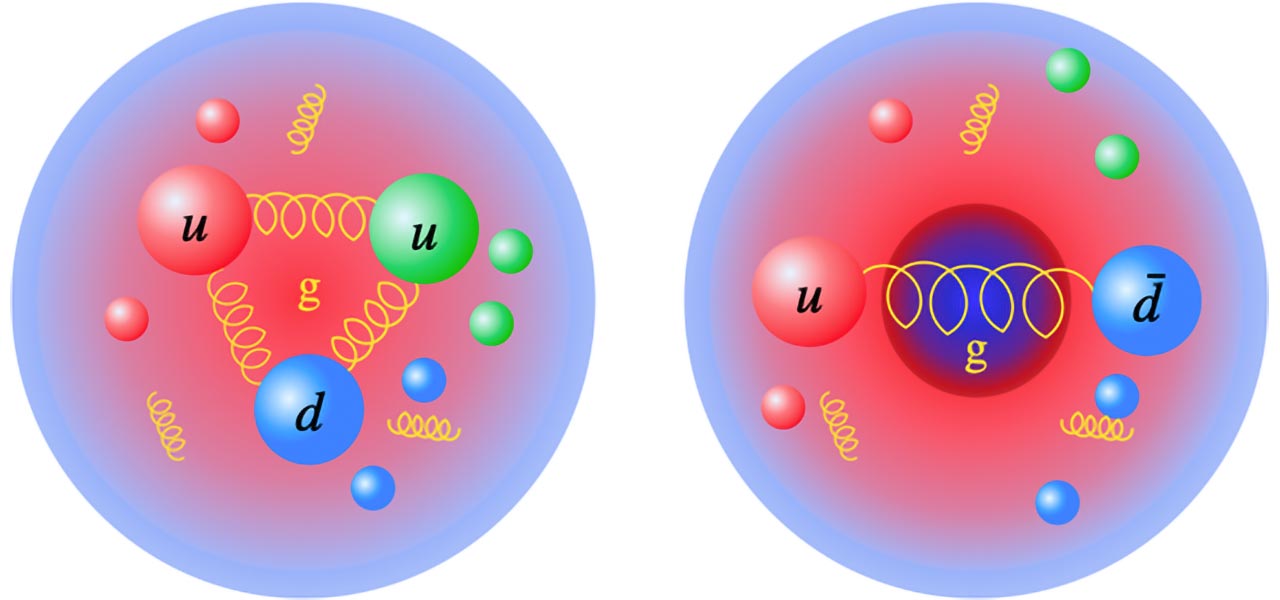
Nuclear theorists uncover the mass distribution within the pion and the proton through groundbreaking first-principle numerical calculations.
Scientists use the trace anomaly in spacetime to understand the mass of subatomic particles. This new approach in numerical calculations helps predict mass distribution in particles like protons and pions, supporting experiments at the Electron-Ion Collider which will explore quark and gluon mass distribution.
Subatomic Mass Distribution and the Role of Trace Anomaly
Scientists can determine the mass of subatomic particles, which are made of quarks, by analyzing their energy and momentum in four-dimensional spacetime. A key factor in this process is the trace anomaly, a quantity that reflects how physical measurements from high-energy experiments vary depending on the energy and momentum scales involved. The trace anomaly is thought to play a crucial role in binding quarks together within subatomic particles.
In this study, researchers calculated the trace anomaly for both nucleons (protons and neutrons) and pions (particles composed of one quark and one antiquark). Their findings revealed that in pions, the mass distribution closely resembles the charge distribution of neutrons, while in nucleons, the mass distribution aligns more closely with the charge distribution of protons.
Electron-Ion Collider Goals and Hadron Mass Analysis
Understanding the origin of the nucleon mass is one of the major scientific goals of the Electron-Ion Collider (EIC). Scientists also want to understand how the mass from quarks and gluons is distributed in hadrons. These are subatomic particles such as protons and neutrons that are made up of quarks and held together by the strong force.
The new calculations demonstrate that the distribution of mass can be obtained numerically based on first principle calculations, which start from basic physical laws. Calculations from this new approach will also aid scientists in interpreting data from nuclear physics experiments.
Future Experiments and Proton Structure Insights
Experiments exploring the origin of the nucleon mass are planned for the future EIC at Brookhaven National Laboratory. In these experiments, electron-proton scattering can produce heavy states that are sensitive to the inner structure of the proton, particularly the gluons’ distributions.
By analyzing the data from the scatterings, scientists can know how the mass of quarks and gluons is distributed within the proton. This is similar to how researchers used X-ray diffraction to discover the iconic double-helix shape of DNA.
Theoretical Insights and Standard Model Implications
Theoretical calculations help scientists understand how mass is distributed among hadrons according to the Standard Model, and they provide direction for upcoming experiments. The findings reveal important aspects of how mass is spread out within particles like the pion and the nucleon.
The results suggest that the structure of the pion, in particular, plays a role in connecting two properties of the world that is described by the Standard Model: the existence of an absolute scale, and the asymmetry of left-handed and right-handed quantities.
References:
“Trace anomaly form factors from lattice QCD” by χQCD Collaboration, Bigeng Wang, Fangcheng He, Gen Wang, Terrence Draper, Jian Liang, Keh-Fei Liu and Yi-Bo Yang, 9 May 2024, Physical Review D.
DOI: 10.1103/PhysRevD.109.094504
“Hadrons, superconductor vortices, and cosmological constant” by Keh-Fei Liu, 27 December 2023, Physics Letters B.
DOI: 10.1016/j.physletb.2023.138418
This work is partially supported by a Department of Energy (DOE) grant under the framework of the DOE Office of Science topical collaboration in nuclear physics framework, managed by Keith Jankowski and Xiaofeng Guo. Both Bigeng Wang and the PI Keh-Fei Liu are affiliates of Lawrence Berkeley National Laboratory, where the work was carried out. This research used resources of the Oak Ridge Leadership Computing Facility at the Oak Ridge National Laboratory, a DOE Office of Science user facility. This work also used Stampede time under the Extreme Science and Engineering Discovery Environment, which is supported by National Science Foundation The authors also thank the National Energy Research Scientific Computing Center for providing high performance computing resources. Finally, they acknowledge the role of facilities of the USQCD Collaboration, which are funded by the DOE Office of Science.
Never miss a breakthrough: Join the SciTechDaily newsletter.
Follow us on Google and Google News.