
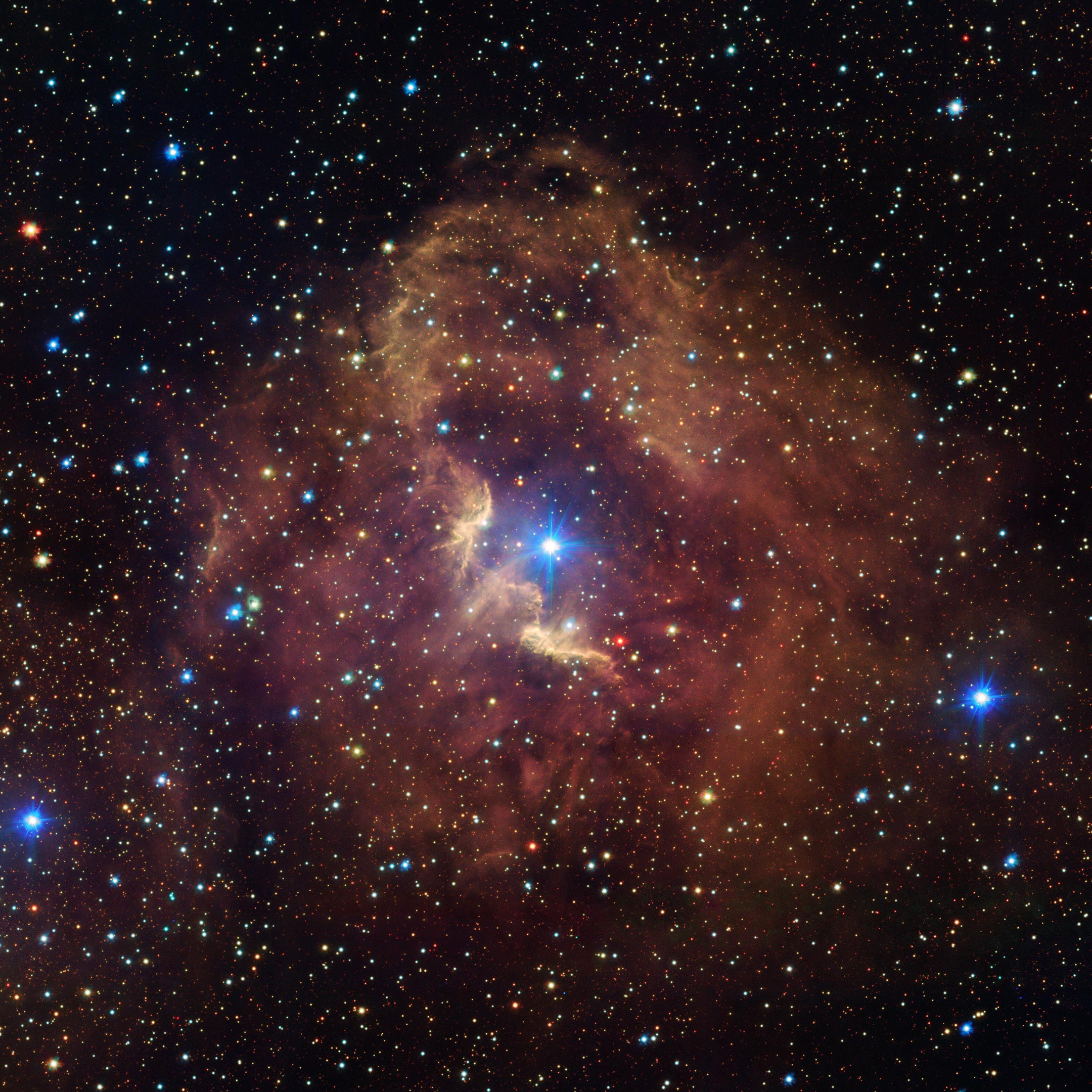
Gum 41, a radiant nebula in the southern sky, glows due to powerful radiation from a pair of massive stars at its core.
This stunning region, part of the Running Chicken Nebula, is home to many such stellar duos, but their lifespans are fleeting. As these stars burn through their fuel, the nebula’s glow will eventually fade, leaving only darkness behind.
A Celestial Beauty in Centaurus
Nestled in the scenic southern constellation of Centaurus, the Gum 41 nebula dominates this image, captured by the VLT Survey Telescope at ESO’s Paranal Observatory in Chile. This striking celestial structure is a fascinating subject to explore.
Gum 41 stands out against a vibrant starry backdrop as a near-perfect example of a Strömgren sphere — a glowing shell of hydrogen gas illuminated by intense radiation from its central star. What appears to be a single, brilliant light at the heart of the nebula, known as HD 100099, is actually believed to be a pair of young, massive stars orbiting so closely that they blur into one at this scale.
A Star-Crossed Romance in Space
This romantic region is home to many pairs like this, including the luminous object on the lower right outskirts of the nebula, HD 99944. Sadly, the love story in these stellar couples will have a tragic ending: unlike our Sun, these hot and massive stars tend to have short lifetimes of only a few million years, and eventually, there will be no young stars left to make the nebula glow. One day, Gum 41 will fade into transparency and be lost to future astronomers forever.
Gum 41 is also a member of a much larger region, affectionately called the Running Chicken Nebula. Whether Gum 41 forms the foot or the head of the chicken is surprisingly controversial. Take a look here — what do you see?
Never miss a breakthrough: Join the SciTechDaily newsletter.
Follow us on Google and Google News.