
Close Menu
    Facebook X (Twitter) Instagram
    SciTechDaily
    • Biology
    • Chemistry
    • Earth
    • Health
    • Physics
    • Science
    • Space
    • Technology
    Facebook X (Twitter) Pinterest YouTube RSS
    SciTechDaily
    Home»Space»Inside the Sun’s Magnetic Inferno: A High-Res Journey Through Solar Chaos
    Space

    Inside the Sun’s Magnetic Inferno: A High-Res Journey Through Solar Chaos

    By European Space Agency (ESA)April 25, 2025No Comments4 Mins Read
    Facebook Twitter Pinterest Telegram LinkedIn WhatsApp Email Reddit
    Share
    Facebook Twitter LinkedIn Pinterest Telegram Email Reddit
    Solar Orbiter’s Widest High-Res View of the Sun
    This large image was assembled from images taken between 13:06 and 17:31 UTC (14:06–18:31 CET) on March 9, 2025, by Solar Orbiter’s Extreme Ultraviolet Imager at a wavelength of 17.4 nanometers. Solar Orbiter was viewing the Sun from a latitude 11.4° below the equator at a distance of around 77 million km. The final image is 12544 x 12544 pixels in size, corresponding 6171.6 x 6171.6 arc seconds or 2325.5 x 2325.5 million km. The Sun, which has a diameter of 1.4 million km, spans around 7505 pixels and 3692.6 arc seconds. Credit: ESA & NASA/Solar Orbiter/EUI Team, E. Kraaikamp (ROB)

    Solar Orbiter just delivered its most jaw-dropping image yet—an enormous, detailed snapshot of the Sun’s blazing outer atmosphere.

    This isn’t just a pretty picture; it’s a 200-frame composite revealing swirling loops of solar activity, dramatic magnetic filaments, and the Sun’s complex, dynamic behavior. Captured using a precision 5×5 grid while cruising 77 million km away, this view is not only technically astonishing but visually stunning.

    Unprecedented Solar Imagery From Orbiter

    Five years into its mission, Solar Orbiter has once again delivered a remarkable view of the Sun. What you’re looking at is the Sun’s outer atmosphere, known as the corona, which reaches temperatures of over a million degrees Celsius. This image shows the corona as seen in ultraviolet light, revealing features invisible to the human eye.

    Look closely and you’ll find arcs of hot plasma, charged particles, tracing the Sun’s tangled magnetic fields. Bright coronal loops glow above active regions, while cooler, darker filaments and prominences stretch across the surface in striking contrast.

    Capturing the Sun, Grid by Grid

    Creating an image of this detail and scale required careful planning. On March 9, 2025, from a distance of about 77 million kilometers, Solar Orbiter was programmed to scan the Sun using a 5 x 5 grid pattern. At each point in the grid, the Extreme Ultraviolet Imager (EUI) captured six high-resolution images along with two wide-angle shots.
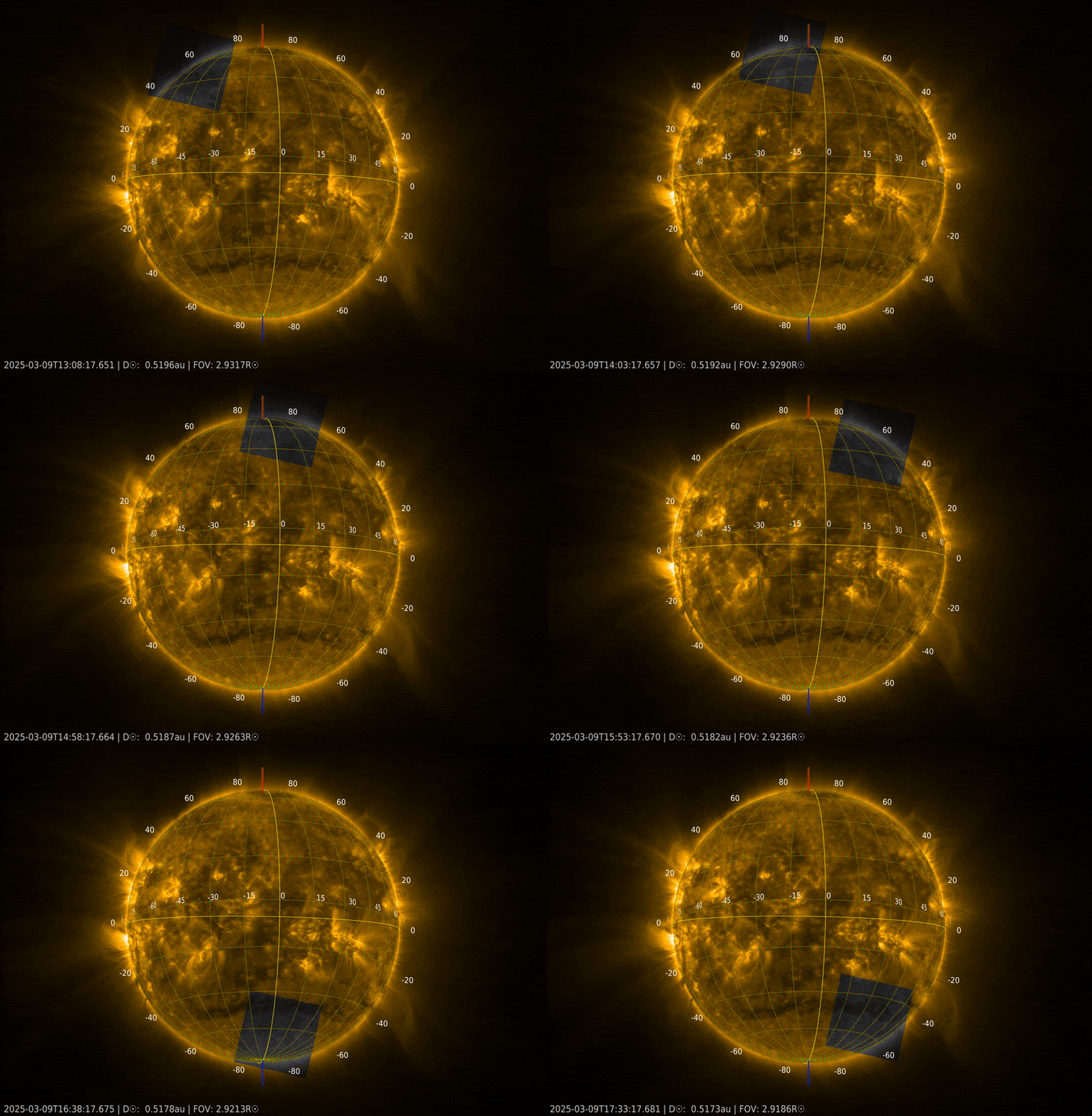
    Making Sun Mosaic
    This animation shows how Solar Orbiter obtains its high-resolution full Sun views. While both the Extreme Ultraviolet Imager (EUI) and Polarimetric and Helioseismic Imager (PHI) instruments on the spacecraft are capable of imaging the entire Sun in a single shot, their high-resolution cameras only cover a small patch of the Sun at any one time. To get a high-resolution view of the full solar disc, Solar Orbiter is first oriented to point to different regions across the Sun, usually in a 5 x 5 grid, with images taken at each pointing direction. These are then stitched together to create a much larger ‘mosaic’. Credit: ESA & NASA/Solar Orbiter/EUI Team, D. Berghmans (ROB)

    200 Snapshots, One Epic Mosaic

    The image you see here combines a whopping 200 individual images into the widest high-resolution view of the Sun yet. (See previous full Sun views here.)

    Zooming Into the Technical Specs

    This large image was assembled from images taken between 13:06 and 17:31 UTC (14:06–18:31 CET) on March 9, 2025 by Solar Orbiter’s Extreme Ultraviolet Imager at a wavelength of 17.4 nanometers. Solar Orbiter was viewing the Sun from a latitude 11.4° below the equator at a distance of around 77 million km. The final image is 12544 x 12544 pixels in size, corresponding 6171.6 x 6171.6 arc seconds or 2325.5 x 2325.5 million km. The Sun, which has a diameter of 1.4 million km, spans around 7505 pixels and 3692.6 arc seconds.

    Solar Orbiter Near Sun
    An artist’s concept shows Solar Orbiter near the Sun. Credit: NASA’s Goddard Space Flight Center Conceptual Image Lab

    Solar Orbiter is a cutting-edge space mission launched through an international collaboration between the European Space Agency (ESA) and NASA. Its primary goal is to study the Sun up close, particularly its outer atmosphere, magnetic activity, and the origins of solar wind. Launched in February 2020, the spacecraft follows an elliptical orbit that brings it as close as 42 million kilometers to the Sun, inside the orbit of Mercury.

    One of its key instruments is the Extreme Ultraviolet Imager (EUI), which captures high-resolution images of the Sun’s corona in ultraviolet light. The EUI is led by the Royal Observatory of Belgium (ROB) and plays a crucial role in revealing the Sun’s dynamic magnetic structures, such as coronal loops and filaments. By combining detailed imaging with in-situ measurements, Solar Orbiter is helping scientists better understand solar activity and its effects on the solar system, including space weather that impacts Earth.

    Never miss a breakthrough: Join the SciTechDaily newsletter.
    Follow us on Google and Google News.

    European Space Agency Solar Orbiter Sun
    Share. Facebook Twitter Pinterest LinkedIn Email Reddit

    Related Articles

    “Campfires” on the Sun Offer Clue to Solar Heating Mystery

    ESA’s Solar Orbiter Spacecraft Communications Disrupted by the Sun

    Solar Orbiter: Turning Pictures Into Physics – Solar ‘Campfires’, Space Weather, and Disintegrating Comets

    First Data From Solar Orbiter Released to the Public

    Closer Than Ever: Solar Orbiter’s First Views of the Sun [Video]

    Solar Orbiter Snaps Closest Pictures Ever of the Sun – Reveals New “Campfires” Phenomena

    Solar Orbiter Ready for Science – Completed Commissioning Despite COVID-19 Setbacks

    Solar Orbiter Made First Close Approach to the Sun Today [Video]

    Solar Orbiter Science Instrument Sends First Measurements to Ground Control

    Leave A Reply Cancel Reply

    • Facebook
    • Twitter
    • Pinterest
    • YouTube

    Don't Miss a Discovery

    Subscribe for the Latest in Science & Tech!

    Trending News

    Artificial Sweeteners May Harm Future Generations, Study Suggests

    Splashdown! NASA Artemis II Returns From Record-Breaking Moon Mission

    What If Consciousness Exists Beyond Your Brain

    Scientists Finally Crack the 100-Million-Year Evolutionary Mystery of Squid and Cuttlefish

    Beyond “Safe Levels”: Study Challenges What We Know About Pesticides and Cancer

    Researchers Have Found a Dietary Compound That Increases Longevity

    Scientists Baffled by Bizarre “Living Fossil” From 275 Million Years Ago

    Your IQ at 23 Could Predict Your Wealth at 27, Study Finds

    Follow SciTechDaily
    • Facebook
    • Twitter
    • YouTube
    • Pinterest
    • Newsletter
    • RSS
    SciTech News
    • Biology News
    • Chemistry News
    • Earth News
    • Health News
    • Physics News
    • Science News
    • Space News
    • Technology News
    Recent Posts
    • What if Dark Matter Has Two Forms? Bold New Hypothesis Could Explain a Cosmic Mystery
    • Researchers Expose Hidden Chemistry of “Ore-Forming” Elements in Biology
    • Geologists Reveal the Americas Collided Earlier Than We Thought
    • 20x Difference: Study Reveals True Source of Airborne Microplastics
    • Scientists Uncover Hidden Force Powering Yellowstone’s Supervolcano
    Copyright © 1998 - 2026 SciTechDaily. All Rights Reserved.
    • Science News
    • About
    • Contact
    • Editorial Board
    • Privacy Policy
    • Terms of Use

    Type above and press Enter to search. Press Esc to cancel.