
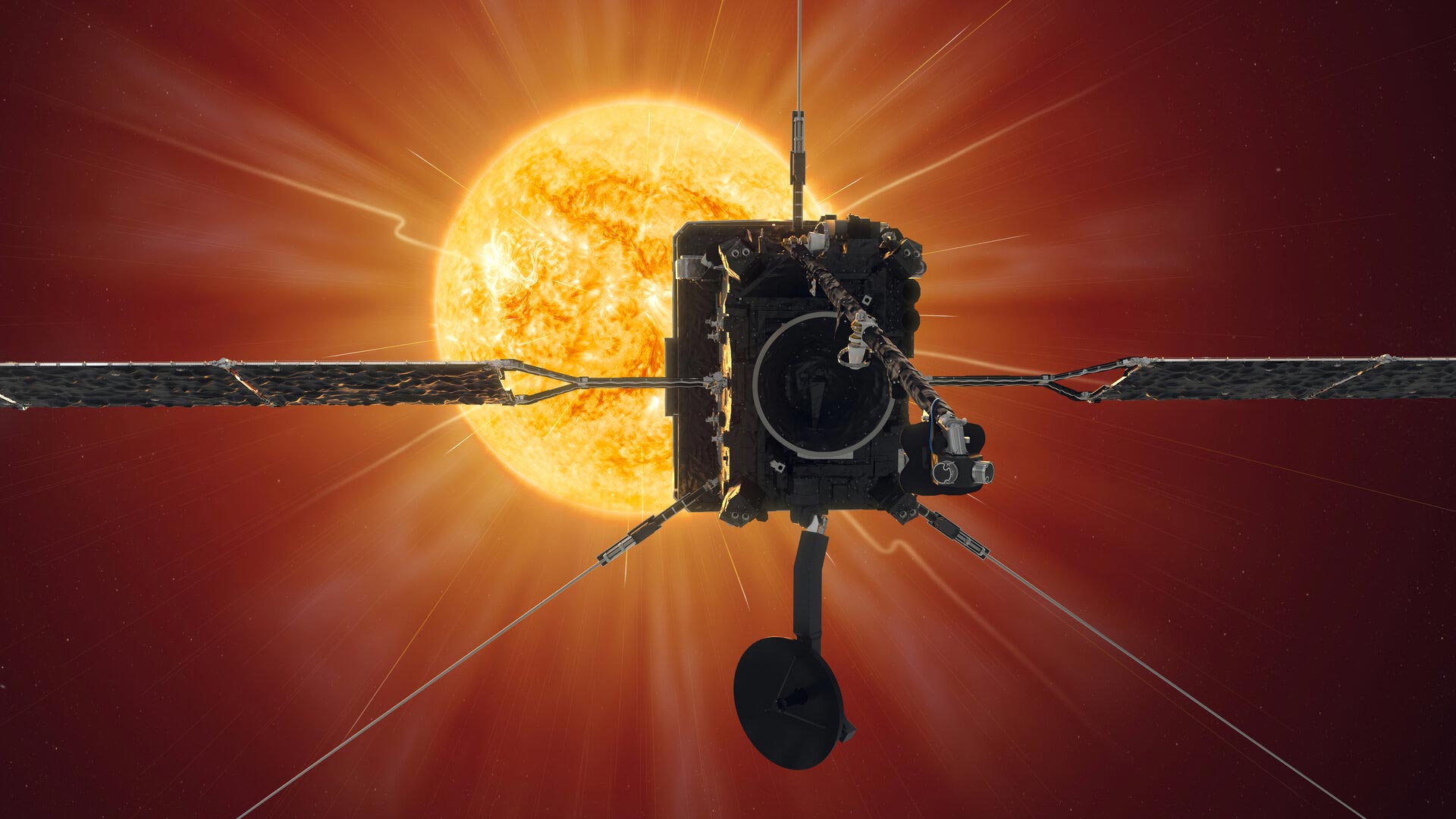
ESA’s Sun-exploring mission Solar Orbiter has made its first close approach to the star on June 15, getting as close as 77 million kilometers to its surface, about half the distance between the Sun and Earth.
In the week following this first perihelion, the point in the orbit closest to the Sun, the mission scientists will test the spacecraft’s ten science instruments, including the six telescopes on-board, which will acquire close-up images of the Sun in unison for the first time. According to ESA’s Solar Orbiter Project Scientist Daniel Müller, the images, to be released in mid-July, will be the closest images of the Sun ever captured.
“We have never taken pictures of the Sun from a closer distance than this,” Daniel says. “There have been higher resolution close-ups, e.g. taken by the four-meter Daniel K. Inouye Solar Telescope in Hawaii earlier this year. But from Earth, with the atmosphere between the telescope and the Sun, you can only see a small part of the solar spectrum that you can see from space.”
Solar Orbiter’s first close approach to the Sun.
NASA’s Parker Solar Probe, launched in 2018, makes closer approaches. The spacecraft, however, doesn’t carry telescopes capable of looking directly at the Sun.
“Our ultraviolet imaging telescopes have the same spatial resolution as those of NASA’s Solar Dynamic Observatory (SDO), which takes high-resolution images of the Sun from an orbit close to Earth. Because we are currently at half the distance to the Sun, our images have twice SDO’s resolution during this perihelion,” says Daniel.
The primary objective of these early observations is to prove that Solar Orbiter’s telescopes are ready for future scientific observations.
“For the first time, we will be able to put together the images from all our telescopes and see how they take complementary data of the various parts of the Sun including the surface, the outer atmosphere, or corona, and the wider heliosphere around it,” says Daniel.
The scientists will also analyze data from the four in-situ instruments that measure properties of the environment around the spacecraft, such as the magnetic field and the particles making up the solar wind.
“This is the first time that our in-situ instruments operate at such a close distance to the Sun, providing us with a unique insight into the structure and composition of the solar wind,” says Yannis Zouganelis, ESA’s Solar Orbiter Deputy Project Scientist. “For the in-situ instruments, this is not just a test, we are expecting new and exciting results.”
Solar Orbiter will use several gravity-assist maneuvres at Venus to shift its orbit out of the ecliptic plane to be able to look at the Sun’s poles.
Solar Orbiter, launched on February 10 this year, is completing its commissioning phase on 15 June and will commence its cruise phase, which will last until November 2021. During the main science phase that follows, the spacecraft will get as close as 42 million kilometers to the Sun’s surface, which is closer than the planet Mercury.
The spacecraft will reach its next perihelion in early 2021. During the first close approach of the main science phase, in early 2022, it will get as close as 48 million kilometers.
Solar Orbiter operators will then use the gravity of Venus to gradually shift the spacecraft’s orbit out of the ecliptic plane, in which the planets of the Solar System orbit. These fly-by maneuvers will enable Solar Orbiter to look at the Sun from higher latitudes and get the first-ever proper view of its poles. Studying the activity in the polar regions will help the scientists to better understand the behavior of the Sun’s magnetic field, which drives the creation of the solar wind that in turn affects the environment of the entire Solar System.
Since the spacecraft is currently 134 million kilometers (83 million miles) from Earth, it will take about a week for all perihelion images to be downloaded via ESA’s 35-m (115-ft) deep-space antenna in Malargüe, Argentina. The science teams will then process the images before releasing them to the public in mid-July. The data from the in-situ instruments will become public later this year after a careful calibration of all individual sensors.
“We have a nine-hour download window every day but we are already very far from Earth so the data rate is much lower than it was in the early weeks of the mission when we were still very close to Earth,” says Daniel. “In the later phases of the mission, it will occasionally take up to several months to download all the data because Solar Orbiter really is a deep space mission. Unlike near-Earth missions, we can store a lot of data on-board and downlink it when we are closer to home again and the data connection is much better.”
Never miss a breakthrough: Join the SciTechDaily newsletter.
Follow us on Google and Google News.