
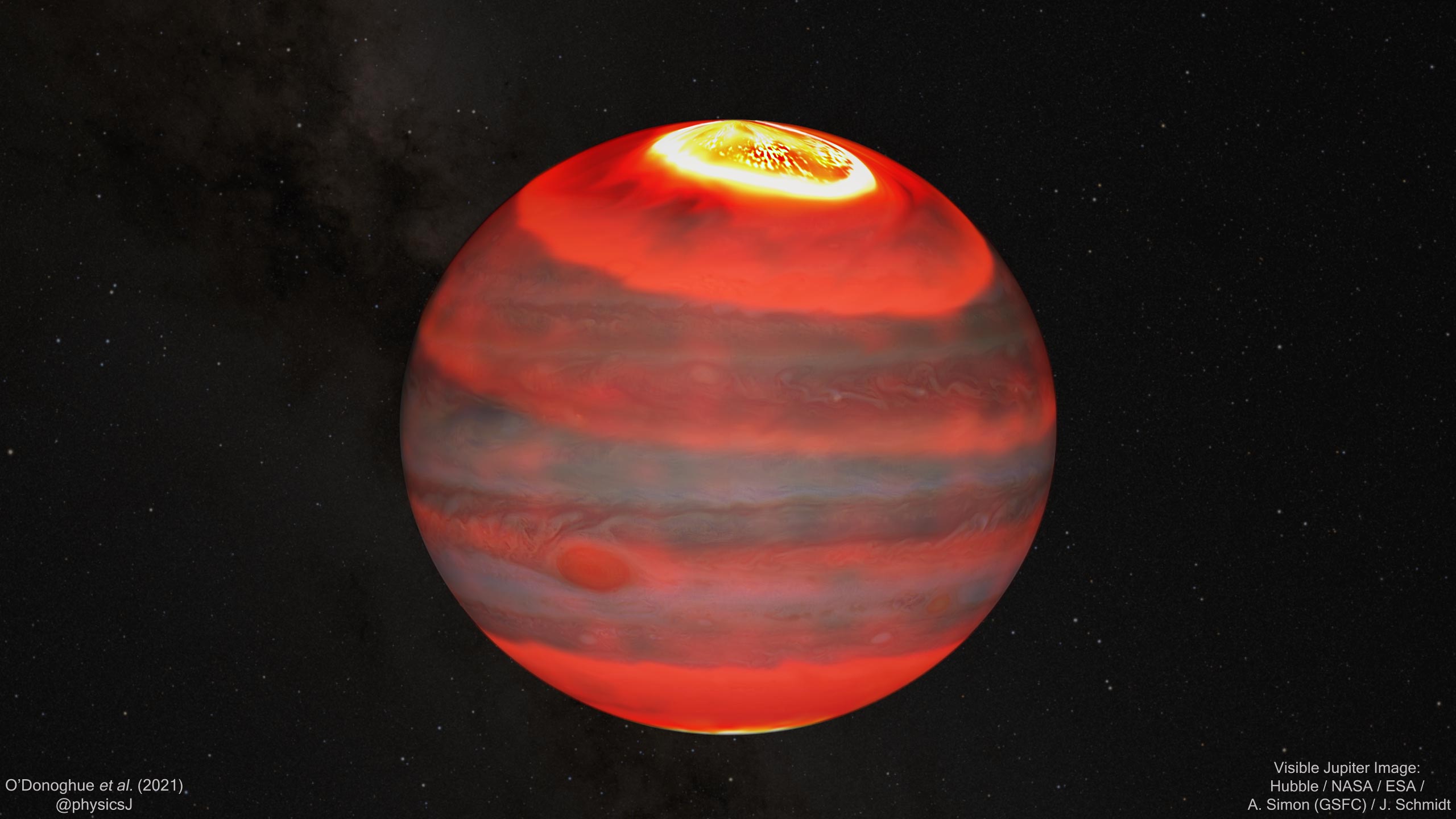
Jupiter’s unexpectedly hot upper atmosphere is caused by its intense auroras, which distribute heat globally, driven by energy from the solar wind.
Sitting more than five times the distance from the Sun as Earth, Jupiter is not expected to be particularly warm. Based on the amount of sunlight received, the average temperature in the planet’s upper atmosphere should be about minus 100 degrees Fahrenheit or a chilly minus 73 Celsius. Instead, the measured value soars to around 800 degrees Fahrenheit or 426 Celsius. The source of this extra heat has remained elusive for 50 years, causing scientists to refer to the discrepancy as an “energy crisis” for the planet.
Recently, an international team assembled observations from a trio of observatories — NASA’s Juno spacecraft, W. M. Keck Observatory on Maunakea in Hawaiʻi, and the Hisaki satellite from the Japan Aerospace Exploration Agency (JAXA) — to discover the likely source of Jupiter’s thermal boost.
“We found that Jupiter’s intense aurora, the most powerful in the solar system, is responsible for heating the entire planet’s upper atmosphere to surprisingly high temperatures,” said James O’Donoghue of the JAXA Institute of Space and Astronautical Science, Sagamihara, Japan. O’Donoghue began the research while at NASA’s Goddard Space Flight Center in Greenbelt, Maryland, and is lead author of a paper about this research published in the journal Nature.
How Auroras Heat Jupiter’s Atmosphere
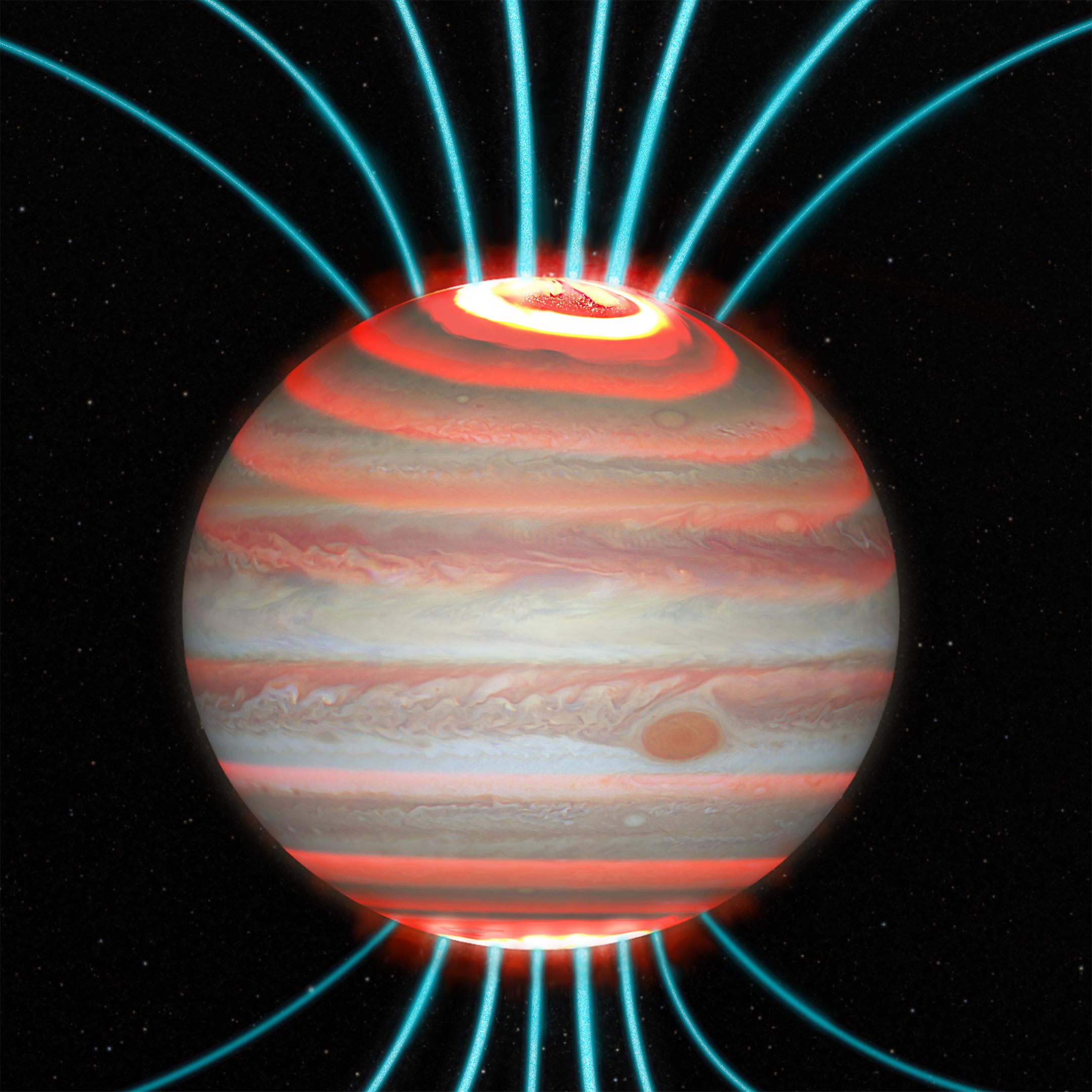
Auroras occur when electrically charged particles are caught in a planet’s magnetic field. These spiral along invisible lines of force in the magnetic field towards the planet’s magnetic poles, striking atoms and molecules in the atmosphere to release light and energy. On Earth, this leads to the colorful light show that forms the aurora Borealis and Australis, also known as the northern and southern lights. At Jupiter, material erupting from its volcanic moon, Io, leads to the most powerful aurora in the solar system and enormous heating in the upper atmosphere over the polar regions of the planet.
The idea that the aurora could be the source of Jupiter’s mysterious energy had been proposed previously but observations have been unable to confirm or deny this, until now.
Global models of Jupiter’s upper atmosphere suggested that winds heated by the aurora and headed to the equator would be overwhelmed and redirected by westward winds driven by the planet’s rapid rotation. This would prevent the auroral energy from escaping the polar regions and heating the whole atmosphere. However, this new observational result suggests that such trapping is not occurring, and that the westward winds may be relatively weaker than expected compared with equatorward winds.
High-resolution temperature maps from Keck Observatory, combined with magnetic field data from Hisaki and Juno, allowed the team to catch the aurora in the act of sending what appears to be a pulse of heat toward Jupiter’s equator.
Jupiter is first shown in visible light for context before an artistic impression of the Jovian upper atmosphere’s infrared glow is overlain. The brightness of this upper atmosphere layer corresponds to temperatures, from hot to cold, in this order: white, yellow, bright red, and lastly, dark red. The aurorae are the hottest regions and the animation shows how heat may be carried by winds away from the aurora and cause planet-wide heating. At the end, real data is added with a temperature scale, indicating the observed global temperatures measured in the study. Credit: J. O’Donoghue (JAXA)/Hubble/NASA/ESA/A. Simon/J. Schmidt
The team observed Jupiter with the Keck II telescope for five hours on two separate nights in April 2016 and January 2017. Using the Near-Infrared Spectrograph (NIRSPEC) on Keck II, heat from electrically charged hydrogen molecules (H3+ ions) in Jupiter’s atmosphere was traced from the planet’s poles down to the equator. Previous maps of the upper atmospheric temperature were formed using images consisting of only several pixels. That’s not enough resolution to see how the temperature might be changing across the planet, providing few clues as to the origin of the extra heat.
Mapping Temperatures Across Jupiter
To improve the situation, the team utilized the power of Keck II to take many more temperature measurements across the face of the planet and only included measurements with uncertainty in the recorded value of less than five percent. This took years of careful work and yielded temperature maps with over 10,000 individual data points, the highest resolution to date.
“We’ve attempted this multiple times with other instruments but with Keck’s NIRSPEC, we were able to measure for the very first time the light from Jupiter all the way to the equator quickly enough that we can then map out the temperature and ionospheric density,” said Tom Stallard, a co-author of the paper at the University of Leicester, Leicester, United Kingdom.
Instead of high temperatures only in the polar regions near the aurora, which would be expected if the heat was trapped there, these detailed maps showed that the heat in the upper atmosphere was more widely distributed, with a gradual decrease in temperature closer to the equator.
“We also revealed a strange localized region of heating well away from the aurora – a long bar of heating unlike anything we’ve seen before,” said Stallard. “Though we can’t be sure what this feature is, I am convinced it’s a rolling wave of heat flowing equatorward from the aurora.”
Solar Wind’s Influence on Jupiter’s Aurora
Additionally, observations from JAXA’s Hisaki satellite showed that conditions at the time of the Keck II temperature observations could generate a strong aurora on Jupiter. From orbit around Earth, Hisaki has observed the aurora-generating magnetic field around Jupiter since the mission’s launch in 2013. This long-term monitoring has revealed that Jupiter’s magnetic field is strongly influenced by the solar wind; a stream of high-energy particles that emanates from the Sun. The solar wind carries its own magnetic field and when this meets Jupiter’s planetary field, the latter is compressed. At the time of the Keck II observations, Hisaki showed that pressure from the solar wind was particularly high at Jupiter and the field compression is likely to have created an enhanced aurora.
Finally, observations from Juno in orbit around Jupiter provided the precise location of the aurora on the planet.
“Juno’s magnetic field data provided us with a ‘ground truth’ as to where the aurora was. This information isn’t readily available from heat maps, as heat leaks away in many directions,” said O’Donoghue. “Picture this like a beach: if the hot atmosphere is water, the magnetic field mapped by Juno is the shoreline, and the aurora is the ocean, we found that water left the ocean and flooded the land, and Juno revealed where that shoreline was to help us understand the degree of flooding.”
Catching a Heat-Shedding Event
“It was pure luck that we captured this potential heat-shedding event,” adds O’Donoghue. “If we’d observed Jupiter on a different night, when the solar wind pressure had not recently been high, we would have missed it!”
The team will continue to analyze the data and produce more maps; their goal is to catch Jupiter’s aurora spew another hot spot, this time observing it over a 2-3 day period so they can track its energy as it moves around the planet.
“Can we observe one of these features moving? Will it show the flow of auroral heat in action? How does this flow of energy then affect the surrounding magnetic fields that we now know are so complex? It’s a thrilling set of research questions in a region of Jupiter’s ionosphere that, five years ago, we thought of as mundane,” said Stallard.
For more on this research, see Secret Behind Jupiter’s “Energy Crisis” Revealed.
Reference: “Global upper-atmospheric heating on Jupiter by the polar aurorae” by J. O’Donoghue, L. Moore, T. Bhakyapaibul, H. Melin, T. Stallard, J. E. P. Connerney and C. Tao, 4 August 2021, Nature.
DOI: 10.1038/s41586-021-03706-w
About NIRSPEC
The Near-Infrared Spectrograph (NIRSPEC) is a unique, cross-dispersed echelle spectrograph that captures spectra of objects over a large range of infrared wavelengths at high spectral resolution. Built at the UCLA Infrared Laboratory by a team led by Prof. Ian McLean, the instrument is used for radial velocity studies of cool stars, abundance measurements of stars and their environs, planetary science, and many other scientific programs. A second mode provides low spectral resolution but high sensitivity and is popular for studies of distant galaxies and very cool low-mass stars. NIRSPEC can also be used with Keck II’s adaptive optics (AO)system to combine the powers of the high spatial resolution of AO with the high spectral resolution of NIRSPEC. Support for this project was provided by the Heising-Simons Foundation.
About W. M. Keck Observatory
The W. M. Keck Observatory telescopes are among the most scientifically productive on Earth. The two 10-meter optical/infrared telescopes atop Maunakea on the Island of Hawaiʻi feature a suite of advanced instruments including imagers, multi-object spectrographs, high-resolution spectrographs, integral-field spectrometers, and world-leading laser guide star adaptive optics systems. Some of the data presented herein were obtained at Keck Observatory, which is a private 501(c) 3 non-profit organization operated as a scientific partnership among the California Institute of Technology, the University of California, and the National Aeronautics and Space Administration. The Observatory was made possible by the generous financial support of the W. M. Keck Foundation. The authors wish to recognize and acknowledge the very significant cultural role and reverence that the summit of Maunakea has always had within the Native Hawaiian community. We are most fortunate to have the opportunity to conduct observations from this mountain.
Never miss a breakthrough: Join the SciTechDaily newsletter.
Follow us on Google and Google News.
1 Comment
Lol. We live in a Electric plasma universe. Birkland currents give power to the universe duh. The standard model is Garbage