

Close Menu
    Facebook X (Twitter) Instagram
    SciTechDaily
    • Biology
    • Chemistry
    • Earth
    • Health
    • Physics
    • Science
    • Space
    • Technology
    Facebook X (Twitter) Pinterest YouTube RSS
    SciTechDaily
    Home»Physics»Intriguing Discovery Grants New Insights Into Photoelectric Effect
    Physics

    Intriguing Discovery Grants New Insights Into Photoelectric Effect

    By Lund UniversityOctober 2, 2019No Comments3 Mins Read
    Facebook Twitter Pinterest Telegram LinkedIn WhatsApp Email Reddit
    Share
    Facebook Twitter LinkedIn Pinterest Telegram Email Reddit

    Aromic Physics Illustration

    The discovery that free electrons can move asymmetrically provides a deeper understanding of one of the basic processes in physics: the photoelectric effect. It was first described by Albert Einstein and explains how high-frequency light releases electrons from a material. The results have been published in Physical Review Letters.

    “The photoelectric effect has been studied for many years and it’s very uplifting to suddenly understand how it works in a deeper way,” says Marcus Dahlström, Associate Senior Lecturer of Mathematical Physics at Lund University in Sweden, who worked on the article with colleagues in Lund and at Stockholm University.

    The researchers studied how an electron that has just been released from an atom via the photoelectric effect can change its wave motion using a laser field. The free electron can both absorb and emit laser light, which changes the electron’s rotation in an asymmetrical way.
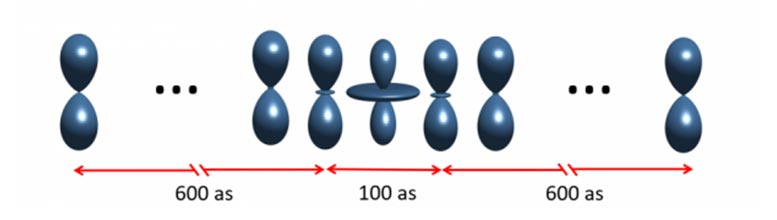
    Rapid Particles in an Explanatory Light
    Rapid particles in an explanatory light: When electrons are no longer fixed to the atomic shell and can move freely, their waveform can be changed using laser light. Credit: Marcus Dahlström / Lund University

    To discover this phenomenon, the researchers used ultrashort laser pulses with a time precision on an attosecond scale, which is staggeringly short: 0.000000000000000001 seconds. (That’s 10-18 seconds.)

    The discovery of the asymmetry in combination with the high time resolution gave the researchers the opportunity to disrupt the electrons’ ingrained behavior. From only moving up and down along the laser field, the researchers succeeded in getting the electrons to also spread sideways. 

    “Now that we understand there is an asymmetry in the free electrons’ movement, we can gain a better understanding of the quantum dynamics in photo-ionization,” says David Busto, doctoral student of Atomic Physics at Lund University.

    In classical physics, particles move in a deterministic way from one point to another via Newton’s laws. In contrast to this, quantum mechanics says that a particle can move to several places simultaneously. The researchers have been able to take advantage of the latter:

    “When we change the direction of the electron wave, we are using quantum mechanical interference. That is, the electron takes several paths toward its changed waveform. In classical physics, the electron can only go one way.”

    The phenomenon of the asymmetrical movement pattern has been proved both in experiments and in theory. The results are based on the knowledge that electrons increase their rotating movements when they absorb light, something the American-Italian physicist Ugo Fano demonstrated 30 years ago.

    The research aims to control electrons in atoms and molecules with greater precision. In the long term, it is conceivable that this and other basic science knowledge on how atoms and molecules function will provide an opportunity to improve the way reactions are controlled in molecules, which in turn can pave the way for more effective chemistry.

    Reference: “Fano’s Propensity Rule in Angle-Resolved Attosecond Pump-Probe Photoionization” by David Busto, Jimmy Vinbladh, Shiyang Zhong, Marcus Isinger, Saikat Nandi, Sylvain Maclot, Per Johnsson, Mathieu Gisselbrecht, Anne L’Huillier, Eva Lindroth and Jan Marcus Dahlström, 23 September 2019, Physical Review Letters.
    DOI: 10.1103/PhysRevLett.123.133201

    Never miss a breakthrough: Join the SciTechDaily newsletter.
    Follow us on Google and Google News.

    Lund University Particle Physics Stockholm University
    Share. Facebook Twitter Pinterest LinkedIn Email Reddit

    Related Articles

    Physics’ Strangest Prediction: Researchers Propose Way to Finally “See” the Warmth of the Vacuum

    Turning Invisible Dark Matter Into Visible Light

    After 50-Year International Hunt, Physicists Discover Mythical Odderon Particle

    Does a Quantum State Collapse Instantly During a Measurement? Scientists “Film” It to Find Out.

    Evidence of Elusive Majorana Fermions Raises Possibilities for Quantum Computing

    Possible Mistakes Found in Faster Than Light Neutrino Measurement

    Quantum Entanglement of 8 Photons Successfully Accomplished by Physicists

    Higgs Boson Signals Gain Strength at Large Hadron Collider

    Quantum Physicists Take a Step Forward in Understanding Quantum Inseparability

    Leave A Reply Cancel Reply

    • Facebook
    • Twitter
    • Pinterest
    • YouTube

    Don't Miss a Discovery

    Subscribe for the Latest in Science & Tech!

    Trending News

    Scientists Discover Game-Changing New Way To Treat High Cholesterol

    This Small Change to Your Exercise Routine Could Be the Secret to Living Longer

    Scientists Discover 430,000-Year-Old Wooden Tools, Rewriting Human History

    AI Could Detect Early Signs of Alzheimer’s in Under a Minute – Far Before Traditional Tests

    What if Dark Matter Has Two Forms? Bold New Hypothesis Could Explain a Cosmic Mystery

    This Metal Melts in Your Hand – and Scientists Just Discovered Something Strange

    Beef vs. Chicken: Surprising Results From New Prediabetes Study

    Alzheimer’s Breakthrough: Scientists Discover Key Protein May Prevent Toxic Protein Clumps in the Brain

    Follow SciTechDaily
    • Facebook
    • Twitter
    • YouTube
    • Pinterest
    • Newsletter
    • RSS
    SciTech News
    • Biology News
    • Chemistry News
    • Earth News
    • Health News
    • Physics News
    • Science News
    • Space News
    • Technology News
    Recent Posts
    • Researchers Discover Unknown Beetle Species Just Steps From Their Lab
    • Jellyfish Caught Feasting on Exploding Sea Worms for the First Time
    • Ancient “Spaghetti” in Dogs’ Hearts Reveals Heartworm’s Shocking Origins
    • Milk Nanoparticles Could Revolutionize Treatment for Deadly Bile Duct Cancer
    • Largest-Ever Study Finds Medicinal Cannabis Ineffective for Anxiety, Depression, PTSD
    Copyright © 1998 - 2026 SciTechDaily. All Rights Reserved.
    • Science News
    • About
    • Contact
    • Editorial Board
    • Privacy Policy
    • Terms of Use

    Type above and press Enter to search. Press Esc to cancel.