

New Name, Same Great Supersonic Mission
Introducing Quesst.
Evoking the experimental nature of flight testing and the spirit of aeronautical exploration, Quesst is what NASA is now calling its mission to enable supersonic air travel over land. This new moniker – complete with an extra “s” to represent “supersonic” – draws its inspiration from NASA’s long legacy of supersonic flight research.
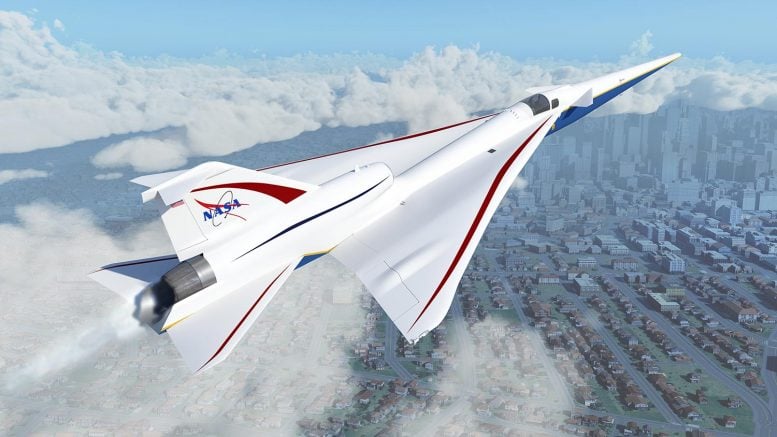
The mission’s centerpiece is the sleek research plane known as the X-59, which Lockheed Martin Skunk Works is currently building in Palmdale, California.
Quesst replaces the mission’s original name: the Low-Boom Flight Demonstration. (The US Air Force already designated the demonstrator aircraft as X-59 QueSST back in 2018.)
“With Quesst, we’ve found a name that more effectively conveys the purpose, relevance, and – most importantly – excitement of what this mission is all about,” said Peter Coen, NASA’s mission integration manager for Quesst.
Through Quesst, NASA plans to demonstrate that the X-59 can fly faster than sound without generating the loud sonic booms supersonic aircraft typically produce. This thunderous sound is the reason the U.S. and other governments banned most supersonic flights over land.
Working with select communities, NASA will fly the X-59 to learn how people react to the diminished sonic “thump” it produces – if they hear anything at all. The agency will share survey data with regulators, with the hope they will consider writing new rules that lift the ban.
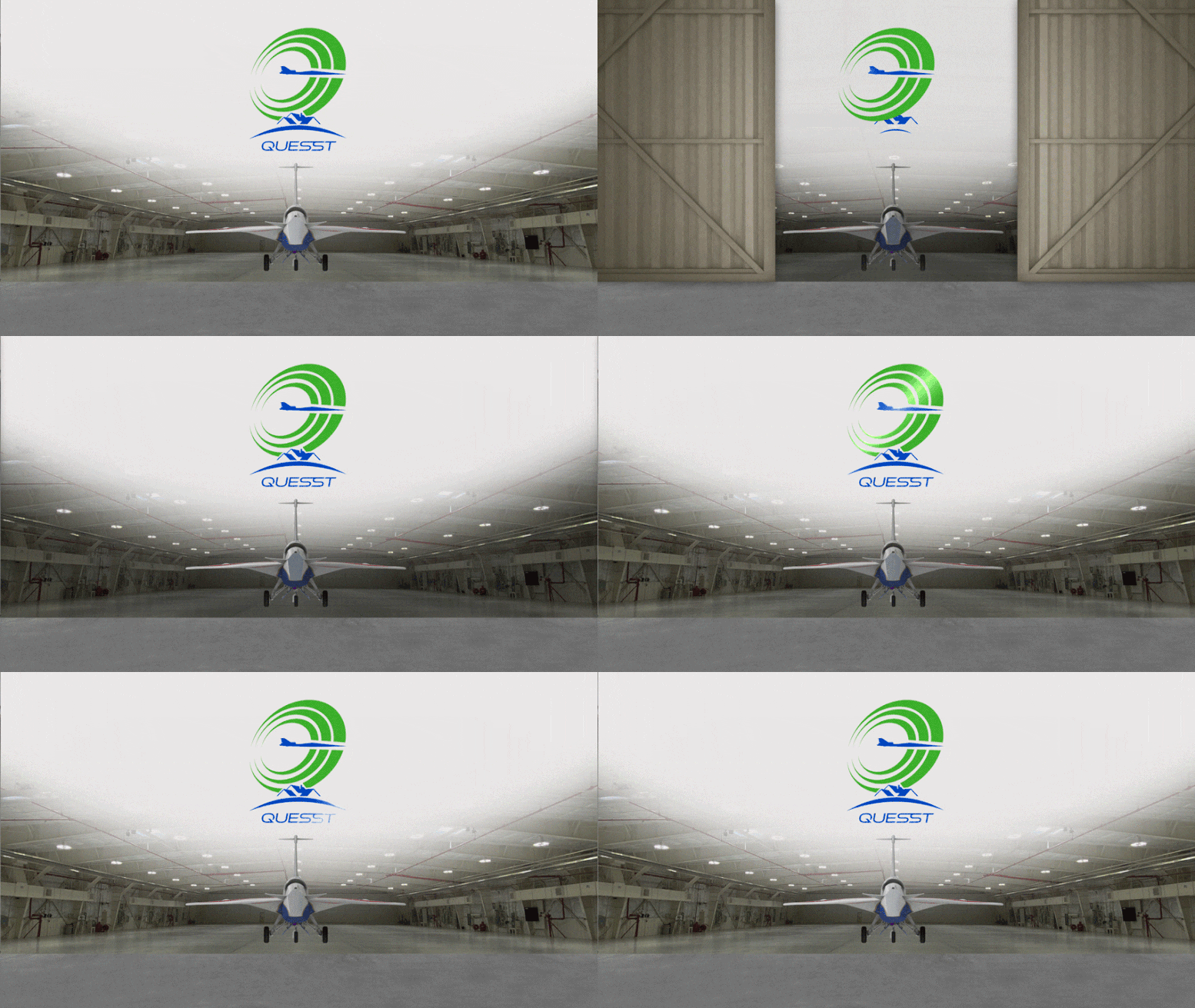
Quesst’s New Look
With the introduction of Quesst comes a new mission identity — a blue and green signature mark that represents the elements of Quesst.
The new mission graphic displays stylized supersonic shockwaves encircling the research aircraft, above a community of homes. The imagery highlights the ground-breaking research that will be conducted across several U.S. cities during this mission.
Inspiration for the design comes from images captured during NASA’s 2019 Air-to-Air Background Oriented Schlieren (AirBOS) flight series, which recorded images of intersecting shockwaves from supersonic jets.
Here’s a breakdown of the design and its color palette:
- The supersonic shockwaves, represented here in green, do not merge. This is what enables the X-59 to produce a quieter sonic thump.
- The aircraft shape represents the X-59. While previously known as the X-59 Quiet SuperSonic Technology, the aircraft will now just be referred to as the X-59.
- The three houses represent the communities that will provide the data that could allow for future commercial supersonic flight over land.
- The crescent represents land, highlighting the crucial and unique aspect of our mission – commercial supersonic flight over land.
- Overall, the blue and green symbolize the Earth, and where the value of NASA’s aeronautics research is experienced by humankind every day.
The Quesst Plan
To achieve its mission goals, NASA has laid out Quesst in three phases. The first and current phase focuses on the assembly of the X-59, followed by initial flights planned for later this year to prove the safety and performance of the aircraft.
The second phase, expected to take place during 2023, will focus on acoustic validation. During this phase, the mission will prove the X-59 is ready for regular operations in the National Airspace System. The aircraft will fly over NASA’s Armstrong Flight Research Center in Edwards, California to demonstrate that the supersonic technologies work as designed. The flights will also show that the tools used to predict and measure the sound level of the sonic thump are ready for use in phase three.
Likely the most anticipated point in the mission, phase three will feature the X-59 flying over several communities across the U.S., gathering data from the public to learn what people think of the X-59’s sound. This phase is expected to take place in 2024 through 2026. NASA has yet to select the communities.
The mission is set to wrap up in 2027 by taking the information collected during phase three and sharing it with U.S. and international regulators. With the information gathered during the Quesst mission, the hope is to enable regulators to consider rules based on how loud an aircraft is, not based on an arbitrary speed.
“The Quesst mission has the potential to transform air travel as we currently know it,” Coen said. “Success of this mission will open the door to fast air travel for everyone across the globe.”
Learn more about the advances in this transformational mission.
Quesst — the mission where speed never sounded so quiet.
Never miss a breakthrough: Join the SciTechDaily newsletter.
Follow us on Google and Google News.
4 Comments
A quieter way for the rich to suppress the poor. Your tax dollars at work.
cool jet .
Wealth is created when it works with wisdom to create something useful.
Indoor-plumbing, automobiles and nighttime lighting were once available only to the super wealthy. War does more than destroy buildings and kill people.
It reverses historical progress.
It is a pity for us to keep peace we need to prepare for war.